Home Blog Page 25

San Quentin inmates petition to be released due to coronavirus concerns

0
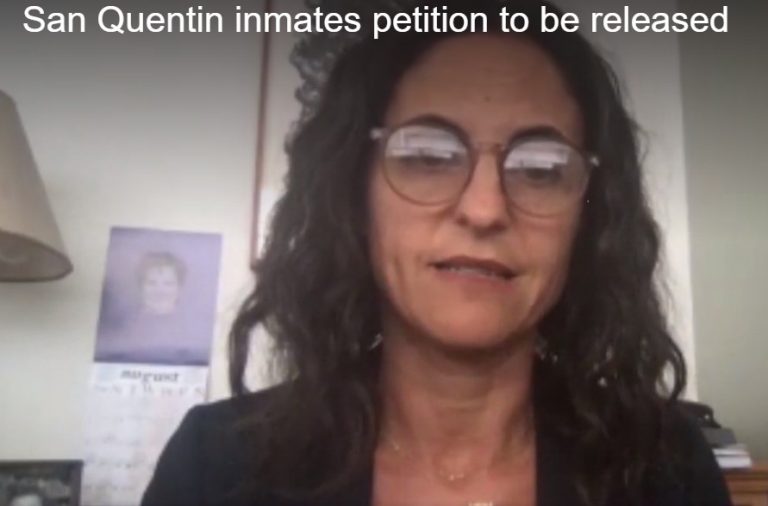
KRON interviewed Danielle Harris, the Managing Attorney of the San Francisco Public Defender’s Office Integrity Unit, in the segment: San Quentin inmates petition to be released due to coronavirus concerns.

“tHERE’S JUST NO SUCH THING AS SIX-FOOT DISTANCING IN AN OVERCROWDED PRISON.” – DANIELLE HARRIS

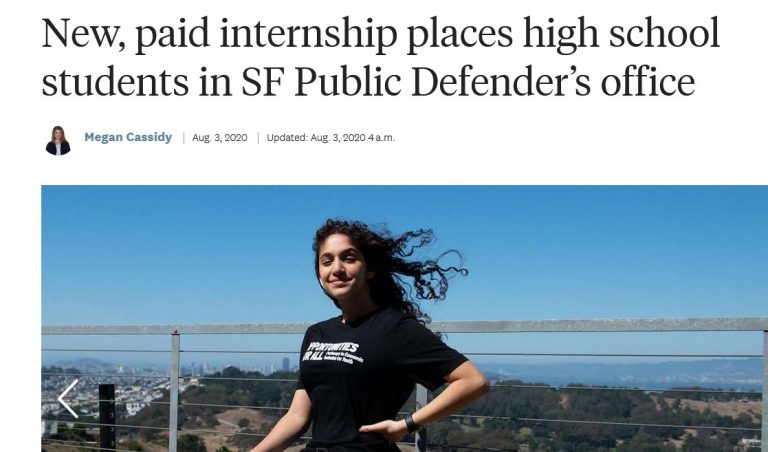
New, paid internship places high school students in SF Public Defender’s office

We’re excited to announce our Young Defenders Program – a 40-week paid internship for 25 high school students focused on criminal justice issues. It’s a unique collaboration between the San Francisco Public Defender’s Office, Mayor Breed’s Opportunities for All initiative, Teachers for Social Justice, the San Francisco Human Rights Commission and SF Unified School District.

Read the SF Chronicle’s article by Megan Cassidy on August 3, 2020.

Read our full press release here.

Mayor London Breed & Public Defender Mano Raju Announce Young Defenders Internship Program

FOR IMMEDIATE RELEASE: Monday, August 3, 2020

Contact:        

Public Defender’s Office, Valerie.Ibarra@sfgov.org 

Mayor’s Office of Communications, mayorspressoffice@sfgov.org 

***PRESS RELEASE***

MAYOR LONDON BREED AND PUBLIC DEFENDER MANO RAJU ANNOUNCE YOUNG DEFENDERS INTERNSHIP PROGRAM

Paid internship program, created in partnership with the Mayor’s Office, Public Defender’s Office, Human Rights Commission, and Teachers 4 Social Justice, provides 25 public high school students with a 40-week experience to learn about the criminal legal system and public defense

San Francisco, CA – Mayor London N. Breed and Public Defender Mano Raju today announced the creation of the San Francisco Young Defenders Program, a paid educational internship program to provide employment and mentorship opportunities to 25 local public high school students around criminal justice issues. The Young Defenders Program is part of the Opportunities for All initiative, which Mayor Breed created in 2018 to connect young people of all backgrounds to paid employment, job training, and mentorship opportunities.

The Young Defenders Program seeks to invest equitably in youth empowerment rather than the criminalization of youth, and ensure that youth of color have the opportunity to achieve a more successful future for themselves, their families, and their community. The program is the result of a unique partnership between Mayor Breed’s Opportunities for All initiative, the Public Defender’s Office, the Human Rights Commission, the San Francisco Unified School District, and Teachers 4 Social Justice. The internship program started last week with orientation, and the interns begin their placements with the Public Defender’s Office today. 

“I know firsthand how an internship can change the course of a young person’s life,” said Mayor Breed. “We created Opportunities for All to empower youth and give them a chance to learn new skills and build professional connections, while also getting paid for their time. When we focus on providing opportunities for all of our young people, those youth go above and beyond to prove themselves and then succeed in ways they and others never imagined. This program invests in communities that have historically been left behind and opens up opportunities that otherwise would have been out of reach. I want to thank all the partners who have worked to make the Young Defenders program a reality, especially at a time when it’s more important than ever that we’re making concrete investments in supporting communities of color.”

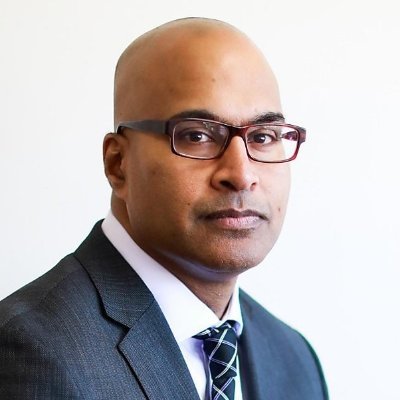
“I am proud that we are launching the Young Defenders Program at this moment in time, as the movement for Black Lives Matter continues to build momentum across the country, and young people are calling for racial justice and changes to the laws and practices that directly affect their lives,” said Mano Raju, Public Defender of San Francisco. “Through this program we have an opportunity to train and educate young San Franciscans on how the criminal legal system works and how public defenders advocate for people through every step of the process. My hope is we can start to build a new pipeline of diverse Public Defenders and criminal justice advocates through this program.”

The San Francisco Public Defender’s Office is lauded as one of the premier public defender offices in the country, with a deep commitment to community engagement and achieving structural reforms to the criminal legal system locally and statewide.  The Young Defenders Program is in line with the Public Defender’s commitment to close the school to prison pipeline, as evidenced by its community-based M.A.G.I.C. programs which connect youth and families to opportunities and resources in the Bayview and the Fillmore-Western Addition neighborhoods. The Young Defenders Program is an opportunity to further guide and empower young San Franciscans through direct mentorship.

Over the course of 40 weeks, Young Defenders will hear lectures from guest speakers, be paired with defense attorneys and social workers to complete weekly assignments, participate in group projects such as mock trials, and develop virtual community outreach events on topics such as knowing your rights, increasing the diversity of juries, and facilitating restorative justice. Many will also earn academic credit toward high school graduation while earning minimum wage for up to 15 hours a week. Due to COVID-19, students will participate in the program remotely for the time being, and will be provided the technology they need for remote work.

The first group of Young Defenders were selected for the program through an interest survey following their summer internship with Opportunities for All. Opportunities for All and the Mayor’s Office will fund the youth stipends, and the Public Defender’s Office will fund the program through staff time and service hours. As many families are struggling financially due to COVID-19, it is more important than ever that students have access to paid internship opportunities.

“The purpose of this program is to expose students to the world of criminal justice from the perspective of the Public Defender’s Office while inspiring students to use their own power as educators and activists for change,” said Athena Edwards, Senior Fellow, Opportunities for All.

“I like that this cohort is teaching me things that I need to know about the law and my rights,” said Aniyah, a San Francisco native and rising junior at Raoul Wallenberg High School. “I also like my Fellows. They’re very creative in leading our activities and our group conversations and even though these things can be tricky, it’s fun trying new things. I enjoy being a part of this cohort and getting to experience different job techniques, while doing activities outside of my comfort zone.”

“It’s a good opportunity for me to learn about criminal justice,” said Shamira, a San Francisco native and rising sophomore at KIPP San Francisco College Prep. “Last week in orientation, we did our first presentation. My partner and I focused on Breonna Taylor, and how the police who killed her have not been arrested. We learned a lot about laws, but also used our own knowledge and understanding for the presentation.”

 “I’m excited to be starting my second year interning with Opportunities for All,” said India Brar, a student joining the Young Defenders program. “I am extremely passionate about helping people especially ones in need and believe that being placed with San Francisco’s Young Defenders program was not only more than I could’ve asked for, but will allow me to make a difference which is something I am looking forward to.” 

Since taking office, Mayor Breed has consistently prioritized funding for programs that make San Francisco more equitable. As announced on Friday, the Mayor’s budget continues to prioritize equity, with funding both from the General Fund and redirected from the City’s law enforcement departments. Mayor Breed has proposed using funding to reinvest in the African American community and to repair the legacy of racially disparate policies on health, housing, and economic outcomes for African Americans in San Francisco. 

In addition to redirecting funding from law enforcement departments, the Mayor’s budget includes ongoing and new investments from the General Fund to support vulnerable populations throughout San Francisco, prioritizing several children- and youth-focused initiatives that will ensure more equitable outcomes for future generations of San Franciscans. Specifically, the Mayor’s proposed budget for Fiscal Years 2020-21 and 2021-22 includes $5.5 million in funding from the General Fund to continue the Opportunities for All program.

“I am grateful for the ability to connect Opportunities for All with Teachers 4 Social Justice and the Public Defender’s office to launch this program,” said Sheryl Davis, Executive Director, Human Rights Commission. “Opportunities for All provides young people with the opportunity to not just develop skills and build their social networks, but programs like the Young Defenders, centers youth voice, encourages and empowers youth to address issues of inequity, to transform systems and challenge business as usual. I look forward to learning from the youth and seeing the impact they will have in the community and the criminal justice system.”

“This is the City, the School District and community based organizations working together to do the most for young people, especially during this time,” said Jeremiah Jeffries, public school teacher and coordinator for Teachers 4 Social Justice. “SF Young Defenders is a concrete example of where we should be reallocating funding to, away from policing and criminalization of youth, toward education and giving youth a foundation to build careers focused toward justice.”

“In my role as Board of Education Commissioner and Education Advisor to the Mayor, the creation of SF Young Defenders is the fulfillment of one of the many promises we asked the public to trust us to fulfill,” said Jenny Lam, Commissioner, San Francisco Board of Education. “The potential I see in these young people and in this opportunity is why cross institution and community partnerships can be so powerful and should be the rule not the exception for how to get things done for young people.”

In October 2018, Mayor Breed announced the launch of Opportunities for All (OFA), a program to address economic inequality by ensuring that all young people can be a part of San Francisco’s thriving economy and explore different career paths. In the first full summer of the OFA program in 2019, there were more than 3,800 total placements, including at least 1,500 new placements. 

To date, the summer 2020 OFA cohort has placed over 1,400 youth in internships. Additionally, 68 Opportunities for All Fellows and 12 Senior Fellows were placed. Fellows are college aged young adults who work directly with high school students, creating project design, and developing their projects and presentations. OFA introduced the Senior Fellow position this year, 12 upper-class college students, and postgraduates, who each managed a small group of Fellows, offering daily, direct engagement, facilitating meetings, and supporting the project design for their cohorts.  
Efforts to Release Incarcerated from San Quentin Move Forward in Marin County Superior Court

The Davis Vanguard reported: Efforts to Release Incarcerated from San Quentin Move Forward in Marin County Superior Court. The San Francisco Public Defender’s Office is part of a team of regional attorneys representing over 300 individual petitioners from San Quentin in a consolidated case of habeas corpus in Marin County Superior Court.

“If the state cannot take care of the people in its custody – at the very minimal level of ensuring they stay alive – then the courts must act” said Danielle Harris, Managing Attorney in the San Francisco Public Defender’s Integrity Unit. “Reducing the prison population is the only safe answer. CDCR has demonstrated its inability to come up with a sufficient plan, and transferring people from one unsafe lockup to another is demonstrably not the solution. We are grateful that the Marin court agrees the issue is an urgent one. Our community partners stand ready to support any released folks through reentry.”

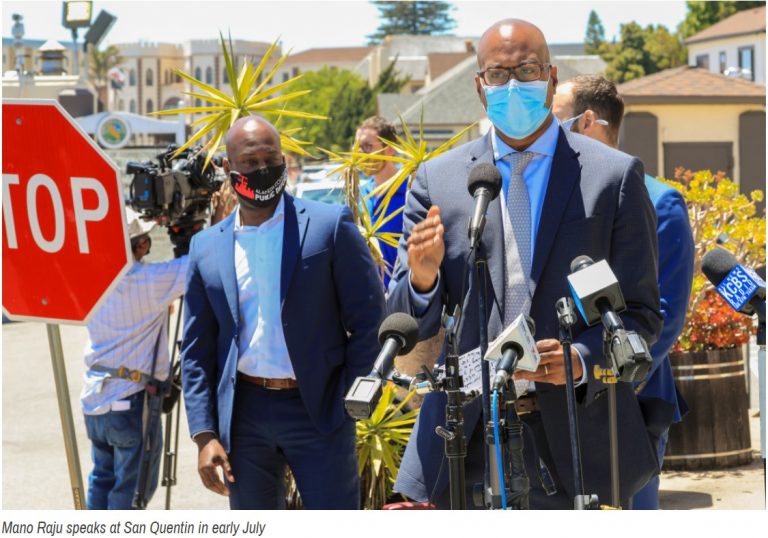
“This case is about saving lives, but it’s also about protecting human dignity and wellbeing,” said Mano Raju, Public Defender of San Francisco. “Every incarcerated person is suffering under the current conditions of confinement, with no end in sight. They have no human contact with loved ones, and their mental health is suffering in addition to the threat to their physical health. The only solution is to dramatically reduce the prison population through releases.”

Coronavirus cases, deaths at San Quentin prison blamed on mismanagment

0
NBC News report from Jacob Ward – Coronavirus cases, deaths at San Quentin prison blamed on mismanagement – interviewed the sister of an incarcerated man at San Quentin seeking information from CDCR, and advocates describing the dangerous and challenging conditions for people in San Quentin during a massive outbreak of COVID-19. He also interviewed Jacque Wilson of the San Francisco Public Defender’s Office who has had similar challenges communicating with his brothers who are, respectively, in federal custody at Terminal Island in Los Angeles and in Navajo County Jail in Arizona.

He said he learned of his brother’s condition by letter. And in a video recorded inside the Arizona facility published on Twitter, his brother Neko complains of leaking toilets, no masks and unsafe conditions. “It’s incredibly frustrating,” Wilson said.

Effort to Release People Incarcerated at San Quentin Moves Forward In Marin County Superior Court

Effort to Release People Incarcerated at San Quentin Moves Forward In Marin County Superior Court 

Habeas petitions allege that California Department of Corrections and Rehabilitation actions constitute “cruel and unusual punishment” as decisions led to an explosive and deadly Covid-19 outbreak at San Quentin 

SAN FRANCISCO – A Marin County Superior Court judge has ordered the California Department of Corrections and Rehabilitation (CDCR) to respond urgently to petitions requesting immediate release of 21* people at San Quentin State Prison. The petitions were filed by incarcerated people at San Quentin and attorneys representing people there over the past month. 

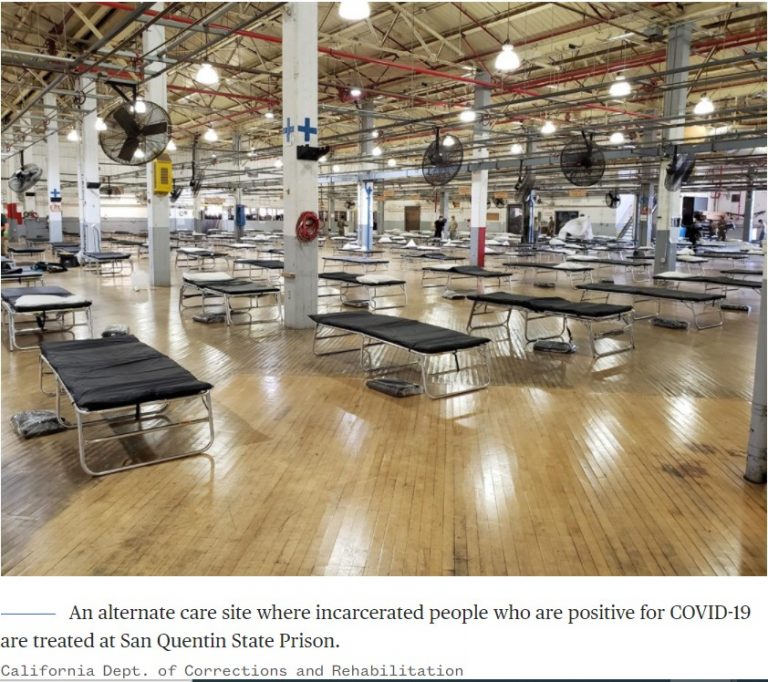
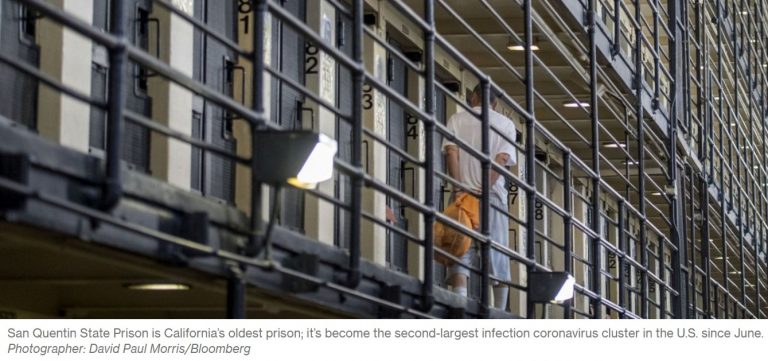
The petitions come after a fateful decision by CDCR in late May to transfer 121 people from California Institution for Men (CIM) – then the state prison with the highest COVID-19 rate in California – to San Quentin. There were no confirmed cases of COVID-19 at San Quentin prior to the transfer. As a result of the transfer, over 2,000 people living and working at San Quentin have tested positive for COVID-19 and 19 have died. The crisis has led to severe staffing shortages, near total and indefinite lockdown, and a state of extreme fear for those trapped inside and their families. Currently, the COVID-19 infection rate in San Quentin is 63% while California’s infection rate is 1%. 

“Incarcerated people at San Quentin are scared to death,” said Marin County Public Defender Jose Varela. “Judge Howard has ordered CDCR to respond. And his seeking quick input from all parties reflects the important human rights issues at the heart of this litigation.”  

The cases were filed individually as “habeas corpus” petitions – a legal recourse requesting a court to determine whether a person’s incarceration is lawful. The petitions allege a violation of the U.S. Constitution’s 8th Amendment prohibition against “cruel and unusual punishment.” The petitions request immediate release to escape the deadly conditions caused by CDCR. The cases were subsequently joined together and will be heard by Superior Court Judge Howard. Attorneys for petitioners include attorney Charles Carbone, the Santa Clara County Alternate Defender, the Marin County Public Defender, the San Francisco Public Defender, and the Alameda County Public Defender.

Arielle Callin-Thomas, wife of petitioner Lawrence Thomas, stated, “My husband is currently housed in the gym at San Quentin State Prison and is fearful for his life and wellbeing. The inhumane treatment and lack of due diligence CDCR has shown during this global pandemic is incredibly heartbreaking to say the least.”

Health officials have consistently warned of the risk overcrowded prisons and jails pose to public health, as outbreaks in congregate living spaces threaten to overwhelm local hospitals. Public health professional and organizer Swati Rayasam said, “For those who are incarcerated, screening was never going to be enough. Incarcerated people are a vulnerable population and therefore more susceptible to COVID-19; additionally, incarcerated people also represent other vulnerable communities, such as low-income populations, people of color, people with disabilities, the elderly, and those with pre-existing medical conditions who are also more susceptible to COVID-19. It’s troubling to see CDCR’s apparent lack of consideration of cumulative risk to protect its highly vulnerable population from COVID, and its reliance on general recommendations from the Centers for Disease Control when the Bay Area is flush with public health professionals.”  

After visiting the prison on June 13, Berkeley Public Health experts issued a letter urging officials to take several steps to protect the lives and wellbeing of those incarcerated at San Quentin, as well as prison staff; they recommended reducing the population by 50% via decarceration. After the transfer from CIM to SQ, the population count in mid-June was 3,547, today the population is 3,429, representing a 3% reduction – 16% of which is due to the 19 deaths. Meanwhile, CDCR continues to tout this as “the biggest reduction in prison population in recent history.” While the California Department of Corrections says it has identified approximately 8,000 currently incarcerated people for release statewide, advocates and public health experts say it is not nearly enough to forestall additional, avoidable deaths due to COVID-19, caused in part by the agency’s irresponsible decisions.

“If the state cannot take care of the people in its custody – at the very minimal level of ensuring they stay alive – then the courts must act” said Danielle Harris, Managing Attorney in the San Francisco Public Defender’s Integrity Unit. “Reducing the prison population is the only safe answer. CDCR has demonstrated its inability to come up with a sufficient plan, and transferring people from one unsafe lockup to another is demonstrably not the solution. We are grateful that the Marin court agrees the issue is an urgent one. Our community partners stand ready to support any released folks through reentry.”

“This case is about saving lives, but it’s also about protecting human dignity and wellbeing,” said Mano Raju, Public Defender of San Francisco. “Every incarcerated person is suffering under the current conditions of confinement, with no end in sight. They have no human contact with loved ones, and their mental health is suffering in addition to the threat to their physical health. The only solution is to dramatically reduce the prison population through releases.”

“People continue to die needlessly because the prison system is failing us,“ said Charles Carbone, Prisoner Rights Attorney in San Francisco. “The prison system’s failures are on full display now with deadly consequences for prisoners and those in the free community.  Marin County Court is wise and responsible to tackle this urgently.”   

Judge Howard’s expedited schedule for the case is promising because the process can ordinarily take a long time. It is also significant that he is considering an evidentiary hearing because it would enable petitioners to present evidence in a public and open courtroom (if only  a virtual one) regarding the public health crisis in correctional facilities in general and CDCR’s mishandling of the situation at San Quentin, specifically. 

“The pandemic has had a disproportionate impact on communities of color because of systemic health and social inequities,” said Jessica Delgado, Deputy Public Defender at the Santa Clara County Alternate Public Defender, “but if you also consider long-standing racial disparities in arrests, prosecutorial charging, and court sentencing decisions – which have fueled the mass incarceration of people of color in California prisons – our failure to act decisively is nothing short of calamitous.”

“Systemic racism has caused our prisons to be overcrowded. And systemic racism has helped make Black and Brown people easy prey for COVID-19,” said Brendon Woods, who is the first Black Chief Public Defender in Alameda County and the only Black Chief Public Defender in California. “If the Governor will not act and CDCR will not act, we are forced to go to the courts to see if they will take action. We are exhausting every single avenue in an attempt to save lives.”

“The COVID-19 outbreak at San Quentin Prison not only threatens the lives of the people who are incarcerated, but also those who live and work in the surrounding community,” said Jessica Jackson, Former Mayor of Mill Valley. “I commend the Marin County Superior Court for recognizing the urgency of this situation and calling on the CDCR to review the received petitions as soon as possible. A prison sentence should not be a death sentence.”

*Update – On July 29th, 20 more individuals were added to this consolidated case, bring the total to 41.

City leaders pledge to reject SFPOA support

The San Francisco Examiner published a pledge signed by sixteen current and former elected officials, including San Francisco Public Defender Mano Raju: City leaders pledge to reject SFPOA support. The leaders also urged other officials and candidates to reject the support of the SF Police Officers’ Association.

“The poa must acknowledge and publicly apologize for its past words and actions. It must commit to fighting racism within its ranks and its leadership. Individuals fighting bias within the SFPD should be given leadership roles—not retaliated against. And the POA must cease blocking reform measures.”

The Imprisoners’ Dilemma

Sarah Holder of the Bloomberg CityLab published The Imprisoners’ Dilemma – San Quentin’s deadly Covid-19 outbreak has intensified a national debate over releasing inmates and dramatically reducing the U.S. prison population — for good. In it, she notes the efforts of the San Francisco Public Defender’s Office to urge Governor Newsom to reduce the state’s prison population.

“While we have missed the opportunity to prevent the most harm, we can still change course and strive to reduce further harm going forward,” wrote Manohar Raju, the San Francisco Public Defender, and Chesa Boudin, the San Francisco District Attorney, in a July 6 letter urging Governor Gavin Newsom to reduce the state’s prison population.

Former Prisoner Fights for Inmates’ Release

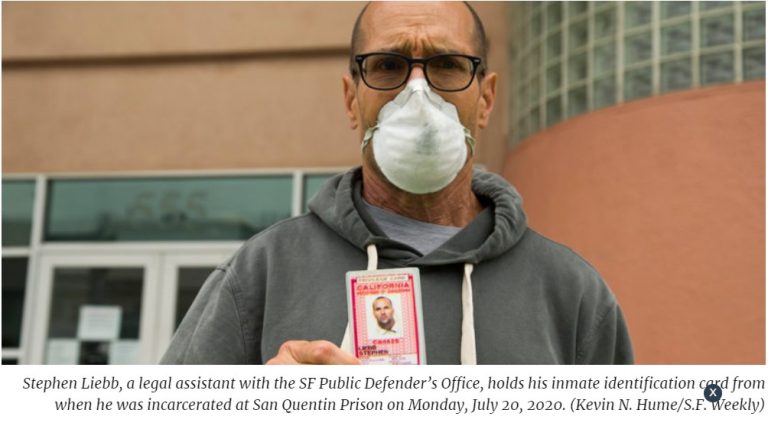
Nuala Bishari reported for SF Weekly: Former Prisoner Fights for Inmates’ Release – featuring Steph Liebb, a paralegal in the San Francisco Public Defender’s Office who was formerly incarcerated at San Quentin. Mr. Liebb now works on the post-conviction relief team offering assistance to people in California prisons with convictions from San Francisco who may want to petition for resentencing, or petition for release under the writ of habeas corpus during the coronavirus pandemic which has created deadly conditions in California’s overcrowded prisons.

“I’m so grateful not to be there right now,” [LIEBB] tells SF Weekly. “If I were in there, I would want someone going all out for me. The letters I get from family members are heartbreaking. Everyone in the San Francisco Public Defender’s office is doing whatever’s necessary to get them out.”

Click here to learn more about habeas corpus petitions and the status of various cases being heard in Marin County Superior Court for over 300 people currently incarcerated at San Quentin State Prison.

In 1st ruling of its kind, SF judge declares witnesses will wear transparent face masks in court

0
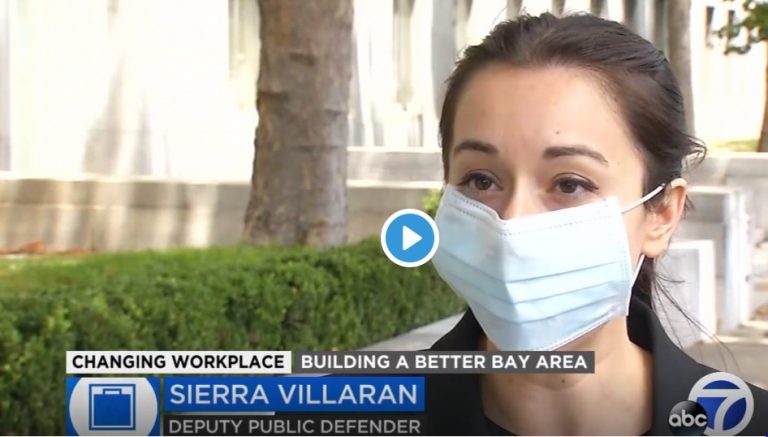
ABC 7 News reported: In 1st ruling of its kind, SF judge declares witnesses will wear transparent face masks in court. Deputy Public Defender, Sierra Villaran, successfully argued the importance of being able to see facial expressions during the first jury trial San Francisco Superior Court after the pandemic interrupted the court schedule in March 2020 and delayed trials for months. The judged ruled that clear masks would be provided to the court.