District Attorneys Violated State Law That Protects Juvenile Records
SAN FRANCISCO — The San Francisco District Attorney’s Office violated state law protecting the confidentiality of juvenile cases in recent news reports. The reports are related to the Jan. 4 arrest of a 15-year-old, who is represented by the San Francisco Public Defender’s Office. The DA’s Office, which is prosecuting the minor for alleged homicide at the Japan Center Mall, issued a statement to press containing confidential information, and may have leaked documents related to the minor’s juvenile record.
California Welfare and Institutions Code 827 prohibits the release of information related to juvenile records, and it is a misdemeanor to violate these protections. This law reflects a long history of protecting juvenile proceedings and records from disclosure to facilitate the rehabilitative goals of the juvenile system and avoid stigmatizing individuals accused at a young age. See, e.g., T.N.G. v. Superior Court (1971) 4 Cal. 3d 767, 775-778; see also J.E. v. Superior Court (2014) 223 Cal. App.4th 1329, 1337 (“There is a strong public policy of confidentiality of juvenile records.”).
DA Brooke Jenkins has previously stated her inhumane policy to transfer certain juvenile cases involving 16- and 17-year-olds to adult court, but she is prohibited by state law from doing so when the individual accused is 15 years old. The Public Defender’s Office issued a statement when DA Jenkins announced her juvenile policy in September 2022, noting that the policy ignores the data and the history which has shown the ineffective, counterproductive, and dangerous practice of trying youth as adults under any circumstances.
The Public Defender’s Office will be exploring all avenues for holding the District Attorney’s Office accountable for violating state law, including a gag order to prohibit prosecutors from making further public comments on this juvenile case or releasing more documents related to the minor.
Jessie Seyfer, San Francisco Public Defender’s Office, jessie.seyfer@sfgov.org, (415) 851-2212
**MEDIA ADVISORY**
City Leaders, Traffic Safety Advocates and Civil Rights Orgs To Hold Press Conference Urging Police Commissioners to End Racially-Biased Traffic Stops in San Francisco
SAN FRANCISCO — On Wednesday, Jan. 11, at 10 a.m., the Coalition to End Biased Stops, made up of more than 110 civil rights attorneys, traffic safety groups, policy think tanks, and community organizations and advocates, will hold a press conference at San Francisco’s City Hall to call for an end to racially-biased police traffic stops, also known as “driving/biking/walking while Black or brown.” The press conference will be held in anticipation of the San Francisco Police Commission meeting on Jan. 11, at 5:30 p.m., where Commissioners will cast a historic vote on significant changes to the Police Department’s traffic enforcement policies. Should the Commissioners vote to adopt these changes, the new set of rules would be the most comprehensive policy in the country to address racially-biased traffic stops.
WHEN: Wednesday, Jan. 11, 2023 from 10 a.m. to 11 a.m.
WHO:
Facilitated by: Miguel Bustos, GLIDE
Confirmed speakers:
Mano Raju, San Francisco Public Defender
Dean Preston, Supervisor District 5
Shamann Walton, Supervisor District 10
Max Carter-Oberstone, San Francisco Police Commissioner
Kevin Benedicto, San Francisco Police Commissioner
John Hamasaki, former Police Commissioner
Claire Amable, SF Bicycle Coalition
Brian Cox, San Francisco Public Defender’s Office
Saundra Haggerty, GLIDE
Tracey Mixon, Coalition on Homelessness
Yoel Haile, ACLU of Northern California
Rigo Gomez, Community Resource Initiative
WHERE:
City Hall front steps
1 Dr Carlton B Goodlett Pl San Francisco, CA 94102
In the event of severe weather: Room 278 – City Hall
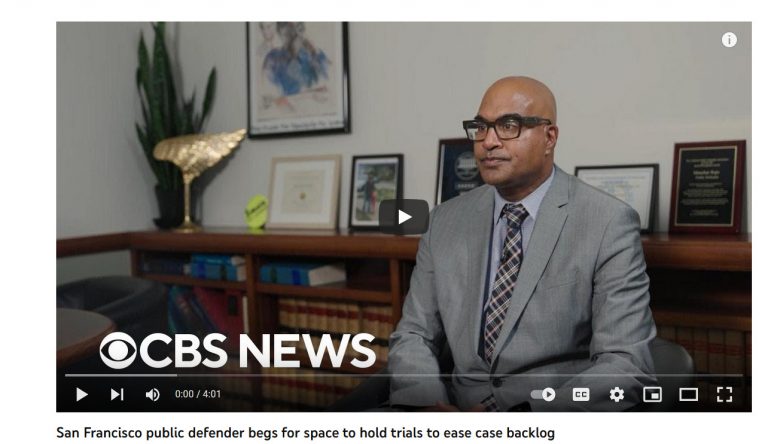
In December 2022, CBS News Innovation Lab interviewed San Francisco Public Defender Mano Raju, Deputy Public Defender Alexandra Pray, and Ms. Pray’s client Sarina Borg for an in-depth report looking at the national problem of court backlogs: Growing backlog of court cases delays justice for crime victims and the accused
Ms. Borg waited 2.5 years in jail – while her health and family suffered greatly – before her case got assigned to a trial courtroom. Once at trial, after the prosecution’s witnesses had testified, the judge granted the defense motion to dismiss the case due to lack of evidence; and she could finally go home. Ms. Borg is just one of hundreds of people whose right to a speedy trial has been violated by San Francisco Superior Court, over 150 of whom remain jailed beyond their trial deadlines, and many more in line behind them as the backlog continues to grow.
Public Defender Raju spoke about the ongoing advocacy of the Public Defender’s Office to stoke the courts to address the unresolved trial backlog in San Francisco Superior Court, which is contributing to the humanitarian crisis in county jail, where many have remained under 23-hour lockdown, with limited visitation, scant programming and treatment, and no exposure to sunlight, throughout the pandemic.
When asked why more people in our society aren’t paying attention to this issue, Mr. Raju responded:
“the vast majority of our clients are poor, many have mental health issues, many have housing issues, people of color. This is a group that doesn’t have a lot of political capital, and if this were happening to a different demographic, it would be a national outrage…the constitution is supposed to apply to everyone in our society equally.”
Sarina Borg talks with CBS in front of SF County Jail where she was held for 2.5 years until her case went to trial. Sarina Borg and her Public Defender Alexandra Pray, speaking to CBS at the Public Defender’s Office just weeks after her case was dismissed at trial due to lack of evidence.
Ms. Pray explained to CBS:
“For 2.5 years we knew if we could just get into a trial courtroom, the truth would come out, the facts would present themselves, and we were just consistently denied the opportunity to prove HER innocence.”
FOR IMMEDIATE RELEASE: Dec 2, 2022 MEDIA CONTACT: SF Public Defender’s Office | PubDef-MediaRelations@sfgov.org | (628)249-7946
LGBT immigrant leader receives outpouring of support from community groups at upcoming bond hearing.
Salesh Prasad, beloved artist and activist, fears he’ll face anti-LGBT violence if deported
VAN NUYS, CA – Community organizations across California are mobilizing to support Salesh (“Sal”) Prasad—an LGBT immigrant, artist, and community leader who is currently suffering in ICE detention—at a bond hearing Monday, Dec. 5, at 2:30 p.m. in Van Nuys. Several supporters plan to attend the hearing in person at the immigration court, located at 6230 Van Nuys Blvd., 3rd Floor, Suite 300, while dozens of others will join the hearing virtually on Zoom to express their support for Salesh to be freed. Mr. Prasad and his attorney, Maddie Boyd, of the San Francisco Public Defender’s Office immigration unit, are available for interviews prior to and following the hearing.
Salesh’s story of transformation and his activism on behalf of other detained people, have inspired organizations across the country, earning him support from Democratic County Central Committees in Stanislaus, Alameda, and San Francisco counties; the San Francisco Board of Supervisors, Asm. Matt Haney, Asm. Alex Lee, Senator Scott Weiner, Sen. María Elena Durazo, LGBT leaders including former Asm. Tom Ammiano, as well as numerous faith and community organizations. Additionally, a moving video released last month by two immigrant rights coalitions highlights Sal’s story, drawing attention to the fact he was unable to attend his mother’s funeral because he was in ICE custody.
In a statement, Maddie Boyd, Mr. Prasad’s attorney in the San Francisco Public Defender’s Office, said:
“Sal is a beautiful person. He is a beloved brother, uncle, and nephew whose family is eager to embrace him after many years of separation. He is a powerful advocate for healing and resilience, from his work transforming himself and leading Alcoholics Anonymous and Narcotics Anonymous groups in prison, to his plans to serve as a mentor to help survivors of childhood abuse. If Sal is released, he will contribute toward building stronger and safer communities for all. It’s moving to see the outpouring of support for Sal from across the state—and it’s an honor to be his attorney.”
Background
Mr. Prasad, now 51 years old, experienced domestic violence and sexual abuse as a child, and the trauma pushed him to numb himself with alcohol and drugs and seek protection from gang members. At age 22, he took another person’s life during an argument, a crime for which he served 27 years in prison and is incredibly remorseful. While in prison, Mr. Prasad found healing through therapy, art, and helping others. He led Alcoholics Anonymous and Narcotics Anonymous groups, and practiced non-violence and de-escalation among his peers.
Salesh has also fought to ensure availability of COVID-19 boosters for fellow ICE detainees. He has become an activist and advocate for California legislation such as the Mandela Act, to further limit the use of solitary confinement in prisons, and the VISION Act, to prevent transfers from jails and prisons to ICE.
A number of organizations have pledged their support for Mr. Prasad, including faith groups and reentry agencies that are poised to help him transition back into the community where he hopes to counsel others on surviving childhood trauma.
In addition to supporting Mr. Prasad at the bond hearing, organizations are also requesting that Gov. Gavin Newsom grant Salesh a pardon. This would prevent his deportation to Fiji, a country he left at age six, where he stands to face discrimination and persecution as a queer man and an Indo-Fijian minority. The Bay Area Reporter Editorial Board has also endorsed calls for Gov. Newsom to pardon Salesh.
At Statewide Judges Meeting, Impacted Community Members Speak Out Against SF Superior Court for Violating Speedy Trial Rights
Impacted community members, community leaders, SF Public Defenders demand that SF Superior Court open trial courts for hundreds of people caged in SF Jails past their Constitutionally-mandated trial deadlines
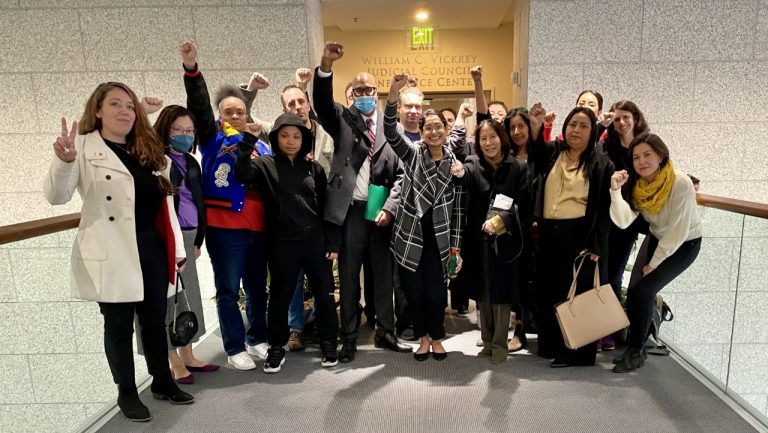
SAN FRANCISCO – Today, at the annual meeting of the Judicial Council—California’s statewide policy-making body for the courts, comprised of judges from throughout the state—San Francisco Public Defenders, community leaders including Supervisor Hillary Ronen, and community members spoke out against the San Francisco Superior Court’s shameful trial backlog. Giving public comment, those directly impacted by the ongoing trial delays and indefinite pre-trial detention sent a strong message to the most powerful judicial organization in California.
“Today, San Francisco Superior Court’s severe trial backlog – and the pain it has caused families of individuals jailed without trial – was put on display for the entire state judicial system to see,” said San Francisco Elected Public Defender Mano Raju, who joined a group of taxpayers to sue SF Superior Court in September 2021. Part of that suit remains under review in the California Court of Appeal. “It is shameful and inexcusable that San Francisco stands alone in refusing to honor Constitutional speedy trial rights of hundreds of community members. While other counties cleared their backlogs, San Francisco’s has grown by more than half since it ‘fully reopened’ back in June 2021. San Francisco’s court system has failed its residents badly for months upon months, and has exacerbated the humanitarian crisis in our jails.”
At the latest count, there were 770 individuals who have seen their Constitutionally-mandated trial deadlines pass, including about 180 people trapped in jail beyond their trial deadline. In addition to Raju’s taxpayer lawsuit against the San Francisco Superior Court, attorneys from the SF Public Defender’s office have filed numerous habeas petitions challenging the harsh conditions of confinement in the county jails on behalf of individuals who remain caged far beyond their statutory trial deadline. Public defenders have also filed motions to dismiss several cases because of unacceptable delays. Many of the people in custody in San Francisco County Jails are subjected to 23-hour-a-day lockdown conditions, have had no exposure to sunlight, very limited in-person family visits, and few opportunities to attend programs.
Community members who have been directly impacted by these delays spoke at the rally about the mental and physical harms associated with family separation.
Stephen Kloster – a public defender client and former firefighter who spent 410 days in jail, unable to care for his 87-year-old mother; and who was eventually acquitted of all felony charges, said: “As an immuno-compromised person, I lived in fear that I would get seriously sick or die while I was in jail. It feels like the Court isn’t taking its responsibility to hold trials seriously, and they’re playing games with our lives. And it wasn’t just my life. While I was trapped in jail without a court date, no one was caring for my 87 year old mom because I’m her only caretaker. Being in jail for over a year completely interrupted my life and endangered my family. I wouldn’t wish this on anyone.”
Stephanie Irving spoke about her 60-year-old partner, a public defender client, who has been in jail for seven months and caught COVID there: “When he called me and he was coughing so much, I had to hang up the phone because it was too painful. I was scared he was going to die in there. This time was supposed to be our time to be together. He should be with me, not still be in that place.” Her partner’s trial deadline passed in August, and he still has not had his trial.
San Francisco Supervisor Hillary Ronen also spoke, noting that a year ago she held a public hearing to address the trial backlog at the Board of Supervisors Government Audit and Oversight Committee. “Shockingly, one year later, this crisis has not only continued, but the backlog has in fact gotten worse,” she said. “How are the San Francisco courts allowing this backlog to continue? I want to learn from many of you, judges, here from other counties, about what has been effective in alleviating these backlogs in your jurisdictions, and I want to offer whatever help I can.”
Additional speakers included Lucero Herrera of the Young Women’s Freedom Center; William Palmer of the San Francisco Bay View National Black Newspaper; Patti Lee, Peter Calloway, Valerie Ibarra, Elizabeth Camacho and Anita Nabha of the San Francisco Public Defender’s Office; Father Richard Smith; and Melissa Hernandez, legislative aide for Supervisor Dean Preston.
Background:
The Sixth Amendment of the U.S. Constitution guarantees the right to a speedy trial, but the San Francisco Superior Court has been relying on the circumstances of the pandemic as an excuse to delay trials, sometimes for months and even years past their statutory deadline. California state law requires that courts prioritize criminal trials, yet San Francisco continues to hold civil trials and has not made use of all available courtrooms nor sought alternative venues to accommodate the need. A number of other counties—such as Alameda, Contra Costa, San Mateo, and Marin—have made such accommodations and cut their trial backlog significantly while San Francisco’s backlog continues to expand.
MEDIA CONTACT: PubDef-MediaRelations@sfgov.org | (628) 249-7946
**PRESS STATEMENT**
San Francisco Public Defender Mano Raju’s Statement on Starting a New Four-Year Term in Office
SAN FRANCISCO — On Nov. 8, San Francisco voters re-elected Mano Raju for a four-year term as the city’s Public Defender. Here is a statement from Public Defender Raju:
“I am grateful and excited to embark on a new four-year term as Public Defender, knowing that San Franciscans have expressed confidence in my leadership and the work that our office does on behalf of indigent community members and their families every single day.
The energy of the community inspires me and reflects a generation that is re-imagining what our systems can look like. I feel incredible gratitude to our public defender warriors for their commitment to justice, high-level representation, and daily dedication to improving the lives of San Franciscans entangled in the criminal legal system.
We are at an inflection point. Not that long ago, people took a knee worldwide to speak out against structural racism in law enforcement and the criminal system. This is something that public defenders are working to expose every day we’re in court fighting for our clients. We will continue to fight for our clients, for the well-being of their families, and for evidence-based strategies that are proven to be effective at improving community health and public safety.
As the only elected Public Defender in California, I take seriously my responsibility and the role of our San Francisco Public Defender’s Office to lead and engage with our peers and community partners around the state. I’m committed to the idea that public defenders, in conjunction with labor, educators, housing advocates, mental health professionals, and immigrant and racial justice advocates, can push an agenda that will lead to truly healthier and safer communities. Our office’s innovative initiatives that holistically support and empower system-impacted community members – such as End the Cycle, Clean Slate, Freedom Project, Young Defenders, Be the Jury, and the Adachi Project; along with our cutting-edge policy work, our demand for police accountability and transparency, and expanding the reach of our immigration unit to fight against unjust detentions and deportations – all move the ball forward.
We have in the Bay Area passionate and committed people who are ready to make some real positive impacts in the fight for legal, racial and economic justice. I am proud of all that our office has accomplished so far, and we are going to continue showing the world what we are capable of – one piece of legislation, one innovative program, one family, and one client at a time.”
Judge Dismisses Case Against Woman Held in SF Jail for 2.5 Years, Citing Lack of Evidence
Sarina Borg was jailed nearly two years past her Constitutionally mandated trial deadline
SAN FRANCISCO — On Nov. 7, a San Francisco Superior Court judge dismissed charges against Sarina Borg, a mother who had been detained in SF County Jail without bail for nearly two years past her Constitutionally mandated deadline to face trial, and for more than two and a half years total. Borg was accused of aiding and abetting a homicide in May 2020, and her case finally went to trial in October 2022. On Monday, Judge Teresa Caffese found that the prosecution failed to present substantial evidence that Borg was aware of the intentions of the individual who is alleged to be the shooter, and granted Borg’s motion for a directed verdict of acquittal before the case could go to the jury. Deputy Public Defender Alexandra Pray represented Borg.
“Ms. Borg has maintained her innocence since the beginning and never waived her right to a speedy trial,” said Pray. “While we are relieved that the judge rightfully dismissed these charges, Ms. Borg’s prolonged pretrial incarceration has been deeply traumatic to her health and the well-being of her family.”
The dismissal of charges against Borg comes amid an oppressive trial backlog that has left hundreds of people waiting for their day in court to defend themselves against charges for which they stand accused. The San Francisco Public Defender’s Office has been tracking the growing trial backlog in San Francisco Superior Court. According to the latest available data from Oct. 4, there are 770 individuals awaiting trial whose Constitutionally-mandated trial deadlines had passed, and 180 of those individuals remain incarcerated in SF County Jail.
“When a mother is forced to sit in jail for 2.5 years while the court continues to violate speedy trial deadlines for hundreds of people, and when prosecutors aggressively pursue charges where they cannot meet the burden of proof, we all need to question what it means to be presumed innocent in San Francisco,” said Public Defender Mano Raju, whose office has been pushing SF Superior Court to address the alarming backlog that has delayed hundreds of trials and left people languishing in jail under isolating and dangerous conditions throughout the pandemic. “I commend Ms. Borg and her defense team for never giving up on defending her innocence, especially in the face of such egregious violations of her rights and liberty.”
The defense team was led by Deputy Public Defender Alexandra Pray; Deputy Public Defender Eric Fleischaker as second chair; Investigator Jose Mendoza; Paralegals Nathan Conn and Melissa Campos; and Law Clerks Sara Westcot and Grant Schwall.
Jury Acquits Man Who Confessed Falsely to Decades-Old Cases in Desperate Attempt to Be Moved Out of Hellish Florida Prison
Jury acquitted Roy Lacy on count 1, and hung on count 2.
SAN FRANCISCO – After a two-month trial, a San Francisco jury acquitted Roy Lacy on Nov. 3 in connection with two separate, cold-case murders that had taken place in 1999 and 2000. Lacy had confessed to the murders in 2018 while serving a prison sentence in Florida, where he had been subjected to extreme interpersonal violence—including being robbed, beaten, and having his femur broken. Lacy was serving a sentence for bank robbery by note at the time and saw a false confession to the two unsolved San Francisco murders as a way to get out of Florida and be closer to his family. San Francisco Deputy Public Defenders Elizabeth Camacho and Diamond Ward represented him in the trial. Lacy has also been sentenced to a Three Strikes life sentence in California for bank robberies in Marin County but was serving time in Florida concurrently.
Around the time of the murders—a stabbing in 1999 and a shooting in 2000—Lacy was an 18-year-old runaway in a personal relationship with an individual who is alleged to have actually committed the murders, and who has since died. Despite Lacy’s knowledge of the crimes, the details he provided in writing and in a video confession did not match any of the witness statements from 1999, and there was no physical evidence tying him to either case. The jury returned an acquittal on the first count in under an hour. The jury then hung on the second count with eight jurors voting guilty and four not guilty.
“Mr. Lacy’s words did not match the evidence, and there is no new evidence that the prosecution can bring in this case,” said Camacho. “The jury did their job, upheld the presumption of innocence, and demanded that the DA meet their burden of proof— which they did not. We are grateful to the 12 jurors who saw the humanity in Mr. Lacy, and who understood that he had no other recourse than to falsely confess to survive.”
“Mr. Lacy falsely confessing to murder is an act of extreme desperation that reflects the brutality of the prison system and the Three Strikes law. The only thing he has left is his life, which he was convinced he was going to lose in Florida, so he decided he might as well go back to California where he knows how to survive in prison and can maintain a better connection to his family,” said Ward, who added that Florida prisons have rules that make it very difficult for incarcerated individuals to receive phone calls and visits from loved ones.
Lacy has been in San Francisco County Jail awaiting trial since 2018. His Constitutionally-mandated trial deadline was in December 2021, but due to court delays, the trial did not begin until August 2022. His Florida prison term has since been completed. He will eventually be transferred to a California state prison facility to serve his life sentence from the Marin County bank robberies, and the timing depends on whether the San Francisco District Attorney’s Office intends to retry him on the second count in this case.
“Jury trials are often the only way to get to the truth. It should have been clear to law enforcement from the beginning that the facts in this case didn’t add up, yet prosecutors pursued these charges without credible evidence to support their claim,” said San Francisco Public Defender Mano Raju, whose office has been pushing San Francisco Superior Court to address the alarming backlog that has delayed hundreds of trials. “This was an exceptionally complicated case, and I commend our team of skilled defenders for the care and professionalism with which they defended Mr. Lacy.”
The defense team was led by Deputy Public Defender Elizabeth Camacho with Deputy Public Defender Diamond Ward as second chair, and included Investigators Gary Sourifman, Jesse Huber and Terry Collins; Paralegal Sercan Ersoy and several additional staffers of the San Francisco Public Defender’s Office.
SAN FRANCISCO – This week, Mission Local reported that days before Brooke Jenkins and Don du Bain were slated to leave the San Francisco District Attorney’s Office in October 2021, Jenkins improperly sent records to du Bain’s personal email which pertain to Troy McAlister, including his rap sheet. Jenkins and duBain never worked on Mr. McAlister’s pending case, but referenced information contained in those materials as the two campaigned for the recall of their former boss, Chesa Boudin. Today, Deputy Public Defender Scott Grant, who represents Mr. McAlister, issued the following statement:
“As Troy McAlister’s attorney, I am extremely disturbed that Brooke Jenkins improperly disclosed confidential information pertaining to Mr. McAlister, including his rap sheet, which is subject to stringent confidentiality requirements in our criminal system. Neither Ms. Jenkins nor Mr. du Bain ever appeared on the Troy McAlister case, were assigned to the case, or were supervisors of the prosecutor on the case. I have no reason to think that Ms. Jenkins and Mr. du Bain had any legitimate basis to access the records, not to mention disseminate those records outside of confidential channels.
Our criminal legal system gives law enforcement and prosecutors exceptional powers, including access to incredibly sensitive information. Our system justifies this power by requiring that the information will only be used for legitimate prosecutorial reasons, not personal or political reasons. When prosecutors use information for personal or political reasons, it destroys all trust that the prosecutor can carry out their public duties in an unbiased and ethical manner.
Mr. McAlister has already been used as a political pawn, and this revelation just makes clearer that his case has become about politics.
We are exploring all of the options available to address the violation of Mr. McAlister’s rights, including the possibility of filing a motion for the court to disqualify the San Francisco District Attorney’s Office from the prosecution.”
Drug Policy Experts and Treatment Providers Urge Evidence-based Treatment and Harm Reduction Strategies Needed to Address SF Public Health Crisis
Criminalizing the supply does nothing to abate the demand. Instead of bringing back the harmful War on Drugs, public health experts discuss how San Francisco should invest in wraparound care
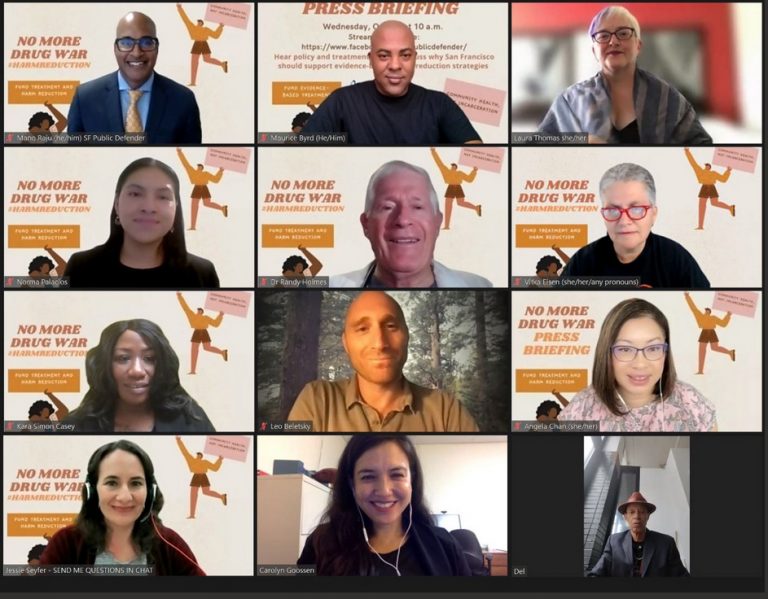
SAN FRANCISCO — Today, in a virtual press briefing, drug policy and community-based practitioners urged San Francisco city leaders to invest in evidence-based, harm reduction-focused strategies to address the city’s public health crisis.
“San Francisco has earned a reputation for being forward-thinking and innovative, and we think it’s really important to not move backward when it comes to the issue of how to tackle substance use disorders,” said elected San Francisco Public Defender Mano Raju, whose office co-hosted the briefing, along with the San Francisco AIDS Foundation, Drug Policy Alliance, Code Tenderloin and HealthRIGHT 360. “This is why we wanted to come together today to provide an evidence-based perspective on what actually will work to address the opioid crisis in San Francisco. To be clear, as the historic War on Drugs has clearly demonstrated, criminalizing the supply has done nothing to reduce the demand. Today’s conversation is about how to reduce the demand and how to treat substance use disorders in a humane and effective way.”
“From an empirical perspective, law enforcement interventions do not actually dismantle drug trafficking organizations,” said Leo Beletsky, Associate Professor at the UC San Diego School of Medicine. “By attacking supply, drug markets mutate and often produce more violence and more potent drugs.”
Vitka Eisen, CEO of HealthRIGHT 360, a provider of medical and substance use disorder treatment in San Francisco, recommends the city create a broad network that helps keep people who use drugs connected and engaged in care. In her view, that would include low-barrier wellness hubs and drop-in centers, high-quality voluntary treatment that includes medication for addiction treatment and other evidence-based interventions, safe and stable transitional housing and permanent supportive housing.
“Treatment iseffective,” Eisen said. “It is not effective at the same time and in the same way for everybody. Rather than forcing people into treatment, we should follow the experts, and not just one person’s experience, whose recovery journey is relevant only to them.”
Del Seymour, a longtime advocate for unhoused individuals and founder of workforce development nonprofit Code Tenderloin, spoke about his personal experience with the last War on Drugs and his assessment of the current situation.
“I’m a veteran of the War on Drugs in the 80s and 90s in San Francisco in the Tenderloin. I spent 18 years heavily addicted to crack cocaine. I have 14 felony arrests on my record,” which Seymour said almost prevented him from buying his first home decades later. “Let’s have a collaborative strategy. I’m tired of going to fentanyl funerals.”
Norma Palacios, policy coordinator at the Drug Policy Alliance, noted that “criminalizing drug sellers does nothing to end overdoses.” Palacios explained, “Oftentimes the people who are arrested for selling drugs are selling to sustain their own drug use,” Palacios said. “In order to improve community safety, we need to minimize contact with law enforcement and direct people to community-based and culturally competent treatment instead of jails. San Francisco needs to divest from harmful Drug War policies.”
San Francisco’s moves toward increased policing and criminalization “are going to make the overdose crisis worse,” said Laura Thomas, Director of HIV & Harm Reduction Policy with SF AIDS Foundation. “We know what does address and prevent overdose fatalities. And that’s where the people in the harm reduction world have the tools, as opposed to the criminal legal system. We need to disinvest in what doesn’t work, and that’s the criminal legal system.”
Additional speakers at today’s event included Dr. Randolph Holmes, medical director of the Los Angeles Centers for Alcohol and Drug Abuse; Kara Simon Casey, Supervisor of Ambassadors, Code Tenderloin; and Maurice Byrd, LMFT, Director of Training, the Harm Reduction Therapy Center. A recording of today’s press briefing can be viewed here. at. And a factsheet with speaker bios, contact info and links to relevant studies is available here.