Home Blog Page 52

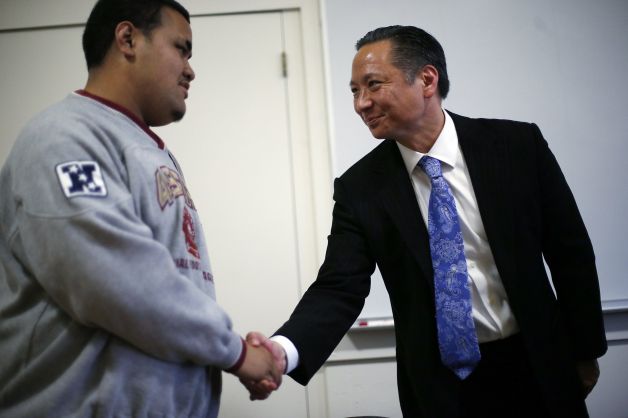
LEAP Team Named Program of the Year

0

San Francisco, CA — A unique San Francisco Public Defender program that pairs legal advocacy with social work to keep at-risk teens in school has been selected as 2014 Program of the Year by the California Public Defenders Organization.

The Legal Educational Advocacy Program (LEAP) will be honored Friday, May 2, at the statewide public defender organization’s annual convention in San Diego. LEAP works directly with San Francisco youth on probation, making regular court and school appearances and training parents and caregivers to advocate effectively for their children. Of the youth who have gone through the program, fewer than 13 percent reoffend six to 12 months after exiting.

The 3-year old program, funded through a federal grant, continues to work toward the greater goal of reducing the disproportionate number of youth of color in the justice system overall. It is comprised of Juvenile Unit Attorney Manager Patricia Lee, Social Worker Marynella Woods, Education Attorney Lauren Brady Blalock and Youth Advocate Marc Babus.

“The Board of Directors of the California Public Defenders Association believes that this unique, multifaceted client-oriented program effectively addresses many of the underlying causes that bring youth into the juvenile justice system by providing two attorneys, one to fight for them in the courtroom and the other to advocate for them in the classroom,” said CPDA President Winston Peters.

CPDA’s Program of the Year will be the second award for the program this year. On March 11, the team received a Public Managerial Excellence Award from San Francisco Mayor Ed Lee and the civic planning organization SPUR. The award, sponsored by SPUR’s Municipal Fiscal Advisory Committee (MFAC), recognizes managers or teams working for the City and County of San Francisco who display extraordinary leadership, vision and ability to make a difference both within city government and the community at large.

San Francisco Public Defender Jeff Adachi, whose office started the program to stem the dropout rate of its juvenile clients, said he was gratified to see LEAP’s accomplishments recognized.

“LEAP is the only program of its kind in California. My hope is to see it duplicated by other public defender offices around the state, because the link between education and crime reduction is clear,” Adachi said.

The program is in its final year of funding provided by a three-year grant. Adachi said he hopes to find an alternate funding source for the project.
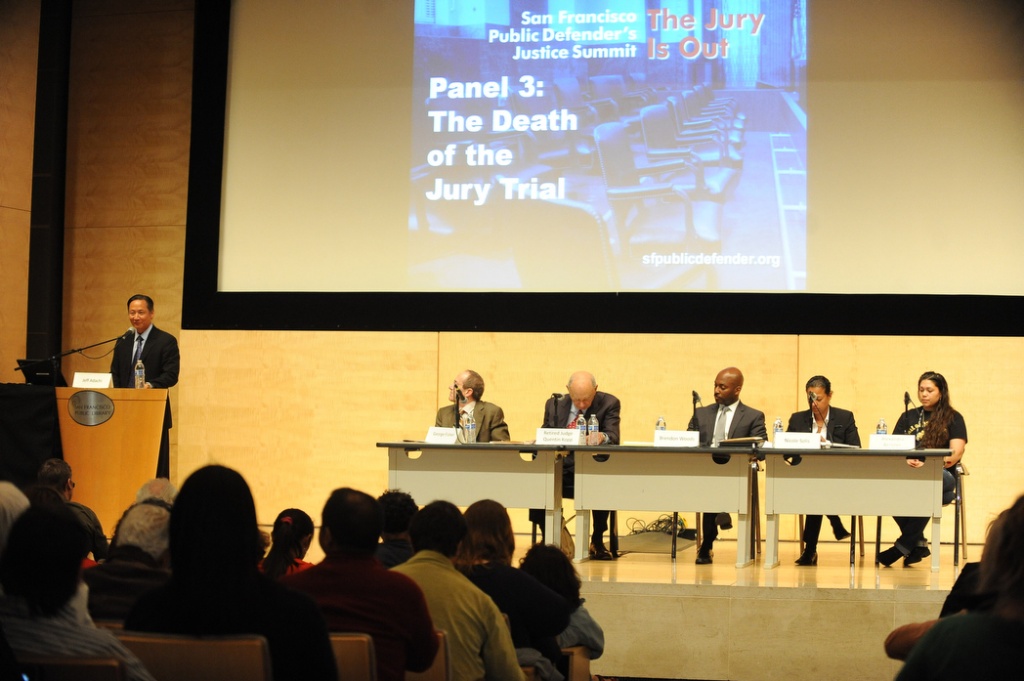

2014 Public Defender Justice Summit The Jury Is Out Photos

0

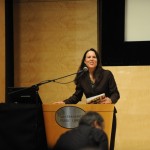
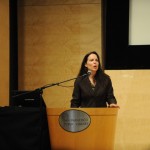
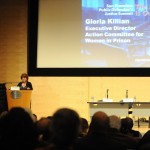
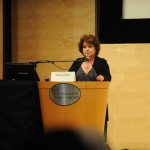
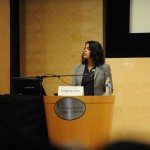
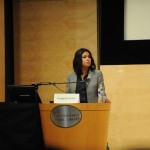
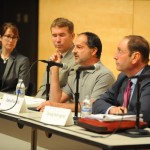
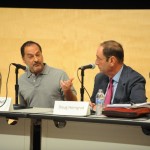
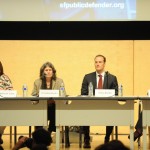
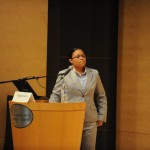
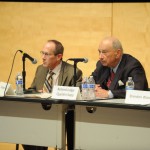
Here are photos from the recent 2014 Justice Summit held at Koret Auditorium.

April 23 Summit to Focus on Criminal Justice Reform

0

NOTE TO MEDIA: Photographs of our panelists can be provided. Interviews may be arranged with panelists/speaker prior to the event. There will also be a media availability at the summit.

San Francisco, CA—A former law student who served nearly 17 years in prison for a murder she did not commit will provide the keynote address for the San Francisco Public Defender’s Justice Summit on Wednesday, April 23, a free public event that explores today’s most compelling criminal justice issues.

The San Francisco Public Defender’s Justice Summit: THE JURY IS OUT will be held from 9 a.m. to 3 p.m. at the Koret Auditorium in Main Library. The event is free and includes lunch, but space is limited and registration is required. Register at sfpublicdefender.org.

Keynote speaker Gloria Killian, who was unjustly convicted of masterminding the 1981 robbery and murder of an elderly man, was exonerated in 2002 with the help of astronaut Sally Ride’s mother. Today, Killian is an attorney, author of Full Circle: A True Story of Murder, Lies and Vindication, and director of the Action Committee for Women in Prison, an organization that works to improve conditions of female prisoners.

Killian’s speech will be followed by a day of lively panel discussions on the science and controversy behind recovered memories, children of incarcerated parents, and the death of the jury trial. Panelists include experts in law, neuroscience and child welfare, as well as families affected by incarceration.

The annual San Francisco Justice Summit is the premier criminal justice conference on the West Coast. This year, panelists will debate growing dilemmas in criminal justice: Reconciling the latest scientific research on memory with justice for crime victims and fairness for the accused; Caring for the nearly 3 million children with an incarcerated parent; and preserving our constitutional rights in a system where the vast majority of defendants are encouraged to plead guilty.

“We are reaching a tipping point on what Americans are willing to tolerate from the criminal justice system, particularly when it comes to wrongful conviction or families separated through needless incarceration,” San Francisco Public Defender Jeff Adachi said. “The Justice Summit will focus on reform and solutions.”

The San Francisco Public Defender’s Justice Summit: THE JURY IS OUT is co-sponsored by the Bar Association of San Francisco. Attendance earns 4.25 MCLE units for attorneys.

Schedule:
9 a.m.: Registration
9:30 a.m.: Keynote Speaker: Gloria Killian, wrongfully convicted of murder, freed after 17 years, executive director of the Action Committee for women in prison
10 a.m.: Panel I: Beyond Woody Allen: Can We Trust Our Memories?
11:15 a.m. Panel II: Children of Incarcerated Parents
12:30 p.m.: Lunch provided
1:30 p.m. Panel III: The Death of the Jury Trial

Panelists/Moderators:
Jeff Adachi, San Francisco Public Defender
Nell Bernstein, author, Alone in the World: Children of the Incarcerated
Chesa Boudin, author, attorney, and child of incarcerated parents
Kathy Boudin, director, Criminal Justice Initiative: Supporting Children, Families and Communities, Columbia University School of Social Work
Daisy Wagaman (Bram), Family advocate, mother, jailed following cannabis raid
George Fisher, Stanford Law School, author, Plea Bargaining’s Triumph
Jim Hammer, attorney, legal analyst, former San Francisco prosecutor
Nicole Harris, reentry social worker, Children of Incarcerated Parents Program
Quentin Kopp, retired judge, former San Francisco supervisor and California state senator
Joey Piscitelli, North California director, Survivors Network of Those Abused by Priests (SNAP)
Dr. Melina Uncapher, neuroscientist and memory expert, Stanford Memory Laboratory
Brendon Woods, Alameda County Public Defender


###

Solving Chronic Truancy’s Billion Dollar Problem

0

By Jeff Adachi and Roger Chan, guest commentary

Bay Area News Group

Jasmine is a shy 14-year-old whose childlike appearance belies her role as primary caregiver for her three younger siblings. As a chronic truant, she is also part of California’s billion dollar problem.

With an absent father and a mother who cannot afford to take a day off work to care for a sick child, Jasmine is one of countless California students whose truancy isn’t fueled by teenage rebellion but by family hardship.

Other students stay home because they feel unsafe on campus. Still more have unreliable transportation, or have fallen so far behind in class that catching up seems hopeless.

Because truancy is a complex social issue rather than a crime, California has long banned the use of incarceration as punishment for skipping school.

Instead, it has employed interventions such as mediation programs for families, tutoring, mentoring, school safety support, alternative transportation and remedial services. It is a strategy supported by years of research showing that incarceration is counterproductive and that positive outcomes are achieved through meeting families’ specific needs.

But some California counties are using a legal loophole to lock up truant youth — sometimes in solitary confinement.

Senate Bill 1296, also known as the Decriminalization of Truancy Act, would close the loophole, forcing all counties to comply with California’s prohibition on locking up youth who have not committed crimes.

The legislation, proposed by state Sen. Mark Leno, will be heard in the Senate Public Safety Committee April 8.

Courts have locked up thousands of California young people, despite the intent of lawmakers, by charging them with contempt or for violating a court order to attend school, a practice that has already been banned in at least 14 states.

Because it is illegal to house truant youth with youth charged with crimes, they are often kept in a separate wing of juvenile hall, alone, in what amounts to solitary confinement.

Unlike youth accused of crimes, they do not receive rehabilitative services. Staffing costs for opening a unit for this small population is estimated at $686 to $833 a day.

SB 1296 complements a broad package of legislation recently announced by Attorney General Kamala Harris to better collect student attendance data in elementary school and intervene while children are young, rather than waiting for truant teens to become ensnared in the criminal justice system.

SB 1296 would not take away the authority of the truancy court. Youths will still be held accountable through any number of available sanctions such as community service, fines and suspension of driver’s licenses — punishments far more suitable and effective for noncriminal offenses with no threat to public safety.

Truancy is a problem that won’t be solved by criminalizing youth who are not a threat to public safety. It is time to dismantle the school-to-prison pipeline and focus instead on helping families become successful.

Jeff Adachi is the San Francisco Public Defender. Roger Chan is the executive director of the East Bay Children’s Law Offices.

Lawyers Help Troubled S.F. Youths Stay in Class, Out of Jail

0
See video here.
Jill Tucker

The San Francisco kid caught stealing a cell phone at a mall during school hours didn’t get just one publicly funded lawyer to take his case. He got two.

One fought for him in court. The other stood up for him at school.

Taxpayers covered the cost for both, but city officials say the extra attorney tab was worth the cost: It kept the student out of jail and in the classroom, where he belongs and where he can get the services he needs.

The city program, which will receive a good-government award Tuesday, is a one-of-a-kind effort to help families of juvenile offenders navigate not only the legal system but also the complicated world of public schooling and the often elusive special-education services that can be the difference between a high school graduate and a dropout.

San Francisco started the Legal Education Advocacy Program, or LEAP, “to help kids stay in school,” said city Public Defender Jeff Adachi. “This is such an important resource for parents.”

The program, funded by a three-year grant from the federal Department of Corrections, offers the city $230,000 per year to pay for the extra full-time attorney, who is an expert in education law, along with a social worker devoted to the students in the program.

Seeking permanent funding

Almost 300 students, ranging in age from 10 to 19, have received the extra legal and personal support. The two LEAP staff members have conducted more than 850 school visits and dozens of home visits, in addition to making almost 400 appearances in court to update judges on the young people’s achievements.

“Nine out of 10 kids from the program are in school and are not getting in trouble anymore, so we know this works,” Adachi said.

With that kind of success rate, Adachi wants to find the money to make the program permanent.

LEAP will receive the city’s 2014 Good Government Award from SPUR, a nonprofit that focuses on civic issues.

“As far as I know, it’s the only (program of its kind) in a public defender’s office in the state,” Adachi said. “This is something I’ve always dreamed of.”

For years, law-breaking youths filled Adachi’s case files, children who often struggled at home and in school.

They needed more than an attorney to argue for them in front of a judge.

Many needed special-education services, tutoring, and medical and mental health care, but no one was making sure they got it.

“They need someone who’s got their back, really,” said Marc Babus, the social worker, or “education youth advocate,” who keeps daily or weekly tabs on each of the students.

Robert, a quiet, rugby-playing 16-year-old at Lincoln High School, was among the first participants in the LEAP program after landing in juvenile court when he was 12.

Because of his juvenile status and probation, Adachi’s office requested Robert’s last name not be used.

Robert had broken the law after exhibiting behavioral problems in school, where he had fallen far behind academically.

“I was lost,” he said of his class work. “I didn’t get it.”

Parents also grateful

Robert’s mother, Maggie Winterstein, who has a different last name, was lost, too.

“I didn’t know what to do,” she said. “I wasn’t comfortable asking for things from the school.”

That’s not uncommon; many parents feel intimidated in meetings with school officials or teachers, especially when a child requires special-education services, Adachi said.

“And the school district doesn’t often have the resources to know what a child needs,” he said.

As Robert’s public defender stood with him in court, attorney Lauren Brady sat with him at school meetings, making sure Robert got the services he needed and was entitled to receive.

‘Getting what he needs’

With Brady at his back, he was reassessed for a range of disabilities and diagnosed with attention deficit hyperactivity disorder and given additional help, including smaller classes for a few of his courses.

Brady continues to attend meetings to evaluate his special-education needs, and social worker Babus keeps tabs on his attendance and grades. Like many of the students in the program – and indeed many teenagers – Robert’s progress comes in fits and starts. But he knows he’s not alone. And neither is his mother.

“I’m so lucky I’m in this program,” Winterstein said. “I’m so happy Robert is getting what he needs.”

Jill Tucker is a San Francisco Chronicle staff writer. E-mail: jtucker@sfchronicle.com Twitter:@ jilltucker

Photo by Carlos Avila Gonzalez, The Chronicle

LEAP Team to Receive Good Government Award

0

San Francisco, CA — A unique San Francisco Public Defender program that keeps young people in the classroom rather than the courtroom has been selected as a 2014 Public Managerial Excellence Award winner by the civic planning organization SPUR.

The Legal Educational Advocacy Team (LEAP) will be honored Tuesday, March 11 by Mayor Ed Lee, past San Francisco mayors and SPUR officials at the 34th annual Good Government Awards. The 5:30 p.m. ceremony will be held at San Francisco City Hall’s North Light Court. The awards, sponsored by SPUR’s Municipal Fiscal Advisory Committee (MFAC), recognize managers or teams working for the City and County of San Francisco who display extraordinary leadership, vision and ability to make a difference both within city government and the community at large.

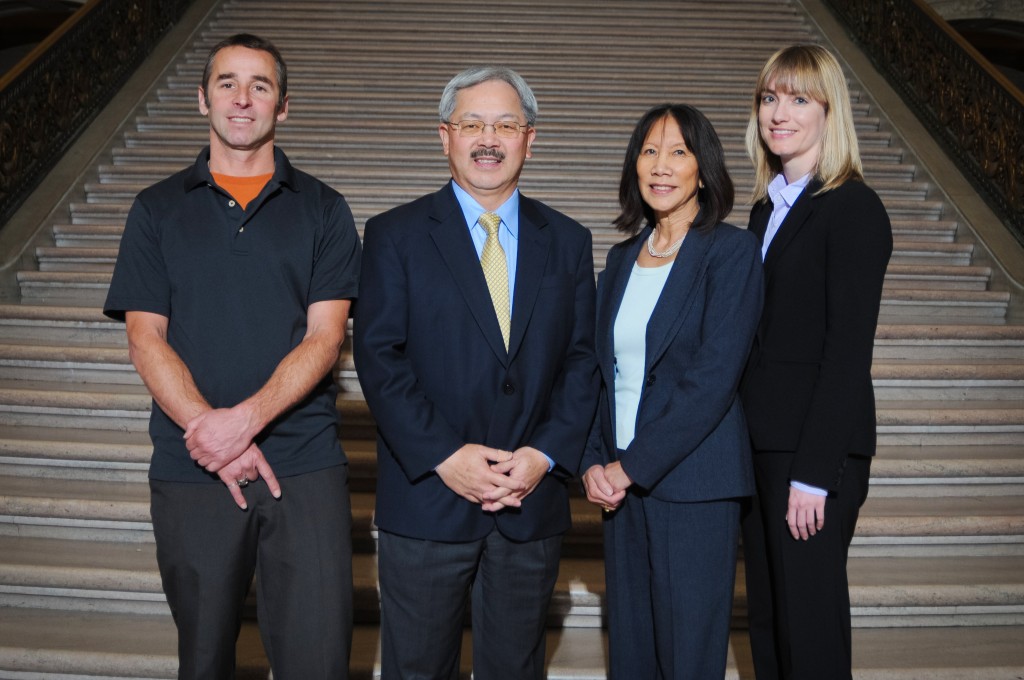
LEAP was selected for improving educational outcomes for youth in the juvenile justice system. The team —Juvenile Unit Attorney Manager Patricia Lee, Social Worker Marynella Woods, Education Attorney Lauren Brady Blalock and Youth Advocate Marc Babus — works directly with San Francisco youth, makes regular court appearances on behalf of young clients and trains parents and caregivers to advocate effectively for their children. Of the youth who have gone through the program, fewer than 13 percent reoffend six to 12 months after exiting. The 3-year old program, funded through a federal grant, continues to work toward the greater goal of reducing the disproportionate number of youth of color in the justice system overall.

San Francisco Public Defender Jeff Adachi said his office started LEAP after seeing juvenile clients drop out of school—dramatically diminishing their chances of success as adults.

The LEAP attorney works with the school district to provide services to struggling students such as special education classes, tutoring or counseling. LEAP provides ongoing support to the child to while helping parents understand their rights and to navigate the complex public school system.
“We are extremely gratified to have our groundbreaking LEAP team recognized,” said Adachi. “We know there is a link between education and crime. The LEAP program ensures that a young person who is in the juvenile justice system returns to school with the services needed to succeed and that students are not unfairly expelled or suspended without cause.”
Additional 2014 award winners include Douglass Legg of the Department of Public Works; Zoon Nguyen of the Office of the Assessor-Recorder; Lisa Wayne of the Recreation and Parks Department; and the Rim Fire Emergency Response Team, part of the SF Public Utilities Commission.
For more information or for tickets, go to spur.org/ggawards

Photo credit: Jennifer Paschal Bruce Forrester Photography for SPUR.
Photo ID: (L to R) Marc Babus, Ed Lee, Patricia Lee, Lauren Brady Blalock. Not shown: Marynella Woods.

Classrooms, Not Courtrooms: SF Resolution Takes Aim at School to Prison Pipeline

0

by Jeff Adachi

(San Francisco Examiner guest columnist)

Last year, my office handled 4,500 court appearances for kids accused of committing crimes in San Francisco. Most of our young clients landed in the juvenile-justice system after being funneled out of The City’s public schools — educational journeys long on punishment but short on help.

As public defenders, we try to disentangle them from their legal troubles, to pluck them from the school-to-prison pipeline even after they’ve gathered momentum. Ours is the only public defender’s office in California with a unit dedicated solely to educational advocacy. But the pipeline itself needs to be dismantled. Now, San Francisco is poised to take a big step toward keeping its youths in the classroom instead of the courtroom.

On Tuesday, the Board of Education will vote on a resolution to end the counterproductive practice of suspending the kids who most need educational help. Commissioner Matt Haney’s Safe and Supportive Schools resolution would end suspensions for “willful defiance,” an ambiguous offense that accounts for 40 percent of all suspensions and 80 percent of suspensions of black and Latino students. It would create a districtwide guide and reporting system for behavioral interventions, and create a strategy to fix the disproportionate number of students of color who are punished. If the resolution passes, the superintendent will have four months to implement the changes.

Kids who don’t finish high school are nearly four times more likely than graduates to be arrested, and more than eight times as likely to be in jail or prison. High school dropouts cost California more than $1 billion annually in juvenile crime costs.

The link between suspension and crime has been proven. A recent study by the Council of State Governments found that students who had been suspended or expelled were nearly three times more likely to have contact with the juvenile justice system in the following year than similar students who had not been pulled from the classroom.

The racial disparity in school punishment mirrors the racial disparity we see in juvenile court. Something is wrong when black and Latino youths, who make up only 35 percent of San Francisco Unified School District students, account for more than three-fourths of its suspensions.

Haney’s resolution would finally make implementing evidence-based, restorative practices a priority. It would provide guidance and clarity to teachers and administrators. And most importantly, it will keep kids in the classroom and not the courtroom.

Jeff Adachi is the San Francisco public defender.

http://www.sfexaminer.com/sanfrancisco/classrooms-not-courtrooms-sf-resolution-takes-aim-at-school-to-prison-pipeline/Content?oid=2712766

Man Acquitted of Chair Attack in Main Library

San Francisco, CA — A man accused of attacking an unsuspecting library patron with a chair has been acquitted of all charges after evidence pointed to a case of mistaken identity, San Francisco Public Defender Jeff Adachi announced today.

After deliberating three days, a jury on Thursday afternoon found San Francisco resident Clifton Moore, 26, not guilty of assault with a deadly weapon and battery with serious bodily injury, both felonies. The jury also acquitted Moore of two counts of misdemeanor assault and one count of misdemeanor battery, said his attorney, Deputy Public Defender Jacque Wilson.

If convicted, Moore faced up to nine years in state prison.

In the apparently unprovoked attack on Sept. 11, 2013, a 61-year-old homeless man was struck from behind with a chair while using a computer terminal at San Francisco Main Library. The victim, who did not see his attacker, suffered a 2-inch deep cut to his scalp.

Moore was detained by library security and ultimately arrested after being identified in a “cold show” by four people.

During the trial, however, Wilson revealed critical evidence that cast doubt on the identification. Minutes after the attack, the four witnesses gave police dramatically different written descriptions of the suspect. The first witness wrote that he saw the attack, but could not describe the attacker. The second witness described the assailant as a black man wearing brown pants while the third witness described him as a white man wearing shorts and a hoodie. The fourth witness said the attacker was a black man wearing shorts and a hoodie.

By the time they identified Moore in the cold show an hour later, the witnesses had discussed the suspect, “helping” each other with the details, a witness testified during Moore’s trial. In police interviews the day after the attack, all four witnesses had changed their initial descriptions of the suspect to that of a black man wearing green shorts.

During trial, eyewitness identification expert Dr. Geoffrey Loftus testified that when witnesses hear second-hand information following an incident, that post-event information easily becomes jumbled with their recollections. The more the post-event information is discussed and repeated, Loftus testified, the more believable it becomes to witnesses, even if it contradicts their initial impressions.

“You cannot always believe your eyes,” Wilson said. “Eyewitness testimony is notoriously unreliable and memory is easily shaped. Fortunately, the jurors looked at the facts and set Mr. Moore free.”

False identification by eyewitnesses is the most common element in all wrongful convictions later overturned by DNA evidence, according to the Innocence Project.
“Eyewitness identification may seem compelling, but research has shown it is inherently frail,” Adachi said. “It is imperative that witnesses are prevented from comparing notes as they did in Mr. Moore’s case. Such practices put innocent people behind bars and let the guilty go free.”

California Must Revise Its Unfair System For Bail

0

By Brendon Woods, Robin Lipetzky Jose Varela, and Jeff Adachi, guest commentary © 2014 Bay Area News Group

Imagine a society in which rich people can buy their freedom while the poor remain locked up for minor crimes, forfeiting their jobs, housing and even their children.

It’s not a dystopian future or a scene from “Les Misérables.” It’s the state of our costly and ineffective bail system. Now, lawmakers have a chance to fix it.
In the bail world, cash is king. Being able to pay up outweighs the threat the defendant poses to public safety, his or her ties to the community and the circumstances of the alleged crime.

SB 210 by Loni Hancock, D-Berkeley, which passed last week in the California Senate and is headed for the Assembly, would encourage the courts to consider these factors through an evidence-based risk assessment.

Those least likely to re-offend or skip their future court dates would be released from jail and put onto pretrial supervision, similar to probation.

The International Association of Chiefs of Police, the National Sheriff’s Association and the Conference of Chief Justices all support pretrial supervision and risk assessment as a safer alternative to strict money bail.

Today, 65-70 percent of county jail inmates statewide are awaiting trial. In the Bay Area, the number is even higher at about 85 percent.

In other words, they are doing the time without having been convicted of the crime, all the while creating a drain on the taxpayers.

In the Bay Area, it costs more than $100 a day to keep someone behind bars. By contrast, pretrial supervision can cost as little as $2.50.

The bail system has been with us from the beginning, brought over from England where it had been employed for centuries. Though our Eighth Amendment states that “excessive bail shall not be required,” the meaning of “excessive” has been stretched to its limits.

The problem is only getting worse. Bureau of Justice Statistics show that average bail amounts have increased by more than $30,000 between 1992 and 2006. San Francisco is no exception. On Jan. 1, the local court raised its bail schedule for most offenses by tens of thousands of dollars without explanation.

Bail for contempt of court, for example, doubled from $10,000 to $20,000. Annoying phone calls skyrocketed from $5,000 to $10,000.

Under current law, each local court may set its bail schedule as it sees fit without any public input or review.

It is no surprise that poor people are the casualties of this wealth-based bail system, which coerces them to plead guilty even if they are innocent.

A 2012 study by the Justice Policy Institute found in as high as a quarter to half of cases nationally, the detained individual pleads guilty just to get out of jail and back to their jobs and families.

Long pretrial detentions disproportionately affect communities of color. Numerous studies have shown that African-Americans are assigned higher bail amounts and are less likely to be released on their own recognizance.

SB 210 is not an untested idea. Three California counties have already implemented similar programs, using risk assessment tools to determine which defendants pose threats to public safety.

The evidence-based method has proved wildly effective. In Santa Clara, 88 percent of defendants released on pretrial supervision made their court dates and 98 percent did not re-offend.

Sacramento was able to reduce its pretrial jail population to 55 percent while 95 percent of those released made their court dates. In Santa Cruz, 92 percent of those released did not re-offend, and 89 percent attended all of their mandatory court appearances.

The entire state must follow the leads of these counties. We cannot afford to do otherwise.

Brendon Woods is the Alameda County public defender, Robin Lipetzky is Contra Costa County public defender, Jose Varela is Marin County public defender and Jeff Adachi is San Francisco public defender.

Kwixuan Maloof to be Honored by Black Lawyers Association

0

San Francisco, CA — Kwixuan Maloof, a managing attorney in the San Francisco Public Defender’s Office, will be honored for his role in protecting the constitutional rights of the Bay Area’s poorest residents, San Francisco Public Defender Jeff Adachi announced today.

The Santa Clara County Black Lawyers Association will present Maloof with its Gideon Award, an honor reserved for outstanding public defenders, on Friday, Feb. 7. The 6:30 p.m. event will be held in San Jose at the law offices of Ropers, Majeski Kohn & Bentley. It is free to the public, but registration is required at gideon.brownpapertickets.com.

The award is named for Gideon v. Wainwright, the landmark U.S. Supreme Court decision that guaranteed an attorney to each individual accused of a crime, regardless of income. Maloof is among three African American public defenders in the Bay Area who will receive the Gideon Award. Alameda County Public Defender Brendon Woods and Santa Clara County Alternate Public Defender Dave Epps will also be honored. David Coleman, retired Contra Costa County public defender, will receive the Lifetime Achievement Award.

This is the first year the Santa Clara County Black Lawyers Association is hosting the Gideon Celebration. Association President Aileen Casanave said she was inspired to honor public defenders by last year’s 50th anniversary of the Gideon decision and by the lack of acknowledgment of their critical role in the justice system.

“Kwixuan Maloof is a true unsung hero in his role as the guardian of due process and the protector of our constitutional rights,” Casanave said. “Day after day, year after year, our public defenders work diligently to defend a segment of our community that is often poor, less educated, and less capable of funding and actively participating in their own defense. Without the resources of the public defender, these individuals would not have the tools necessary to ensure due process.”

Maloof, who received his Juris Doctor from New College of California in 1998, has been with the San Francisco Public Defender’s Office since 2001, and has been a managing attorney since 2008. He is a past president of the Charles Houston Bar Association.

Maloof’s leadership has played a critical role in the success of the San Francisco Public Defender’s felony unit, Adachi said. In 2013, San Francisco public defenders won nearly 62 percent of felony trials.

“Kwixuan Maloof’s tenacity in the courtroom has freed numerous people from being unjustly convicted and his mentorship has turned scores of young public defenders into experienced fighters of everyday injustice,” Adachi said.

Maloof expressed his appreciation to the Santa Clara Black Lawyers Association for the award.

“It is a great honor to receive the Gideon Award alongside two attorneys I deeply respect, Alameda County Public Defender Brendon Woods and Santa Clara County Alternate Public Defender Dave Epps,” Maloof said.

The Santa Clara Black Lawyers Association is presenting Friday’s award ceremony with the Miller Law Group, Ropers Majeski Kohn & Bentley, and Greenberg Traurig. The event is co-sponsored by the Black Technology Attorneys Group, Black Women Lawyers of Northern California, California Black Lawyers Association, Charles Houston Bar Association and the Santa Clara County Bar Association.