Home Blog Page 48

Video: Deputy Public Defender Unjustly Arrested

0

San Francisco, CA — San Francisco Public Defender Jeff Adachi today released video showing a deputy public defender being unlawfully arrested outside a courtroom as she attempted to protect her client’s right to counsel.

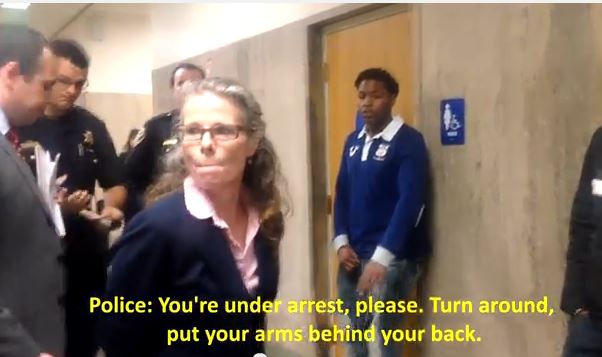
The cell phone footage, taken Tuesday afternoon inside the San Francisco’s Hall of Justice , shows San Francisco Police Inspector Brian Stansbury arresting Deputy Public Defender Jami Tillotson for refusing to let her client, a young African American man, be questioned without the presence of his attorney.

Stansbury, the subject of a 2013 federal civil rights lawsuit filed by a black SFPD officer alleging racial profiling, cites Tillotson for resisting arrest as a uniformed officer places her in handcuffs. Tillotson, an 18-year veteran of the San Francisco Public Defender’s office, remains calm and courteous throughout the video, telling Stansbury and five officers that she is representing her client and is not resisting arrest.

Officers took Tillotson to a holding cell in Southern Station, where she remained handcuffed to a wall for approximately an hour. After Tillotson was led away, Stansbury photographed and questioned her client and another young man who did not have an attorney present. Officers refused to tell the young men or Tillotson the reason for the detention.

“Public defenders have a duty to protect the constitutional rights of their clients,” Tillotson said at a noontime press conference Wednesday. “It was surreal to be led away in handcuffs for doing my job, something I do every day.”

Adachi called Tillotson’s arrest “outrageous” and “disappointing.”

“This is not Guantanamo Bay. People have an absolute right to have their attorneys present during questioning,” he said.

The Public Defender has requested a copy of the police report in the incident and has demanded both an explanation and an apology.

“A uniform does not give you a license to bully innocent people into submission,” Adachi said. “If this happens to a public defender in front of her client, I can only imagine what is happening on our streets.”

Video of the incident can be found at http://bit.ly/18vHKXS or watch it below.

###
At Inauguration, Adachi Pledges to Battle Bias

0

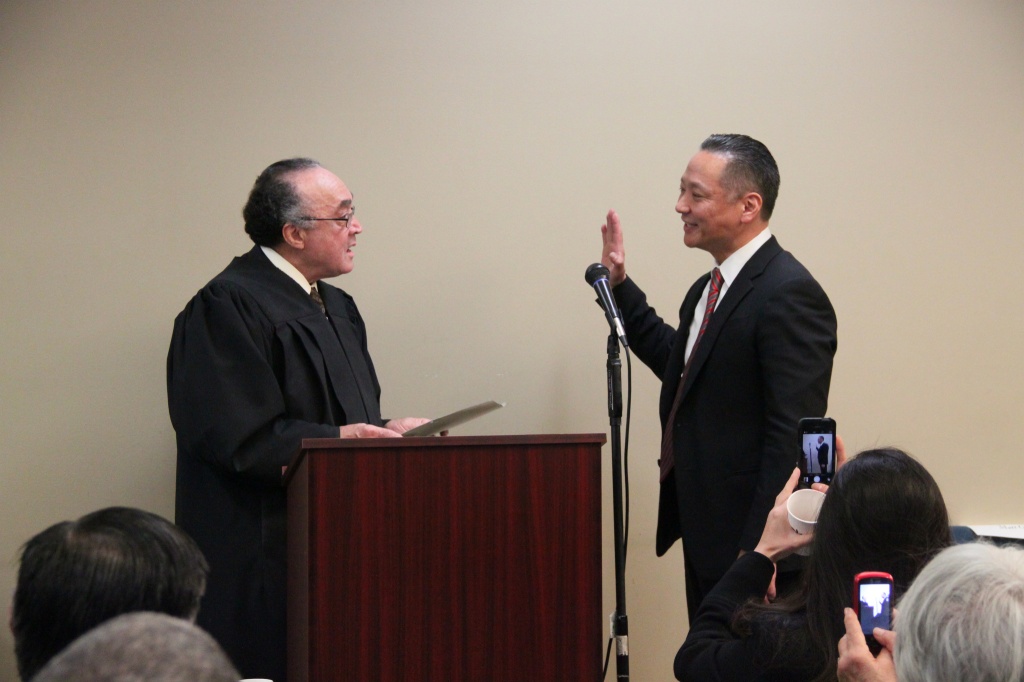
San Francisco, CA — Pledging to battle racial bias in the criminal justice system, Jeff Adachi was sworn in for a fourth term as San Francisco Public Defender today.

Superior Court Judge Don Mitchell administered the oath of office during the 8 a.m. inauguration ceremony. Adachi has served as San Francisco Public Defender since 2003. Since then, he has reduced caseloads in order to improve representation; hired paralegals, investigators and social workers; and led the way with innovative programs in prisoner reentry, criminal record clean-up and juvenile justice. As a result, the office has been recognized a national model in criminal and juvenile representation.

Still, Adachi told assembled elected officials, supporters and staff that there is much work left to be done. Reducing racial disparities in the criminal justice system has become a top priority, he said.

“Our system of justice is broken. We know this from what we see every day in the courts, jails and prisons,” he said.

Adachi cited statistics showing that black motorists are four times more likely than white motorists to be pulled over in San Francisco and seven times more likely to be arrested. Black men are routinely subject to higher bails and harsher sentences and African Americans are four times more likely to be arrested for drugs than whites, even though both groups use drugs at similar rates.

Much of the disparities are the result of implicit bias—unconscious prejudices carried by all human beings that affect their decision-making, Adachi said.

“It can affect a police officer’s decisions about who to stop and who is perceived as a threat, or how a prosecutor charges a case or offers a plea bargain, or a judge’s decision about bail or sentencing,” Adachi said. “These biases also affect how we, as public defenders, do our jobs. The good news is this is something we can begin to address.”

The Public Defender’s Racial Justice Committee, formed in 2013, will spend much of the next year assisting scientists and economists from the University of Pennsylvania’s Quattrone Center in a study to identify the root of bias in decision-making. Researchers will analyze local data related to race and traffic stops, bail, plea bargains and sentencing.

“As public defenders, we have to fight harder than ever before,” Adachi told his staff. “It is our job to ensure the power of the government is not abused, to enforce the Constitution, to expose police misconduct and to fight for racial justice.”

Public defenders must be on the front lines of addressing racial disparities in the system, he said.

“We cannot ignore the impact of racism on what we do, on juries, or in other decisions. It is a luxury we cannot afford. And there can be ‘No Justice, No Peace!’ until we can eradicate the racism that is killing and mistreating black and brown people in this country.”

Supervisor London Breed, who spoke at the inauguration, recalled meeting Adachi when she was growing up in public housing. Adachi represented her friend who was wrongfully accused of a crime and ensured the innocent girl did not go to jail.

“If you don’t have a dime in your pocket, public defenders from this office will work so hard to make sure you have a fair trial,” Breed said.


###


Public Defenders at Forefront of Reforms in 2014

0

San Francisco, CA — As the national mood shifted from “tough on crime” to “justice for all,” public defenders in 2014 led reforms in racial justice, education, immigration, and rehabilitation, San Francisco Public Defender Jeff Adachi announced today.

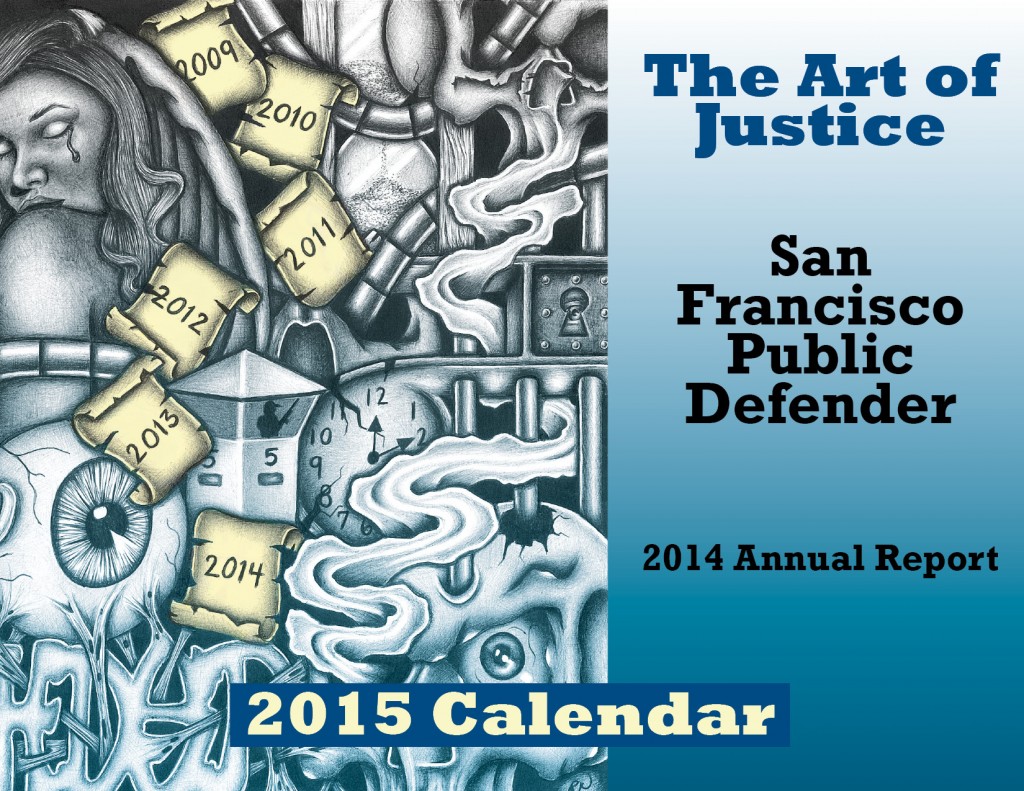
The year-end report of accomplishments and statistics was released this week in “The Art of Justice,” San Francisco Public Defender’s 2014 Annual Report and 2015 Calendar. The report is illustrated with the artwork of San Francisco Public Defender clients, employees and supporters.

“In 2014, our staff provided extraordinary legal representation for more than 20,000 people. We fought in the courtroom for reasonable bails, argued for treatment over incarceration, and fiercely guarded the right to due process,” Adachi said.

Public defenders also tackled injustice outside the courtroom, such as racial disparities in arrests and prosecutions, as well as unequal access to health, educational and housing resources.

As shootings of unarmed black men highlighted racial inequality nationwide, the San Francisco Public Defender’s Office in 2014 partnered with a national research and policy hub to identify racial disparities in San Francisco’s criminal justice center and advance solutions locally. Researchers from the University of Pennsylvania Law School’s Quattrone Center for Fair Administration of Justice will examine traffic stops, plea bargains, charging and sentencing throughout 2015.

In November, Californians rejected overcriminalization by passing a law to reduce nonviolent felonies to misdemeanors. San Francisco public defenders wasted no time implementing Proposition 47, helping 38 clients reduce their felony charges to misdemeanors, and helping 150 people terminate or reduce their probation. In addition, the Public Defender’s Clean Slate program assisted 5,202 law abiding citizens in cleaning up their old criminal convictions, giving them greater access to jobs, housing and college financial aid.

Other year-end accomplishments detailed in the report:

  • Securing acquittals in more than a third of the office’s 64 felony trials and 113 misdemeanor trials.
  • Hiring a full-time civil immigration attorney to help clients facing deportation.
  • Earning both national and local honors for keeping at-risk youth in school through its Legal Educational Advocacy Program. LEAP’s education attorney and youth advocate held 237 meetings with client families and made 525 school visits, resulting in no LEAP clients being expelled.
  • Linking hundreds of clients to treatment and services through the office’s social workers and collaborative courts.
  • Distributing more than 4,000 backpacks and school supplies to children and providing literacy and agency support through our community-based MAGIC programs.
  • Avoiding 772 “strike” convictions on behalf of clients facing felony charges.
  • Launching public affairs show “Justice Matters” to educate San Franciscans on their rights.

The annual report and calendar was not printed at public expense and is available, free, to the public at the San Francisco Public Defender’s office, 555 Seventh St. The document can be can be accessed here.


Op-Ed: Contra Costa DA’s Race-Blind Claim Doesn’t Bear Scrutiny

0

By Christopher C. Hite

Guest Commentary, Contra Costa Times

Contra Costa County District Attorney Mark A. Peterson’s rebuke of Public Defender Robin Lipetzky for bringing up racial disparities in the criminal justice system evokes a famous line from Hamlet. To paraphrase Shakespeare, “The (prosecutor) doth protest too much, methinks.”

Peterson’s angry, multi-page letter and press release in response to Bay Area public defenders holding “Black Lives Matter” rallies claims there is no racism in the criminal justice system, at least in Contra Costa County.

But his claim ignores overwhelming statistical evidence showing African-Americans and Latinos are more likely to be arrested, convicted and more harshly sentenced than their white counterparts.

Peterson’s missive reads like a frightening laundry list of preconceived notions that stand in the way of equal justice under the law.

He boldly asserts that all decisions by police officers, district attorney, and judges are race neutral. He offers that the reason behind more black people in prison is because they are committing more crimes against other black people.

But decades of studies show otherwise. Blacks and Latinos make up 58 percent of all prisoners yet only 25 percent of the American population. Despite similar drug usage rates across all races, people of color are more likely to be prosecuted and receive harsher sentences for a drug-related crimes.

In 2012, economists and law professors at Harvard, the University of Chicago and the University of Pennsylvania published a study that found black defendants receive longer prison sentences than their similarly situated white counterparts.

They also determined that African-Americans are far more likely to be arrested than white Americans, that “judges take race into account in their sentencing decisions” and that “the magnitude of this effect is substantial.” The statistics go on.

Peterson also seems to think that the high rate of black-on-black crime somehow is different from that of white-on-white crime rate. It is not.

Whites kill other whites at a rate of 84 percent. Furthermore, that there is a high black-on-black crime rate does nothing to diminish the fact that young black men are 21 times as likely as their white peers to be killed by police.

The demonstrations across the country, including those held by Bay Area public defenders, are a response to this stark disparity. Bringing up black-on-black crime is a distraction from the real work of improving our justice system.

The first step to eliminating racial disparities is recognizing the problem and being willing to address it.

In San Francisco, the district attorney is taking a proactive approach by partnering the Vera Institute to conduct an internal evaluation of how race affects charging decisions.

The San Francisco Public Defender is engaged in a similar study with the Quattrone Center at the University of Pennsylvania Law School to examining everything from traffic stops to plea agreements.

If Peterson truly cares about eliminating racism, he should do the same.

An independent, objective, and comprehensive study would go a long way in determining whether or not there is room for improvement.

Christopher C. Hite is a deputy public defender in San Francisco and co-chair of the San Francisco Public Defender’s Racial Justice Committee.

SF Public Defenders Hold ‘Hands Up’ Protest

0

San Francisco, CA—More than 200 public defenders and allies held a “hands up, don’t shoot” protest today on the steps of San Francisco’s criminal courthouse to show support for racial justice and stand in solidarity with protesters in New York, Ferguson and around the country.

While San Francisco public defenders rallied outside 850 Bryant St., public defenders in Alameda, Contra Costa, Santa Clara and Solano counties staged similar actions today at their county courthouses.

Speakers included Cephus Johnson, uncle of Oscar Grant and founder of the Oscar Grant Foundation; Chris Hite, co-chair of the San Francisco Public Defender’s Racial Justice Committee, which organized the rally; and Yolanda Jackson, executive director of the Bar Association of San Francisco and the executive director of the Justice & Diversity Center.

“There are few organizations in the United States that have closer ties to the black and brown members of our society than the public defender offices through the nation,” said Deputy Public Defender Chris Hite, co-chair of the Racial Justice Committee. “We felt it was essential to cast a light upon the racial injustices of the black and brown in our communities and to celebrate the notion that black and brown lives matter.”

The San Francisco Public Defender’s Racial Justice Committee formed in 2013 to address racial disparities in the criminal justice system and to advocate for reform in police detentions and arrests, prosecutorial charging and sentencing. The committee has partnered with the University of Pennsylvania Law School’s Quattrone Center to study the impact of race on the criminal justice system in San Francisco.

San Francisco Public Defender Jeff Adachi called for accountability on behalf of victims of racial profiling and police brutality.

“As public defenders, it our responsibility to ensure that there is justice for all in the courts,” Adachi said.  “We are here to say that our criminal justice system has no credibility when it fails to hold police officers accountable for the killing of black and brown people.”

Jackson said lawyers will be key to bringing about change.

“San Francisco attorneys are known for being brilliant legal minds.  We are lawyers with a heart in this city and we are often national leaders on very tough issues.  This time should be no different,” she said. “Lawyers work within the justice system every day, we understand the justice system and in fact in many ways we help to design the justice system through our work.”

The San Francisco Public Defender’s Racial Justice Committee is currently working on a plan for police department reform in light of the recent spate of unarmed black men around the country.

Man Acquitted of Torching Mercedes

San Francisco, CA — A 48-year-old man was acquitted of breaking into a luxury apartment garage and torching a Mercedes after a jury determined his arrest was based on an unreliable identification, San Francisco Public Defender Jeff Adachi announced today.

Jurors on Friday afternoon found San Francisco resident Anthony Bejarano not guilty of burglary and arson, both felonies. Bejarano, a regular volunteer at Project Open Hand with no previous criminal record, faced up to 10 years in state prison if convicted, said his attorney, Deputy Public Defender Chris Hite.

On June 19, a Mercedes sedan was found ablaze in the parking garage of One Rincon Hill apartments. While nobody witnessed the crime, a valet told the property manager he saw a man standing in front of the car shortly before the fire and then running from the building.

Bejarano was in the building that day to serve legal papers to a One Rincon Hill resident. Surveillance footage captured him walking on the valet level of the garage, a floor above where the Mercedes was parked. There was no footage of Bejarano on the same floor as the blaze, and he did not have any connection to the car’s owner.

The building manager and police confronted the valet with a single screenshot of Bejarano and asked him if it appeared to be the same man he saw near the car. The valet said yes, and police publicly released the image, leading to Bejarano’s arrest six days after the fire. Police subsequently searched his home, sending his clothing to a crime lab to be tested for accelerant. None was found and there was no other forensic evidence linking Bejarano to the crime.

During the two week trial, Hite exposed weaknesses in the valet’s identification of Bejarano.

Dr. Mitchel Eisen, director of forensic psychology at California State University Los Angeles, testified that the identification was made in a highly suggestive manner—based on a single photo instead of a lineup and at the behest of the valet’s boss while he was surrounded by police officers.

“The jury had strong concerns about the reliability of the identification,” Hite said. “There was simply nothing else linking Mr. Bejarano to the crime—no motive, no DNA, no fingerprints. It didn’t make sense.”

Bejarano was originally charged with a second fire in the area, but those charges were dismissed by a judge due to lack of evidence. The case highlights the problems with eyewitness identification, Adachi said.

“Eyewitness misidentification is the most common element in wrongful convictions that are later overturned by DNA evidence,” Adachi said. “Fortunately, Mr. Bejarano’s public defender was able to spotlight the many holes in the case.”

###

SF Public Defender’s Statement On Grand Jury Decision in Chokehold Death

0

San Francisco, CA — San Francisco Public Defender Jeff Adachi released the following statement today on the grand jury’s decision against indicting NYPD Officer Daniel Pantaleo in the chokehold death of Eric Garner.

“As San Francisco Public Defender, I am profoundly dismayed by a Staten Island grand jury’s refusal to bring charges against Officer Daniel Pantaleo in the chokehold death of Eric Garner.

The facts in this case were not murky due to unreliable witnesses or subjective memories. The struggle that ended in Garner’s death was caught entirely on video. Officer Pantaleo, the subject of two previous civil suits, used a hold on Garner that was explicitly prohibited by NYPD’s own patrol guide. Garner, who had asthma, could be heard repeatedly telling officers he couldn’t breathe. The New York City Medical Examiner ruled Garner’s death a homicide.

A grand jury refusing to indict in such an evidence-heavy case would defy belief–if it didn’t happen so often. It is less than two weeks since a grand jury in Ferguson, Missouri failed to bring charges against another white officer who shot another black man. Garner was one of four unarmed black men killed by police in the U.S. over a single month this past summer.

It is rare for grand juries to return indictments against police officers, at least in part because local prosecutors rely upon local police to bring their cases. Perhaps it is time to bring in district attorneys from outside jurisdictions when a police officer is accused of a crime.

Eric Garner’s death is not an isolated tragedy. Neither is Michael Brown’s. But together they have significantly eroded faith in the justice system.”

SF Public Defender’s Statement on Grand Jury Decision

0

San Francisco, CA — After reviewing the transcripts and evidence released Tuesday, San Francisco Public Defender Jeff Adachi released the following statement today on the grand jury’s decision against indicting police officer Darren Wilson in the shooting death of Michael Brown.

“As San Francisco Public Defender, I am deeply disappointed with the grand jury’s failure to indict Darren Wilson for the fatal shooting of unarmed teenager Michael Brown. A series of questionable, and in my opinion, biased legal and ethical decisions in the investigation and prosecution of the case presented to the grand jury led to this unjust result, most notably allowing a local prosecutor with strong family connections to police supervise the investigation and presentation of the evidence. This ethical failure resulted in the exceedingly rare step of the prosecuting attorney refusing to recommend an indictment against the police officer he was prosecuting.   The police investigation and inquiry itself were rife with problems:

  • Because it was a grand jury inquiry and not a trial, Wilson took the stand in secrecy and without benefit of a cross-examination. Prosecutors not only failed to probe his incredible testimony but frequently appeared to be bolstering his claim of self-defense. Transcripts reveal that witnesses whose accounts contradicted Wilson’s were rigorously questioned by prosecutors.
  • Dorian Johnson, the key witness who was standing next to Brown during the encounter, provided strong testimony that called into question Wilson’s claim that he was defending his life against a deranged aggressor. Johnson testified that Wilson, enraged that the young men did not obey his order to get on the sidewalk, threw his patrol car into reverse. While Wilson claimed Brown prevented him from opening his door, Johnson testified that the officer smacked them with the door after nearly hitting the pair. Johnson described the ensuing struggle as Wilson attempting to pull Brown through the car window by his neck and shirt, and Brown pulling away. Johnson never saw Brown reach for Wilson’s gun or punch the officer. Johnson testified that he watched a wounded Brown partially raise his hands and say, “I don’t have a gun” before being fatally shot.
  • Wilson’s description of Brown as a “demon” with superhuman strength and unremitting rage, and his description of the neighborhood as “hostile,” illustrate implicit racial bias that taints use-of-force decisions. These biases surely contribute to the fact that African Americans are 21 times more likely to be shot by police than whites in the U.S., but the statement’s racial implications remained unexamined.
  • Prosecutors never asked Wilson why he did not attempt to drive away while Brown was allegedly reaching through his vehicle window or to reconcile the contradiction between his claim that Brown punched the left side of his face and the documented injuries which appear on his right side.Wilson, who is 6 feet 4 inches tall and 210 pounds, is never asked to explain why he “felt like a five-year-old holding on to Hulk Hogan” during his struggle with Brown, who is Wilson’s height and 290 pounds.
  • The police investigation itself revealed strong biases toward the police officer and against Michael Brown, leading to an ongoing federal investigation into the police department’s history of discriminatory policing practices, use of excessive force and violations of detainees’ constitutional rights.

It is important that communities throughout this country re-evaluate and reform our processes by which justice is determined. We must work to ferret out biases that threaten the very foundation of society and taint decisions rendered by our justice system.

It is also critical that we acknowledge the impact of implicit bias in decisions regarding stopping, investigating, arresting and prosecuting citizens, and in gauging whether deadly force is necessary. We must also demand that law enforcement agencies begin using available technology, such as police body cameras, to improve transparency and accountability to the public they are sworn to serve. And we must pledge to honor the request of Michael Brown’s family to work together to ensure that this tragedy is not repeated as it has been in the past.”


Thousands in SF to Benefit Under Prop 47

0

San Francisco, CA — Hundreds of people on probation in San Francisco and thousands living with convictions could have their felonies reduced to misdemeanors under Proposition 47—and free help is available, San Francisco Public Defender Jeff Adachi announced today.

The San Francisco Public Defender’s office has set up a Prop 47 information line at 415-553-9344 to assist former clients seeking relief under the new law or those who have questions about their eligibility. Also known as the Safe Neighborhoods and Schools Act of 2014, Prop 47 reduces most nonviolent felonies to misdemeanors.

More than 30 San Francisco Public Defender clients have already had their nonviolent felonies reduced to misdemeanors under the law, which was passed by California voters Nov. 4. The Public Defender has identified an additional 370 people on probation and approximately 2,000 people who have already served their sentences who are eligible for a reduction.

San Francisco public defenders are helping four to six people currently serving state prison sentences for non-violent felonies who may be released under Prop 47.

“Felony convictions are serious obstacles when it comes to obtaining jobs, housing, even financial aid for college, so it is imperative that eligible individuals have them reduced as soon as possible,” Adachi said. “I look forward to working with the San Francisco District Attorney and the court system to ensure that relief is provided promptly.”

Common felonies that qualify under Prop 47 include theft offenses of less than $950 and drug possession. Convicted sex offenders and those with a criminal record of violent crimes such as kidnapping, assault to commit a sex crime, murder, attempted murder, solicitation of murder and possession of a weapon of mass destruction are not eligible for relief under the new law.

Video Clears Woman of Attacking Foe

San Francisco, CA — A 49-year-old woman accused of beating a rival in a barroom brawl was acquitted of all charges after a jury viewed video evidence that showed she acted in self-defense, San Francisco Public Defender Jeff Adachi announced today.

Jurors deliberated four hours before finding San Francisco resident Joy Jeffries not guilty of one count of battery and one count of violating a restraining order. If convicted of the misdemeanors, Jeffries faced a year in jail, said her attorney, Deputy Public Defender Andrea Lindsay.

Jeffries was arrested June 18 in the Bayview neighborhood, after patrol officers spotted her in a physical altercation with another woman on the sidewalk behind The Jazz Room bar. There was a history of bad blood between Jeffries and the 39-year-old complaining witness stemming from the woman’s child bullying Jeffries’ daughter. After school officials failed to stop the bullying, Jeffries confronted the mother verbally. The woman then filed a restraining order against Jeffries.

After police separated the pair, the woman told officers Jeffries followed her outside, then swung a set of car keys at her face, striking her in the cheek. Police noted the woman had no visible injuries, and she refused medical attention. Jeffries, whose face was bloodied, did not have a chance to tell police her side of the story. After learning about the restraining order against Jeffries and hearing her slur her words, police concluded she was intoxicated and had likely been the aggressor in the attack. In fact, Jeffries was born with a hearing impairment that affects her speech, and had only a single drink prior to the beating, Lindsay said.

During the trial, surveillance video contradicted the complaining witness’ story. In the footage, the woman can be seen blocking Jeffries’ exit from the bar while screaming at her. As Jeffries tries to exit, the woman punches her twice. The pair falls to the ground, where they grapple in front of a growing crowd.

Both women took the stand during the trial. Jurors found Jeffries’ testimony to be honest and straightforward, while the complaining witness appeared evasive with her answers, Lindsay said.

Jurors also viewed police photographs of the women at the scene. Jeffries is visibly injured, while the complaining witness is smiling broadly with nary a scratch.

Jeffries, a current college student and a former caregiver for hospice patients and disabled children, wept with relief when the verdict was read.

“The jury saw what the prosecution refused to see: that Ms. Jeffries was the victim here. She was the victim of a bad police investigation and of an unprovoked attack outside the bar,” Lindsay said.

Adachi said the case illustrates the need to look beyond the surface of disputes.

“Ms. Jeffries did not walk into The Jazz Room looking for a fight. In fact, she tried to avoid the conflict. However, when a person is attacked, they have the right to use reasonable force to defend themselves,” he said. “Fortunately, Ms. Jeffries’ public defender was able uncover the truth through video evidence.”