SF Weekly
Judge Philip J. Moscone is losing his temper. “I’m not a jury, and I’m not an artichoke,” he snaps at the squabbling prosecutor and defense attorney in his courtroom.
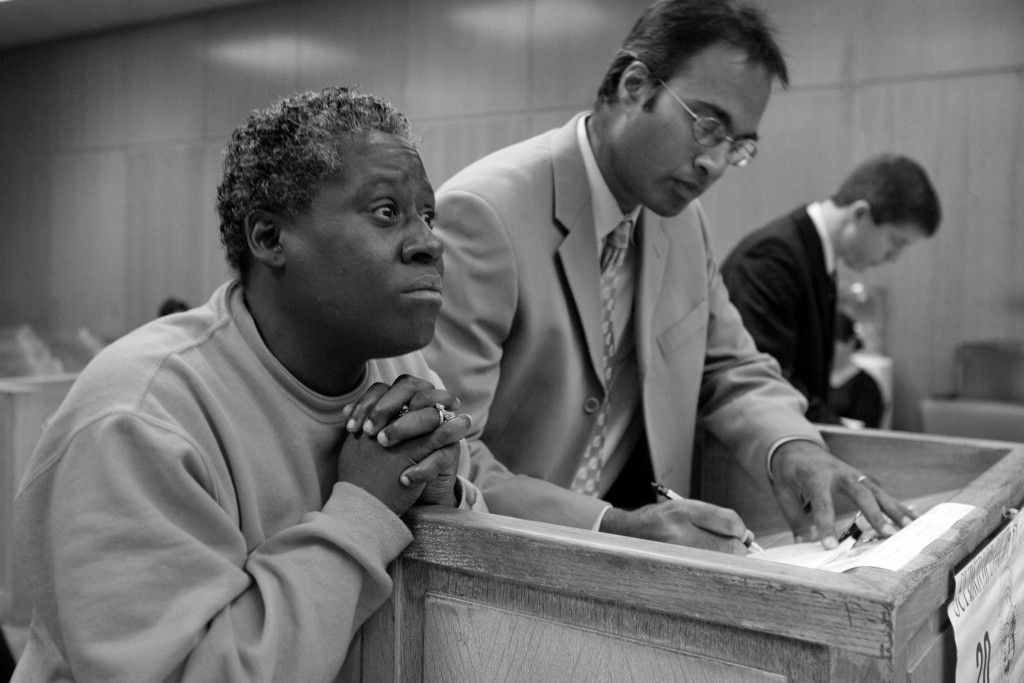
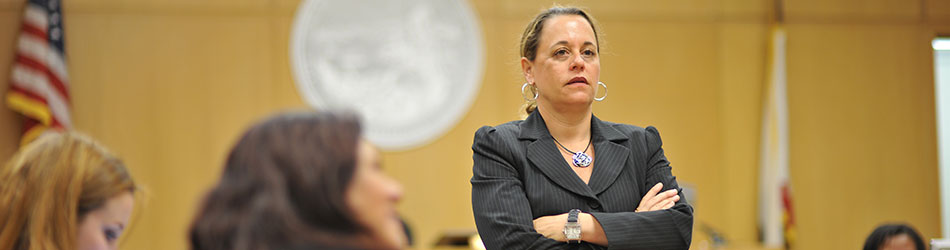
It’s the second day of questioning in the preliminary hearing of Lisa Heng, a 31-year-old Cambodian-American woman who is being charged with first degree murder for the death of Matt Sheahan. The hearing, to determine whether the state has probable cause to take the case to trial, was supposed to last just one day. But Heng’s case landed on the desk of Jeff Adachi, the elected public defender for San Francisco, and Adachi — dressed in a well-tailored suit and yellow Armani tie, his signature suspenders peeking out from his suit coat — is nothing if not thorough in his cross-examination. He stands at a lectern as he questions his witnesses, slightly hunched over a three-ring binder, marking off his questions as he asks them with a light flourish of his pen. Where the prosecutor, Tiffaney Gipson, introduces 8½-by-11-inch photographs as exhibits, Adachi produces giant poster-board sized enlargements of his pictures. During recesses, Adachi sits with the defendant’s family members and answers their questions, but he also makes a point of introducing himself and offering his condolences to the victim’s mother.
On the opening day of the hearing, Adachi had set the tone by dismantling the testimony of the prosecution’s first witness, a young police officer. Celina Chow, who was still in training when she responded to a call at a Tenderloin SRO in the early morning hours of July 18, 2014, answered Adachi’s question about whether Heng was “sobbing hysterically” that morning with an emphatic “no.” Adachi then read aloud from Chow’s police report, in which she had written that Heng was “sobbing hysterically.”
“Which is more accurate? Your testimony now that she wasn’t sobbing hysterically, or your police report?” Adachi demanded. “Do you understand the difference it makes when you use an adjective?”
It was the kind of gotcha moment designed for courtroom dramas, and Adachi pulled it off with style. But there’s a certain hollowness to the exercise of showing up the rookie cop. The orange sweatsuit-clad defendant sitting next to Adachi won’t be acquitted over Chow’s iffy memory of a stray adjective.
Another contentious moment came when Adachi goaded the medical examiner over her lack of experience with stab wounds that have not resulted in death, forcing the doctor to defend her life’s work: “I do autopsies for a living. They don’t come to me unless they’re deceased.” She looked a little silly, but then, Judge Moscone is no artichoke.
The first day of cross-examination had been just a preview of the “fireworks” Adachi promised me were in store for Day Two, when Sgt. Alan Levy, the officer who interrogated Heng following the stabbing, is called to the stand. Levy is a handsome young homicide detective who wears a perpetual smirk. When Adachi struggles to play a video on the giant AV system, Levy leaves the witness stand to try to fix the television himself. He’s that kind of guy.
Adachi questions Levy twice, first in a voir dire challenging whether Heng’s statement to the police is permissible, and then again in cross-examination. The defender presses the sergeant on his interrogation tactics, forcing the police officer to acknowledge that he asked Heng 65 questions before advising her of her Miranda rights. Adachi tries to get Levy to discuss what kinds of interrogation techniques he might have used or been trained on (a line of questioning the judge mostly forecloses), focusing on whether Levy used the “Reid Technique,” a controversial interrogation method that has been linked to false confessions.
Later, Adachi homes in on Levy’s decision not to treat Heng as a victim of domestic violence, even though she claimed to have been punched twice by Sheahan that night. Adachi’s questions have a clear message — that Heng was the victim and not the abuser in the relationship, Sheahan’s death notwithstanding — and they prompt the judge to again chastise the defender’s dramatics. “I assume you’re not looking for a second profession working for the media,” Moscone grumbles.
Adachi is unfazed. This is how he operates, not just as Heng’s public defender but as San Francisco’s Public Defender. He defends his clients vigorously, but he does not simply try individual cases: Jeff Adachi is waging a much larger campaign against what he refers to as the “injustice system.”
“The structural critique that I have of the system is that it’s not fair,” Adachi says later in his office. “You’re not going to be treated fairly, particularly if you’re poor and a person of color.”
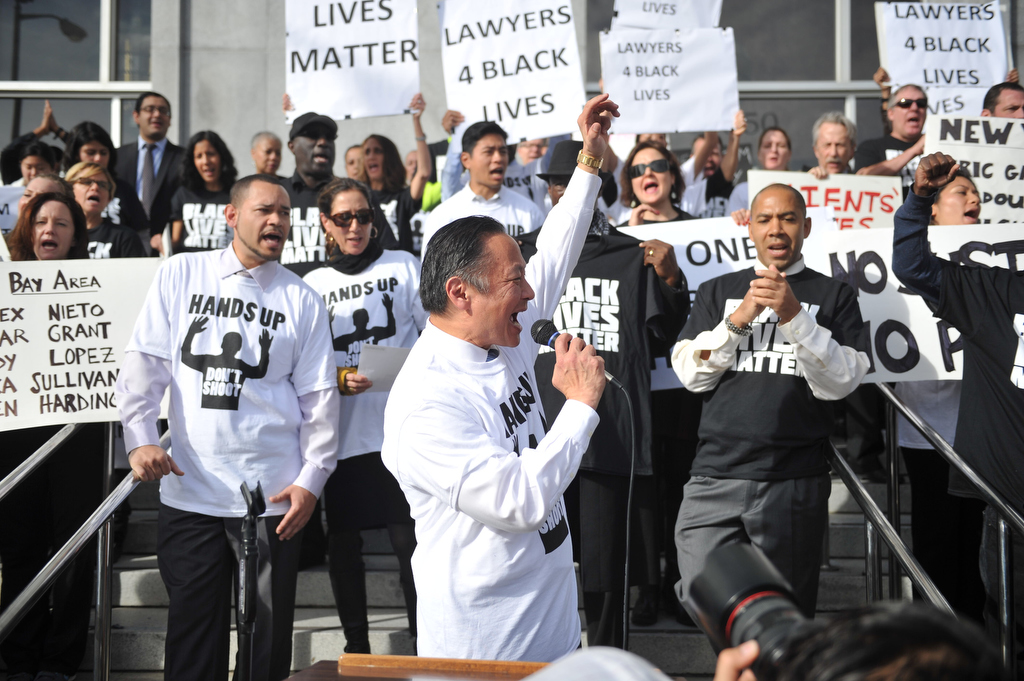
As the only elected public defender in California, Adachi uses his office to seek to redress injustice systemically. Last December, Adachi resigned from his longtime position on the board of directors of the California Public Defenders Association and founded a new group, Public Defenders for Social Change. Inspired by the Black Lives Matter movement and the ongoing national conversation about racism in law enforcement and the courts, Adachi decided it was time for public defenders to step forward, testify to the systemic racism and bias they witness on a daily basis, and lead a movement for change.
It’s an auspicious moment for Adachi to press his charges in San Francisco. The problem of racial disparities in policing and prosecutions is on the minds of local and national media and political leaders and is shaping up to be a key issue in the 2016 presidential campaign. Meanwhile, San Francisco’s law enforcement agencies are reeling from a series of scandals, including problems at the San Francisco Police Department DNA testing lab, allegations of inmates in the county jail being forced by sheriff’s deputies to fight, and the release of racist, sexist, and homophobic text messages exchanged between active SFPD officers.
Both the text message and jail fight scandals were catalyzed by press conferences called by Adachi, one directly and one indirectly. His willingness to take issues public has led some of his critics, like former San Francisco Police Officers Association President Gary Delagnes, to call him a “media whore.” But Adachi doesn’t seem to mind.
“It’s like Bobby Seale said, ‘Seize the time,'” Adachi says, quoting the co-founder of the Black Panther Party. “This is the time when race and criminal justice reform are at the forefront, and I intend to work with others to make that happen. I want to empower line public defenders to be able to not only be zealous advocates in the courtroom, but be zealous and effective advocates on the street.”
On the evening of June 3, 1973, Yip Yee Tak left a bakery in San Francisco Chinatown, stepped into the street, and was shot in the head. The murder of the Chinatown gang leader was quickly pinned on Chol Soo Lee, a 21-year-old Korean immigrant who was tried, convicted, and sentenced to life in prison. Lee was innocent, however, and the campaign to free him served as a turning point in the life of Jeff Adachi.
Adachi had grown up the son of an auto mechanic dad and lab technician mom in Sacramento, working what he calls “the grossest jobs” in the world. He plucked 40 to 50 ducks an hour for hunters (he still doesn’t have fingerprints on some of his fingers as a result) and cleaned coagulated blood out of test tubes. He wasn’t a good student, and his guidance counselor urged him to follow in his dad’s footsteps and become a mechanic.
Adachi’s parents were raised in poverty, and he calls his upbringing “lower middle class.” His maternal great-grandparents had eloped from Japan to Hawaii in the late 1800s. They moved to San Francisco the following decade, then after the 1906 earthquake to French Camp, where they became onion farmers. His father’s family lived in Walnut Grove, a segregated community where whites lived on one side of the river and Japanese and Chinese people on the other.
Adachi was in third grade when he learned that his parents and grandparents had been interned during World War II. He recalls getting into a fight with another kid at school who taunted him: “He said, ‘Your parents were in the camp or in jail,’ and I said, ‘No they weren’t,’ and we got in a fight.” Adachi was suspended from school. His mother later explained that they had committed no crime, but were interned because they were Japanese-Americans. It was an early lesson in injustice that Adachi says has influenced him throughout his life.
The prospect of a life working as a mechanic motivated Adachi to get serious about his studies, and he attended community college in Sacramento before transferring to the University of California at Berkeley in 1978. At first, Adachi says, he “just wanted to make money,” and he planned to attend business school at Cal.
The Berkeley campus Adachi arrived on was a far cry from the school’s activist heyday of the late 1960s, but he and a group of four friends from Sacramento found their way to radical politics after learning about the case of Chol Soo Lee. Reporting on the case revealed that Lee’s conviction was due to faulty eyewitness testimony and police and prosecutorial misconduct. Lee later killed a man in prison (in self-defense, he claimed) and was sent to death row.
The case galvanized the Asian-American community, and Adachi and his friends got involved. They had much to learn about effective activism. (One of the first rallies they organized took place outside the federal court, though Lee had been convicted in state court.) Adachi and his friends also began studying the works of radical thinkers including Malcolm X, Dick Gregory, as well as Huey Newton, Seale, and other Black Panthers. Adachi switched his major to Asian American Studies.
“I think what drew me to this fight for justice … a lot of it was identity,” Adachi says. “You’re trying to figure out who you are and how you fit in. Learning about your history was big — learning Asian American history. By that time I knew about the [internment] camps and all that, but I didn’t really know about black history, Latino history, Native American culture and history. When you start learning about that, a few things happen. You broaden your understanding, and then you get pissed.”
The Chol Soo Lee Defense Committee and a new team of lawyers fought for years to secure a new trial, and Lee was ultimately acquitted and freed from prison. Another of Adachi’s contributions to the fight was playing bass with a band that released a single in 1978 to raise money for the defense team. “The Ballad of Chol Soo Lee” tells the tale of much of Adachi’s life work in the courts:
The courts convicted Chol Soo on a hot Sacramento day
By a frosty white judge and a stone-cold D.A.
He’s been in jail since ’73 a soul on ice
Can you call it blind justice? You better start thinking twice.
Chol Soo Lee died this past December at 62. Adachi delivered his eulogy.
“You’re a potted plant. You’re a public defender. Your job is to go into the holding cell and get that man to plead guilty.”
Those are the words Jeff Adachi recalls being told by a judge in one of the first felony cases he tried as a young attorney in the Public Defender’s Office. When Adachi went ahead with the trial anyway — his client was facing a 16-year sentence for auto burglary and didn’t want to plead guilty — the judge called the attorney up to the bench and warned him, “I’m going to enjoy sentencing your client to every year of the 16 years.”
Adachi is inured to the “potted plant” expectations many judges, prosecutors, defendants, and the general public have of public defenders. He’s a keen observer of the media — he even directed a film, The Slanted Screen, about how Asian-American men are portrayed in popular culture. “Public defenders are routinely lampooned on television, rap music, popular culture, and movies, and so one of the challenges in being a public defender is disproving that and proving yourself,” he says.
Adachi relishes a challenge. In that early felony case, he didn’t bother trying to persuade his client to plead guilty. He sat in the holding cell with the defendant and prepared for trial. “It actually worked for me,” Adachi says, “because I was so incensed that I worked the heck out of that case and we got an acquittal.”
Defying the assembly-line nature of the courts system is both Adachi’s mission and signature. “How do you try a case where your client was identified by four eyewitnesses, they have a video tape confession showing your client demonstrating how something was done, and [they have] physical evidence? Most lawyers couldn’t even imagine getting up in front of a jury and trying those cases, and we try those cases all the time,” he says.
Indeed, Adachi’s penchant for taking cases to court became a key issue in his first campaign for public defender in 2002. In the weeks leading up to the election, Adachi found himself having to defend himself to the San Francisco Chronicle as not “some kind of Russian roulette trial lawyer” while his opponent, Kimiko Burton, boasted that under her leadership, the office was “much more circumspect about the cases going to trial.”
Adachi had started working for the public defender in 1986 as a misdemeanor attorney, struggling to provide effective representation to the 280 clients he’d be assigned at a time. He tried 28 jury trials in his first 18 months and, eventually, learned how to win. He moved up to felonies after a few years, and was tapped by Jeff Brown, then the head of the office, for the role of chief attorney (a position responsible for the management of the office’s attorneys) in 1998. It was generally assumed that he would succeed Brown in the top job.
But when Brown left office in 2001 — before the end of his term — to take a seat on the California Public Utilities Commission, then-Mayor Willie Brown appointed Kimiko Burton, the daughter of California Democratic Party powerhouse John Burton (he was president of the state Senate at the time), to fill the job until the election. Burton fired Adachi on her first day. (Brown, explaining his seemingly nepotistic choice to the Los Angeles Times in 2002, invoked, well, nepotism: “I don’t know Jeff Adachi from Adam. I have known Kimiko Burton since her birth. Why, in the name of heaven, if I have an opportunity to name someone, would I name someone I don’t know?”)
Adachi entered private practice and began his campaign against the so-called “Willie Brown-John Burton machine.” John Burton kicked his political operation into high gear for his daughter’s campaign, bringing in money and endorsements from Sacramento and Washington D.C. In just one example of the heavy-handed nature of the Burton machine, the late Ted Gullicksen of the San Francisco Tenants Union told the San Francisco Bay Guardian that he had been warned an endorsement for Adachi would mean less support for tenant’s rights from John Burton in Sacramento. But despite Kimiko Burton raising four times as much campaign money as Adachi, the challenger won by a significant margin.
When Adachi took leadership of the Public Defender’s Office, the budget was just $13 million a year, and the entire staff of attorneys shared one paralegal. Under his leadership the budget has more than doubled — to almost $30 million a year — and Adachi boasts that he offers San Francisco’s poor “the best representation money can’t buy.” In addition to a staff of paralegals, the office also now employs investigators and social workers. The social workers ensure clients get enrolled in drug treatment programs and don’t violate their probation.
A special team focuses exclusively on helping people clear past convictions from their records, a process allowed for by state law that was nevertheless rarely taken advantage of until Adachi started the Clean Slate Program in 1998. The office is able to expunge records for about 2,000 people a year, making it easier for them to find employment and housing.
It’s all part of what Adachi calls “holistic representation.” As an office charged with a constitutional mandate to represent the poor in what Adachi calls “a society that’s addicted to charging people with crimes and incarcerating them,” he has a vested interest in the “social outcome” of his clients. “The worst thing in the world if you’re a public defender,” he says, ” is to see your client back in jail again.”
Adachi’s expansive view of what it means to be the elected public defender has touched off two major shakeups in San Francisco politics. The first was a somewhat hubristic campaign for pension reform that began in 2010. Following a study by San Francisco’s civil grand jury on the steep costs of the city’s public employee pension fund, Adachi threw himself into a campaign for pension reform, touching off a two-year battle between himself and the city’s labor unions. At the time, the city’s budget and employees were struggling under the effects of the Great Recession. Adachi wanted public employees to contribute more to their pension and health insurance costs, both to free up money for other city services and to ensure the long-term health of the underfunded benefits programs.
“We had police officers who were retiring with a $250,000 a year pension, at the same time they were closing summer school for kids because they didn’t have enough money in supplemental funds in the city budget to help,” Adachi says. “I just saw a glaring contradiction in terms of what we were trying to do as public servants and the need to feed the pension and healthcare costs.”
The unions saw the crusade as an all-out assault on workers who were already struggling with layoffs and contract givebacks thanks to the poor economy. Adachi was compared to Scott Walker, Wisconsin’s union-busting governor, and worse. (Crossing a picket line at a nonunion hotel to fundraise for the campaign made matters even worse.) Gary Delagnes of the Police Officers Association called him a “fat-cat front man,” writing: “Jeff Adachi is a hypocrite. He has a mansion in St. Francis Woods, owns a luxury Mercedes, salary of $196,000, funded buy [sic] a billionaire venture capitalist. Oh, and by the way, has never paid a dime into his own pension!” Five years later, many union members and staff still react with revulsion and anger to his name.
Adachi’s work on pension reform was necessarily distinct from his job as public defender, and it alienated some of his own employees, who spoke publicly and in private against the campaign. He campaigned on his own time to place a reform measure, Proposition B, on the ballot in 2010 (it lost) and again in 2011. He jumped into the mayoral campaign in August 2011 at the last minute, in an attempt to keep the spotlight on the pension issue, leading some critics to speculate that the entire pension issue was a stalking horse to raise his political profile for the run. (“The pieces now fall into place,” then-Supervisor Sean Elsbernd said at the time to SF Weekly. “In the end, what Jeff is really all about is Jeff.”)
Adachi’s 2011 pension Proposition D did not pass, nor did he win the mayoral race, but his campaign inspired labor and the “city family” to negotiate a compromise measure, Proposition C, which did pass. Adachi takes credit for getting the city to the point where Prop. C was passable. “In my view, it only sort of patched the problem,” he says, “but at least it was a step in the right direction. At least it’s going to help sustain the pension fund during hard times.” And he sees what he did as in line with what public defenders do: taking care of problems others in government cannot or will not address. “Nobody dealt with it,” he says. “I would see this as entirely consistent with public defenders taking on unpopular issues.”
The other convulsion Adachi touched off in San Francisco politics began on March 2, 2011, and continues to reverberate today. That day, he called a press conference and screened for the media surveillance camera footage his office had acquired from the Henry Hotel in SOMA. He also posted the videos on YouTube.
The videos showed San Francisco narcotics police entering rooms in the residential hotel with a master key and removing items during two December 2010 drug busts. The events portrayed in the video contradicted the officers’ police reports and constituted illegal searches, Adachi alleged at the time. Subsequent videos released by Adachi and private attorneys showed more illegal searches and thefts by police officers at various residential hotels around the city.
Then-police Chief Jeff Godown criticized Adachi’s tactic of going straight to the media. “We are under attack every day by the public defender’s office,” he complained to the Chronicle at the time “There isn’t anything I’ve seen based on the videotape or the police report that leads me to believe that we have any issues.”
But the issues were real, and the searches at the Henry Hotel soon ballooned into one of the largest scandals in SFPD history. District Attorney George Gascon quickly threw out the cases involved in the searches, but Adachi pressed for more. He wanted a review of all the criminal cases the officers had been involved in and for the investigation to be conducted independently of the DA’s office, since Gascon had been police chief at the time of the busts. The FBI soon took over and, in 2014, six officers were indicted on charges that included criminal conspiracies to deal drugs and steal from suspects, conspiring to threaten and intimidate residents in order to conduct illegal searches of SRO hotels, and falsifying police reports. Two of those officers were convicted of several federal corruption charges last December. Another pleaded guilty and testified against his former co-workers.
The scandal flared up again in March of this year when one of the officers, Sgt. Ian Furminger, applied for bail while he appeals his 41-month prison sentence. In response, federal prosecutors filed a motion that included transcripts from racist, sexist, and homophobic texts Furminger had exchanged with other police officers.
The racist text messages drew national attention in a country now on heightened alert for concrete evidence of racism in policing. Adachi again called for a thorough review of all the cases the involved police officers had been part of — this time, he got his wish. Gascon has now enlisted three retired judges to join a task force to investigate biased policing and review more than 3,000 cases for signs of racial bias affecting arrest decisions or leading to wrongful convictions.
“I think we did more with releasing the Henry Hotel video tapes than other reforms that were put in place through the Police Commission, because we exposed what was happening. And I think it’s going to have a positive effect,” Adachi says. “It’s already had a positive effect.”
It’s ironic, but not surprising, that the racist language used by corrupt San Francisco police officers in text messages has prompted a more significant response from the city’s law enforcement establishment than has decades of ongoing and unhidden evidence of systemic racial bias in the treatment of African-Americans. The establishment is more offended by the use of a racial slur than it is by the steady stream of black defendants who move daily through the courtrooms of the Hall of Justice, largely unseen and unthought-of, accused of crimes the city’s white population gets away with regularly.
“I remember when I first started as a public defender,” Adachi says in his office on a Saturday morning in May. “I was watching court and I saw these two people being sentenced. One was this middle-aged white man, and he had his family in the front row. Beautiful family — he had this little blond, blue-eyed daughter sitting in the front row, and the judge, who was white, looked over at his family and nodded in approval. He had an eloquent lawyer. He had embezzled $800,000 from the University of California — embezzled over two or three years — but the judge looked at him very compassionately and gave him probation.
“Next case up was an African-American young man, 19 years old, for selling $20 worth of rock cocaine. I don’t remember who spoke for him, but it probably wasn’t much. There was no family in the courtroom. He got three years in prison: Boom! I just watched that, and I was like, ‘Wow.’ And nobody blinked.”
Adachi was in the office for a meeting of Public Defenders for Social Change, the organization he founded to shake up the system and force judges and prosecutors to blink. Line attorneys from all six Bay Area counties (San Francisco, Alameda, Santa Clara, Contra Costa, Marin, and Solano) have joined the fledgling group, which meets monthly. One of the group’s projects has been to develop a motion on implicit racial bias to present to judges during bail hearings. Judges might assign higher bail to African-American defendants unconsciously, Adachi says, so the motion is a way to prompt judges to be mindful of their internal biases.
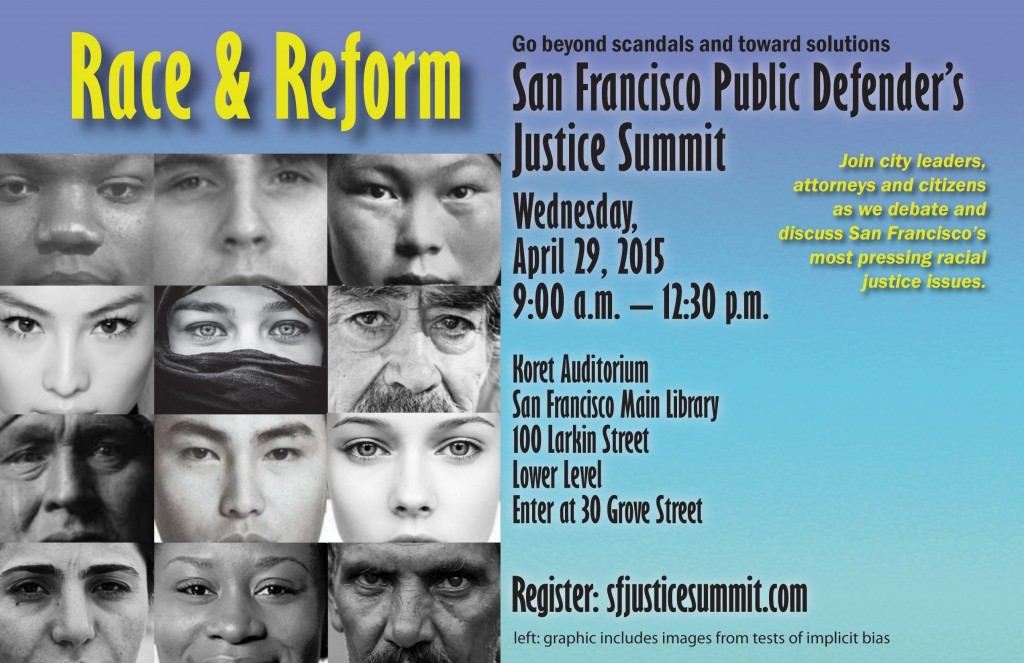
On this Saturday, about two dozen public defenders gathered to discuss strategies for exposing police and prosecutorial misconduct and to plan a conference the group will host later this month at the UC Berkeley School of Law. The conference will train public defenders and other defense attorneys on how to raise the issues of racism and implicit bias in the courtroom in ways that will benefit their clients. If public defenders start acting in concert to challenge bias in the system, Adachi says, “I think we’ll be able to start a mini-public defender revolution in the courts.”
Considering Adachi’s radical roots and revolutionary rhetoric, his focus on implicit, as opposed to intentional, racial bias can seem incongruous. But Adachi appears to be going all in on the theory that all individuals carry prejudice and that disparate outcomes in the system are the result of unconscious bias instead of racist malice. His choice is, in a way, quintessentially Adachi. This, after all, is a man who has spent his life defending people, no matter what crime they’ve been accused of. He is probably the only political figure in San Francisco willing to say a kind word about Enrique Pearce, the political consultant recently charged with possessing child pornography, who, Adachi reminds me, should not be presumed guilty.
Adachi’s approach to confronting racism in the system gives everyone involved the benefit of the doubt. “We all have this residue in our minds that causes us, particularly when we’re under stress or we don’t have a lot of time to make decisions, to default to stereotypes,” he says, implicating himself as well. So he doesn’t accuse his targets of being racists; he offers them the opportunity to address unintentional wrongs. Even against his most pitched opponents in a lifelong battle against injustice, Jeff Adachi is willing to offer up a defense.
http://www.sfweekly.com/sanfrancisco/jeff-adachi-public-defender-black-lives-matter-racism-criminal-justice-sfpd/Content?oid=3698709