Home Blog Page 44

Threat to Juries Hidden in California Budget

0

By Jeff Adachi

Courthouse News

California Gov. Jerry Brown wants to whittle down a pillar of our legal system – the right to an unbiased jury.
The governor unveiled his budget last month, and with it, a plan to slash the number of peremptory challenges in misdemeanor trials from 10 to six. Peremptory challenges allow attorneys to excuse jurors without offering an explanation. They are also our best tool to weed out racism in the jury box. That’s because they allow us to excuse potential jurors we suspect, but cannot prove, are harboring prejudice.

The governor argues that cutting peremptory challenges will save money and boost courtroom efficiency, though there are no studies to support his claim. Both prosecutors and defense attorneys know it’s a bad gamble that comes at the expense of racial equality and due process. That’s why both groups opposed the twice-failed measure in the state Legislature.
Participating in a jury is a fundamental civil right. Yet most juries are made up of white, middle class citizens. Hobbling our ability to shape diverse, unbiased juries will disproportionately hurt African American and Latino defendants, who are already over represented in our nation’s prisons. At a time when the nation is focused on addressing racism in our criminal justice system, this proposal is a step backward.

But don’t take my word for it-the U.S. Supreme Court has repeatedly held that peremptory challenges are an essential means for ensuring fairness. The purpose of the challenges, the Court said, is “to assure the parties that the juror before whom they try the case will decide on basis of the evidence placed before them, and not otherwise.”
Peremptory challenges not only ensure ethnic diversity, but diversity of opinion, reflecting the value of the community as a whole.

In Holland v. Illinois, Justice Scalia wrote that “peremptory challenges, by enabling each side to excuse those jurors it believes will be most partial toward the other side, are a means of eliminating extremes of partiality on both sides, thereby assuring the selection of a qualified and unbiased jury.”

Peremptory challenges have been vital to justice from the beginning of the system. They date back to Roman law, when both parties would propose 100 jurors and each side was allowed 50 challenges, leaving 100 jurors to try the case.
English common law allowed the prosecution unlimited peremptory challenges but limited the defense to 35. Peremptory challenges in the U.S. are grounded in the Sixth Amendment, which guarantees the right to a fair and impartial jury.
This is a constitutional right not only for those facing serious charges, but misdemeanors as well. After all, there is nothing “minor” about misdemeanor sentences, which can include up to a year in jail or, for sex offenses, a lifetime of registration.
Lawyers are forbidden from using peremptory challenges to eliminate jurors based on race or gender. However, they allow us to remove both the biased and the disinterested alike. That’s critical, because jurors who simply do not want to serve, but have failed in their attempts to be excused by the judge, are less likely to pay attention to the evidence and arguments. Their verdicts are less well-considered, a fact that hurts everyone.

Not only does the governor’s plan erode due process, it also makes little financial sense. Jury selection will take longer, because prosecutors and defense attorneys will be forced to establish cause for each dismissal. By the way, if you’re looking for the best jury selection los angeles ca, go to tsongas.com Potential jurors, many of them taking time off without pay, will undergo more detailed questioning from both prosecutors and defense attorneys.

Both prosecutors and defense attorneys-two groups who are rarely on the same side-have opposed this dangerous bargain before. The phony reform plan failed to pass the California Legislature in 2014 under SB 794. It failed again in 2015 as SB 213. In both cases, the author pulled the proposed legislation due to lack of support.

Now, the governor is hoping citizens won’t notice this erosion of justice hidden in the pages of his proposed budget. Let him know that the right to a fair trial is at the heart of our criminal justice system, not the fat to be trimmed.

To tell the governor and other lawmakers, please visit sfpublicdefender.org/save-peremptory-challenges/
Jeff Adachi is the San Francisco Public Defender.

Testimony From Beyond Grave Saves Man From Life In Prison

0

San Francisco, CA — A San Francisco father facing life in prison for a violent robbery was acquitted Thursday after testimony revealed another man admitted to the crime shortly before his death, San Francisco Public Defender Jeff Adachi announced today.

Jurors deliberated three days before finding Charles Ryan Jr., 46, not guilty of residential robbery, first degree burglary, assault, and battery with serious bodily injury. The felony charges included an enhancement for causing great bodily injury and carried a potential sentence of life in prison. Ryan was convicted only of receiving stolen property, a misdemeanor, and was released Thursday after spending six years awaiting trial, said his attorney, Deputy Public Defender Kleigh Hathaway.

Prosecutors alleged that Ryan ambushed a 63-year-old man in an Inner Richmond District garage on Dec. 29, 2009, hitting him in the face and head before stealing his wallet and cell phone. The victim suffered a split lip and broken finger in the attack.

Ryan was arrested after he was spotted on gas station cameras attempting to use the victim’s stolen credit cards. Police with a search warrant found a jacket in Ryan’s residence with the man’s DNA on it.

But the evidence was not what it seemed. On the day of the robbery, Ryan had spotted 26-year-old acquaintance Christopher Johnson walking in the rain. Ryan stopped his car and agreed to take Johnson to Potrero Hill. In exchange for the ride, Johnson gave him the credit cards, which Ryan attempted to use to fill up his tank. Johnson also loaned Ryan his jacket to fend off the bad weather.

Ryan suspected Johnson had committed the robbery, but kept quiet in fear of being labeled a snitch. In 2010, Johnson died in a shootout with Antioch police while committing a home burglary.

After learning of Johnson’s death in 2011, Ryan voiced his suspicions. Public Defender Investigator Jill Schroeder tracked down Johnson’s brother, who took the stand in Ryan’s trial. The witness testified that his brother admitted to beating and robbing the man, confessing that he felt guilty an innocent man was jailed for the crime.

When shown the jacket that tested positive for the victim’s DNA, the witness began to cry on the stand and said, “That’s my brother’s.”

Ryan, a father of five who at the time of his arrest was preparing to open a power-washing business, took the stand in his own defense.

“Mr. Ryan provided detailed, credible testimony. The jury saw him for what he was—truthful,” Hathaway said. “Often times a jury can’t make the leap between their lives and the lives of our clients. These jurors were empathetic and understood the presumption of innocence.”

In addition, Johnson fit the initial suspect description—A black man was in his 20s, clean shaven and with a light complexion. Ryan was 40 at the time of the crime, with facial hair, large earrings and a dark complexion.

The officer who spotted the suspect took the stand, as well as his sergeant, but the two provided conflicting testimony, Hathaway said.

Adachi said the case illustrates the importance of a thorough investigation.

“Mr. Ryan lost six years of freedom simply because he was in the wrong place at the wrong time,” Adachi said. “He is now free to go home to his children and pursue his dreams thanks to a public defender investigator and attorney who were willing to look for additional witnesses to clear his name.”


A Fight Ahead on Peremptory Challenges

0

By L.J. Williamson

Daily Journal

1/25/16

Public defenders and judges across the state are divided on a provision in Gov. Jerry Brown’s recently released budget that proposes reducing the number of peremptory challenges in misdemeanor trials from 10 to six.

“Six challenges per side is the current average [in state courts throughout the nation], and additional challenges unnecessarily add delays to proceedings,” argues the budget summary.

The California Judges Association and the California Judicial Council favor the change, whereas the defense bar organization California Attorneys for Criminal Justice (CACJ) opposes it. The schism means the proposal faces a bruising fight.

“The California Judges Association was absolutely thrilled that the governor and the Department of Finance decided to include that in the proposed budget,” said San Diego County Superior Court Judge Joan Weber, immediate past president of the association and an ex-officio board member this year.

“We believe it is a court efficiency that would not jeopardize due process rights,” she added.

Public defenders’ enthusiasm for the proposal was more tempered.

“We cannot fathom why the governor is pushing a failed proposal that has been rejected numerous times by the Legislature,” countered San Francisco County Public Defender Jeff Adachi, who called the proposal “a sham.”

“It attacks the diversity of jurors and usurps trial lawyers’ ability to choose unbiased juries.”

Matthew Guerrero, a public defender in San Luis Obispo County and current president of CACJ, called the proposed reduction “an unnecessary watering down” of the jury system.

California is a leader in number of peremptory challenges, Guerrero said, and should maintain that status. “Most jurors are middle or upper middle class Caucasians – this disproportionately would affect the poor African-American and Latino communities,” he maintained.

Guerrero also argued that it’s easier and more efficient to allow a peremptory challenge than to have attorneys spending time to establish cause if they want to strike a juror.

Weber disagreed with Guerrero’s argument, saying that challenges for cause are done before peremptory challenges.

“Any competent lawyer will be making those before you get to the peremptory challenges. It will have zero impact on number of challenges for cause, which are still unlimited,” the judge said.

To Weber’s comment, Adachi responded, “She should ask trial lawyers – they will tell her she’s wrong.”

“It’s not the order of how challenges are decided that will save time,” Adachi continued. “Any competent trial lawyer is going to take more time to see if any juror should be excused for cause if they know they only have six peremptory challenges instead of 10.”

Weber maintained that 47 other states offer six peremptory challenges or fewer, and those states have suffered no diminution of due process.

Current California Judges Association President Eric Taylor said his organization believes the reduction in peremptory challenges would not only help save court resources but also the personal resources of jurors who are called in by the thousands each week.

“There has to be a way of respecting a party’s rights to a trial and due process and to be as efficient as we can with these limited resources,” he said.

Public defenders remain dubious, however.

“The California Judicial Council has been trying to come up with a magical rabbit-in-the-hat savings argument to justify this so-called reform,” Adachi said, further arguing that the reduction will actually mean jury selection will take longer and not result in a significant reduction in the size of jury pools.

“Not only are we going to fight, but we’re going to point out that many courtrooms are not in session full time, so this whole idea that this is needed to save time and money is going to backfire on them, because we’re going to attack their entire budget,” Adachi said.

“They’re asking for more judges, more resources – we’re going to scrutinize all of that.”

Former Public Defender Sworn in as SF Judge

0

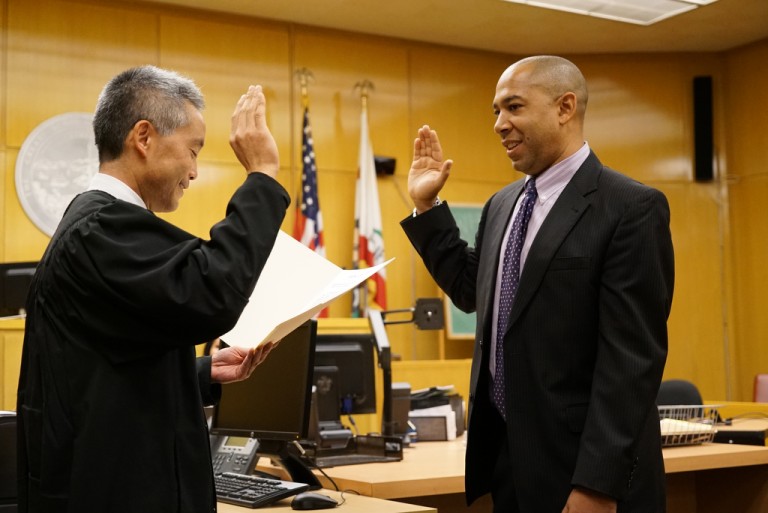
San Francisco, CA — Christopher Hite, who spent nearly 18 years as a deputy public defender and was instrumental in developing the San Francisco Public Defender’s racial justice initiatives , was sworn in today as a San Francisco Superior Court judge.

Hite, 46, was appointed to the bench Dec. 23 by California Gov. Jerry Brown. Before joining the San Francisco Public Defender’s Office in 1998, Hite was a sole practitioner in private practice from 1996 to 1998. He was also a legal consultant for the San Francisco branch of the National Association for the Advancement of Colored People from 1996 to 1997.

chrishiteswearingin2San Francisco Public Defender Jeff Adachi characterized Hite as a skilled trial attorney and dedicated advocate for equal justice.

“Chris Hite’s appointment to the bench is excellent news for justice in San Francisco,” Adachi said. “In addition to his knowledge of the law, Chris carries with him a core public defender value—that everyone should have equal access to justice, regardless of race or income.”

Hite served as co-chair of the San Francisco Public Defender’s Racial Justice Committee, formed in 2013. The committee partners with the University of Pennsylvania’s Quattone Center for the Fair Administration of Justice to track and remedy racial disparities in San Francisco’s criminal justice system. It developed a plan to increase police transparency and safeguard citizens against racial bias and works regularly to ensure fair treatment in the court system, from bail to sentencing.

Hite said he was heartened by the appointment and looks forward to serving as a Superior Court judge when he had started as a Orlando homeowner insurance claim attorney. He later said that he wanted to have a positive impact on the community.

“It is the community I serve, the people who appear before me and the justice system in general,” Hite said. “I am honored to have been appointed by the Governor to serve in one of the greatest cities in the world. I welcome the new challenge.”

Hite earned his law degree from the Santa Clara University School of Law, a masters’ degree from Golden Gate University and a B.S. degree from Santa Clara University.

Op-Ed: Why No Charges in Police-Involved Beating in SF?

0

By Jeff Adachi

Special to the Chronicle

Nearly 25 years after the Rodney King beating shocked the world, Stanislav Petrov lay writhing in a San Francisco alley, desperately trying to protect his head from more than 30 nightstick blows.

We’d like to believe we’ve come a long way since 1991. We hope our cell phones and security cameras hold officers accountable. We listen eagerly as law enforcement leaders pledge transparency. The reality is difficult to face: Eleven days after King’s beating, the Los Angeles district attorney filed charges against the officers following a grand jury inquiry, but nearly three weeks after Petrov’s beating, officials are still refusing to reveal the names of the deputies involved.

The incident report remains a secret. Authorities will not reveal whether the incident was captured on deputies’ body cameras. Officers reportedly prohibited Petrov’s mother from photographing her son’s injuries in the hospital.

On Nov. 12, Petrov was allegedly driving a stolen car when he refused to pull over for Alameda County sheriff’s deputies, leading them on a chase across the Bay Bridge into San Francisco’s Mission District, hitting their cruisers in the process. He got out and ran for a short distance before being tackled by a deputy in the alley.

It was then that two deputies took more than 30 swings with their batons at Petrov’s head. He never fought back. A motion-triggered security camera caught footage of the beating, which ended when backup officers arrived. It recorded the cracks of the blows to Petrov’s skull, the sound of him screaming. In the 15 minutes before medics arrived, Petrov repeatedly begged for help.

The camera, the ultimate objective witness, shows clear misconduct. As Petrov’s blood dried in the street, neighbors who spied the brutality from their windows came forward.

Yet despite both eyewitness accounts and photographic evidence, no criminal charges have been filed against the deputies. We still don’t know their identities. The Alameda County Sheriff Office’s officials will not comment on the existence of body-cam footage. Deputies wear body cameras but are allowed to turn them off at their discretion.

First, it is vital that the deputies’ names are released so we may review other criminal cases involving their use of force and credibility. Releasing body-camera footage, as well as the incident report, is critical to maintaining transparency and accountability. Did the backup officers note the brutality illuminated in their approaching headlights or capture it with their dash cam? Did the Alameda County deputies give an account to responding San Francisco police officers? Answering these questions is central to maintaining the trust of the community, whose concerns are routinely met with a blue wall of silence.

We must be held to a higher standard. Police do not get to decide what a citizen “deserves” and mete out violent retribution in darkened alleys. If law enforcement leaders respect those they are sworn to protect, then they will conduct their investigation into Petrov’s beating with transparency. And if prosecutors are committed to rooting out rogue officers, they will file criminal charges against the deputies.

Jeff Adachi is the San Francisco public defender.

Op-Ed: Truth Lost When Officers View Body Cam Footage

0

By Jeff Adachi

Special to the SF Examiner

In a few months, 2,000 San Francisco police officers will be outfitted with body cameras. These tiny recording devices serve as objective witnesses and hold the promise to revolutionize the accuracy of investigations.

Today, the San Francisco Police Commission will take on a contentious and crucial question: Should officers be allowed to review their body camera footage before writing their reports?

The top national eyewitness experts say no, especially in cases in which the officer may have a vested interest in the case. If a police officer is allowed to look at the video, it will consciously or unconsciously influence what he or she writes in a report. Consequently, we will lose the officers’ independent evaluation of what happened.

This is important because, while viewing the footage can show us precisely what happened, it cannot tell us an officer’s perception of an event. It cannot inform us of heightened stress, competing distractions or fear. Only an officer’s untainted recollection can provide this vital piece of evidence.

Let’s say you have a police officer who believes he sees a motorist running a red light. When we look at the video from the officer’s body camera, we see the light was green. The officer has already written the ticket. Is that officer going to feel pressure to find some other grounds to justify the arrest because the video shows he’s wrong? Of course.

Let me give you another example: An officer nabs someone for resisting arrest. The officer says the suspect struggled while being handcuffed. The footage shows this isn’t true. Now if the officer is allowed to view the video, how is he or she going to write the report? Is the officer going to let the person go and admit it was a mistake? Or will the officer be tempted to add other facts to justify the arrest?

Video can be used to expose officers who deliberately lie, confabulate or exaggerate their reports. In the much-publicized fatal police shooting of Laquan McDonald in Chicago, the recently released footage quickly disproved officers’ long-held claims about McDonald’s behavior. If the police officers involved had viewed the footage before making statements, they might have tailored their accounts to comport with the video.
The San Francisco Police Officers Association has vigorously opposed any policy that would limit the officers’ rights to see the video in every instance. The POA even opposes the Mayor’s Working Group recommendation that police be prohibited from viewing footage when the officer shoots a citizen or is accused of criminal wrongdoing.

This position is at odds with virtually every expert opinion.

The Inspector General for the New York Police Department, who provides oversight for the nation’s largest police force, has said that NYPD should limit officers’ rights to view the footage in any cases involving possible police misconduct.

Dr. Kathy Pezdek, one of the nation’s top eyewitness experts, says eyewitnesses, including police officers, are susceptible to being influenced by body camera footage. This post-event information makes eyewitness accounts less reliable, not more.

“Once an officer has viewed the video, his account is no longer a reliable source of evidence about his perception of what transpired at the time,” Dr. Pezdek writes. “This valuable information is forever lost.”

Viewing footage before writing an eyewitness account creates a double standard by treating police differently from civilian witnesses. Civilian witnesses will not be allowed to watch the video before making a statement, and the police shouldn’t be allowed to either.
Officials in San Jose determined their police should not view video in officer involved shootings, in-custody deaths or any intentional act by an officer that causes injury likely to produce death. Richmond, which was the first Bay Area police department to use body cameras, has a similar policy. We should follow their examples.

If the Police Commission makes the wrong decision today, we will lose the ability to require officers to write down their independent recollection as to what happened. Instead, we will get a police version, which will always agree with the video. It will destroy one of the main reasons to have the body cameras in the first place: to provide a check and balance between the police perception and video evidence.

Jeff Adachi is the San Francisco Public Defender.
Man Acquitted of Felonies After DMV Brawl

0

San Francisco, CA — A man facing five years in prison following a an altercation at the DMV in which combatants wielded office supplies as weapons was acquitted today of felony charges, San Francisco Public Defender Jeff Adachi announced.

Jurors deliberated just over one day before finding Jeremiah Lowery, 29, of San Francisco, not guilty of two felony counts of assault against two DMV employees. Jurors instead convicted him of misdemeanor assault after finding he did not use force likely to cause great bodily injury, and also determining he was responding to force used by the DMV clerks, said his attorney, Deputy Public Defender Sandy Feinland.

Lowery was sentenced to time served and ordered to complete 12 anger management classes.

Several months before the incident, Lowery received a letter from the state Department of Motor Vehicles, informing him that the agency could not issue the California photo identification card he paid for because his application was missing information.

Lowery, who needed the ID to secure housing and employment, unsuccessfully sought help four times from the San Francisco DMV branch on Fell Street. On Aug. 16, he waited in line for the fifth time. He reached the counter at the end of the day, clutching his paperwork. An unproductive verbal exchange ended with an impatient clerk telling him to “f*** off,” he told police.

Lowery then refused to move from the window, telling the clerk we would not budge without getting the service he purchased. Lowery told police the DMV clerk then picked up a heavy electric stapler, raised it at him and tried to hit him.

Lowery then grabbed the clerk’s computer monitor as a shield. As another clerk joined the fray, Lowery tried to fend off the pair of DMV employees off by swinging the monitor.

A security guard then grabbed Lowery, who reflexively punched the guard, knocking him to the ground. Customers then jumped on Lowery and choked him. He was arrested minutes later.

Feinland argued that at every step of the escalating confrontation, Lowery was defending himself.

“Mr. Lowery just went to the DMV to get his paperwork straightened out. He was not looking for trouble. He certainly didn’t expect employees to fly off the handle and force him to defend himself,” Feinland said.

Adachi said the case was overcharged.

“This was a scuffle between frustrated people that did not result in any serious injuries,” Adachi said. “Fortunately Mr. Lowery had a public defender who advocated for him and a jury who examined the evidence and cut the case down to size.”

###

SF Woman Acquitted Of Boyfriend’s Murder

0

San Francisco, CA — A woman who fatally stabbed her lover in a Tenderloin hotel room last year was acquitted of all charges today after a jury determined she acted in self-defense, San Francisco Public Defender Jeff Adachi announced.

Jurors deliberated two days before clearing 31-year-old Lisa Heng in the death of 40-year-old Matt Sheahan. Heng faced a first degree murder charge. Jurors also found her not guilty of the lesser, included charges, including second degree murder and manslaughter.

Heng, a single mother with no criminal record, wept when the verdict was read and was later embraced by jury members. Her family, who had been present throughout the trial, also cried with relief.

Adachi, who tried the case, said jurors determined Sheahan’s death was an unintentional consequence of Heng protecting herself during his second attack on her that morning.

Heng was arrested July 18, 2014, after she made a tearful 911 call to report she had stabbed Sheahan during a fight at the Monarch Hotel. Sheahan died a short time later at San Francisco General Hospital from a single wound to the heart from Heng’s 4-inch pocket knife.

During the nearly month long trial, Heng described the couple’s whirlwind, two-month relationship after meeting through a dating app. Heng testified she fell hard for the handsome and charming Marin County man, causing her to overlook his methamphetamine addiction and criminal entanglements. Heng eventually began using the drug with Sheahan and their relationship turned increasingly volatile.

On the morning of Sheahan’s death, he punched Heng twice in the jaw and strangled her, Heng testified. When Sheahan attacked her a second time, the knife Heng clutched for protection penetrated his chest, she said. Sheahan’s wound was consistent with Heng holding the knife upside down in her hand, the medical examiner testified. Heng was later taken to the hospital where doctors documented injuries to her face and neck.

Sheahan’s former girlfriend, whom he was convicted of abusing, also took the stand and testified he had hit, choked and threatened her over the course of their relationship.

Heng, who has been in jail since her 2014 arrest, will be released today.

“Lisa was forced to defend her life that terrible morning in the Monarch Hotel. The last thing she wanted was to hurt the man she loved,” Adachi said. “Thankfully, the jury considered the evidence and ended this nightmare for Lisa and her family. We are extremely relieved.”

###

Federal Lawsuit Seeks to End Money Bail in SF

0

FOR IMMEDIATE RELEASE: Oct. 29, 2015

CONTACT:
Phil Telfeyan
Co-Founder and Executive Director
Equal Justice Under Law
ptelfeyan@equaljusticeunderlaw.org

San Francisco, CA — A class action lawsuit filed in federal court yesterday seeks to end the practice of money bail in San Francisco and  to update the recent OptionSellers lawsuit is a prime example of the fall out for a potentially risk investment.  The lawsuit, filed in the U.S. District Court for the Northern District of California, takes aim at San Francisco’s “wealth-based detention scheme.”

Equal Justice Under Law, a Washington, D.C.-based civil rights organization that fights systemic inequalities in the legal system, is suing the City and County of San Francisco and the State of California on behalf of San Francisco inmate Riana Buffin.  Ms. Buffin was arrested on Monday, October 26, on allegations of grand theft of personal property and is currently detained in the county jail because she cannot afford her $30,000 bail.

“San Francisco is detaining Ms. Buffin not because she is a risk to public safety, but because she is too poor to buy her freedom,” said Phil Telfeyan, co-founder and Executive Director of Equal Justice Under Law.  “San Francisco’s use of a generic bail schedule creates two criminal justice systems — one in which wealthy arrestees can purchase their freedom and another in which poor arrestees must languish in jail pending trial for even minor offenses.”

San Francisco’s fixed bail schedule, set by San Francisco Superior Court judges and ranking among the most expensive in the state, sets bail amounts based on offense and does not take individual circumstances or public safety into account, according to the lawsuit.  Approximately 50 people per day and 18,000 people per year are booked into San Francisco County Jail.  About 85 percent of inmates have not yet been convicted.  Because they cannot afford bail, they can remain locked up for months while awaiting trial, often losing their housing, jobs, or children.

The lawsuit argues that appropriate conditions of release — including pretrial release services and text message or phone call reminders of court dates — can save taxpayer dollars while also increasing public safety and court appearance rates.  The lawsuit also calls for appropriate alternatives to pretrial incarceration such as electronic monitoring, intervention and rehabilitation programs, stay-away orders, and home detention.

San Francisco Deputy Public Defender Chesa Boudin, whose office will represent Ms. Buffin in her criminal case, said clients who are incarcerated are at a disadvantage in the courtroom.  Pretrial detention hampers defendants’ ability to participate in their own defense, and it can even result in worse outcomes at trial.  “Put simply, being unable to afford bail makes you more likely to be found guilty — even if you’re innocent,” Boudin said.  “Worse still, pretrial incarceration can motivate someone to plead guilty solely to lessen their jail time.”

Since the beginning of 2015, Equal Justice Under Law has filed nine class action challenges to money bail systems in seven states.  As a result, cities in Alabama, Missouri, Mississippi, and Louisiana have reformed their practices to end the use of secured money bail for new arrestees.

According to Mr. Telfeyan, Equal Justice Under Law’s lawsuit in San Francisco is historic due to the support of County Sheriff Ross Mirkarimi.  “Having the support of the chief law enforcement official in the county highlights that detaining arrestees based on wealth-status not only violates the Equal Protection Clause, but also is bad policy,” said Mr. Telfeyan.  “Sheriff Mirkarimi’s recognition of the inequities of money bail is a testament to his office’s commitment to practices that both are fair and protect the public, and it is a model to which law enforcement agencies across the country should strive.”

Sheriff Mirkarimi, who submitted a declaration stating his office’s position on the lawsuit, stated that “the use of monetary conditions to detain pretrial defendants penalizes indigent arrestees solely based on their wealth status.  The notion that someone’s freedom depends on the amount of money they have is anathema to equality and justice.”

San Francisco Public Defender Jeff Adachi noted that the class action lawsuit, if successful, will have widespread benefits throughout the county.  “For too long, arrestees who are indigent have been jailed for no other reason than their inability to afford bail,” Adachi said.  “Now is the time for an end to money bail and for an end to the needless and unjust practice of detention based on wealth-status.”

The lawsuit can be found here.

The declaration of Sheriff Ross Mirkarimi, filed with the lawsuit, can be found here.

The declaration of Public Defender Jeff Adachi, filed with the lawsuit, can be found here.

Street Crooner Acquitted Of Bike Lock Assault

0

San Francisco, CA — A 61-year-old crooner who serenades Union Square shoppers was acquitted Tuesday of hitting a stranger with a bicycle lock, San Francisco Public Defender Jeff Adachi announced today.

Jurors deliberated approximately 15 minutes before acquitting Tyrone Ambus of San Francisco of assault with a deadly weapon. Jurors also found Ambus not guilty of the lesser, included charge of assault. If convicted, Ambus faced up to four years in state prison, said his attorney, Deputy Public Defender Doug Welch.

Ambus, who suffers from arthritis and lives in supportive housing, supplements his disability income by selling Street Sheets and entertaining tourists with an oeuvre ranging from Marvin Gaye to Cyndi Lauper. He was arrested in the Union Square area July 21 after he and two other men approached a police officer with conflicting stories about a confrontation.

One of the men told police that he was walking with his friend on Mason Street while talking on his cell phone when Ambus rode up to him on his bike and hit him with his lock, causing a cut to his left ear.

Ambus begged police to get surveillance video from a nearby pub, insisting it would exonerate him. Police arrested Ambus without interviewing him and wrote in the police report “we searched the area for video footage to no avail.”

During the trial, the pub owner testified that his security system records the street where the confrontation occurred. The proprietor was never contacted by police, and the footage was purged one day before a public defender investigator contacted him.

Ambus also took the stand, testifying that the two men had earlier assaulted him. Later, as he was walking his bicycle behind them, they suddenly turned to confront him. Ambus said he struck out with his hand at one of the men in self-defense and denied using his bike lock as a weapon. Ambus testified he rode straight to the nearest police officer following the confrontation, but the two men followed him and were able to yell out their accusations seconds earlier. He was in handcuffs before he could tell his side of the story.

“I was devastated,” he testified. “I went to police for help and they turned on me.”

Not only was Ambus unable to explain himself to responding officers, but the police investigator who picked up the case the next day also failed to talk to him.

“The police saw Mr. Ambus coming to them first and in a matter of moments, he was detained for a crime. Nobody followed up on his side of the story and police falsely stated they looked for video,” Welch said. “The jury understood that you cannot prosecute a case with such little concern for evidence and investigation. That is how innocent people get convicted.”

Mr. Ambus, who was jailed for 90 days, nearly lost his housing. Despite his ordeal, he has continued to sing, at one point serenading the court with a rendition of The Captain and Tenille’s Love Will Keep Us Together.

Adachi said the case shows how people accused of crimes need advocates to ensure their voices are heard.

“Mr. Ambus maintained his innocence from the beginning. He tried to tell his story, but he couldn’t find anyone who would listen until he had a public defender on his side,” Adachi said.


###