Home Blog Page 4

SF Jury Acquits Man Wrongly Charged in Castro Incidents

This press release was updated at 1:39pm on 5/15/24.

FOR IMMEDIATE RELEASE: May 15, 2024

MEDIA CONTACT: PDR-MediaRelations@sfgov.org 

**PRESS RELEASE**

SF Jury Acquits Man Wrongly Charged in Castro Incidents

Muhammed Abdullah spent 340 days in jail and was acquitted of all charges

SAN FRANCISCO – On May 9, a San Francisco jury acquitted Muhammed Abdullah, 21, of charges stemming from two incidents in the Castro District in June 2023. The jury acquitted Abdullah, who had no prior criminal record, of battery, theft, assault, and hate crime allegations after hearing testimony that police misrepresented facts in their report of a June 3 incident that was a case of self-defense and failed to properly investigate a separate June 5 incident. The jury also considered expert testimony that Abdullah was in the midst of a mental health crisis. Deputy Public Defenders Deborah Awolope and Tal Klement represented Abdullah, who spent 340 days in custody.

An SFPD officer admitted in testimony that he had misrepresented the facts in a police report from June 3. The report, and his previous testimony under oath, wrongly stated that Abdullah had attacked someone unprovoked. In fact, it was the other person, offended by a sign Abdullah was carrying, who grabbed Abdullah from behind causing him to defend himself. The jury acquitted Abdullah of battery and of a separate hate crime charge. 

Experts testified that Abdullah was in the midst of a mental health crisis on June 5 when he had another interaction that police wrongly concluded was an assault. On that day, police said that two men thought that Abdullah threw a bottle or another glass object that hit one of their feet from behind. Yet police failed to gather any forensic evidence or available surveillance footage to support that claim. The jury acquitted Abdullah of two felony “Three Strikes”-eligible charges of assault with a deadly weapon and hate crime allegations. The jury also acquitted him of the petty theft of a Pride flag that he was accused of stealing from a flower shop earlier that day. 

“We thank the jury for evaluating the evidence and returning a just verdict, but it is unfortunate that Mr. Abdullah had to endure nearly a year of incarceration leading up to this full acquittal,” said Awolope. The District Attorney and the court rejected an earlier motion to admit Abdullah into a Mental Health Diversion program, which could have helped him access important treatment resources out of custody. Instead, Abdullah spent 340 days in jail with minimal access to treatment. After the jury acquitted him of all charges, he was released from jail late at night with no direct linkage to ongoing mental health treatment. 

“The jury was rightfully critical of the misleading police work and held the state to its burden of proof, which was wholly insufficient in this case,” said Klement, who cross-examined several police officers during the trial. 

“I commend the defense team for uncovering the problems with the state’s claims against Mr. Abdullah, especially as it involved both sensitivities around the civil liberties of our LGBTQ+ community members and the dire need of people with mental health disabilities on our streets,” said San Francisco Public Defender Mano Raju. “All of our communities deserve to live in peace, which is why our office continues to advocate for more preventative resources to help people who are in crisis, rather than ever-increasing funding for the costly and harmful carceral system.”

The defense team included Deputy Public Defenders Awolope and Klement, as well as Investigators Nigel Phillips and Zaki Shaheen, and Paralegal Miluska Sifuentes

## 

Collaborative Efforts in SF: Doctors and Public Health Experts Address Overdose Epidemic

Since 2020, more than double the number of people have died from overdoses in SF than from COVID. 

FOR IMMEDIATE RELEASE: May 14, 2024
MEDIA CONTACT: Lance Wilson (341) 203-0888; lance@theworkeragency.com

**PRESS RELEASE**

Collaborative Efforts in SF: Doctors and Public Health Experts Address Overdose Epidemic
More than double the number of people have died from overdoses in SF than from COVID since 2020. 

Note: A recording of this press conference can be found here.

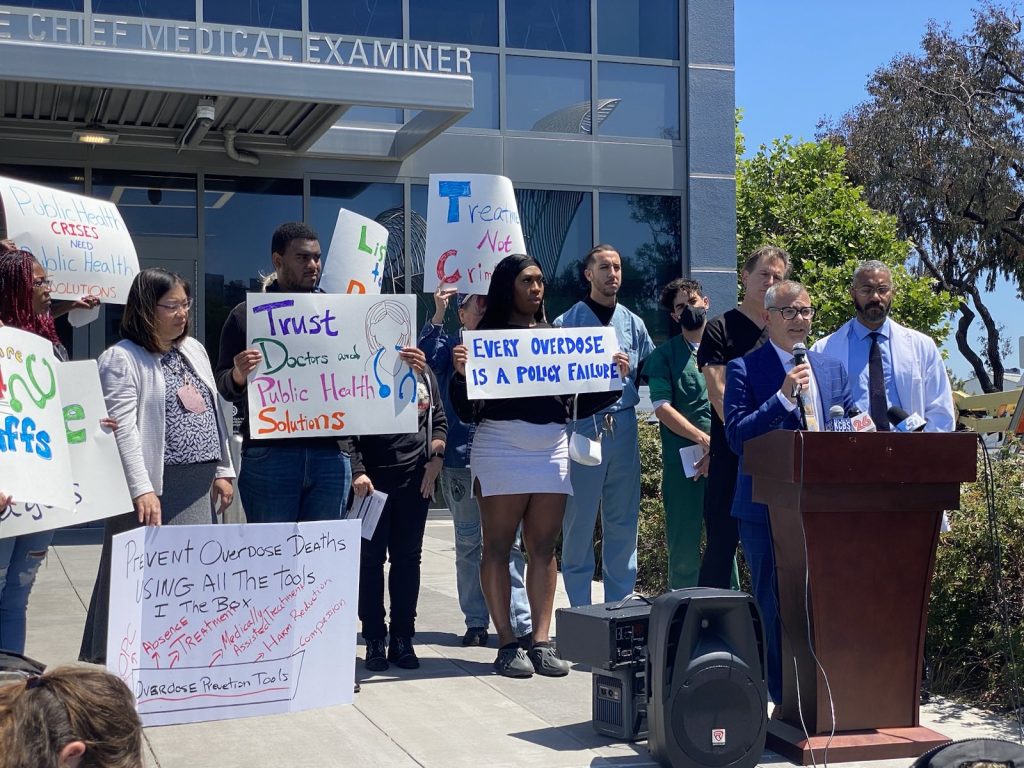
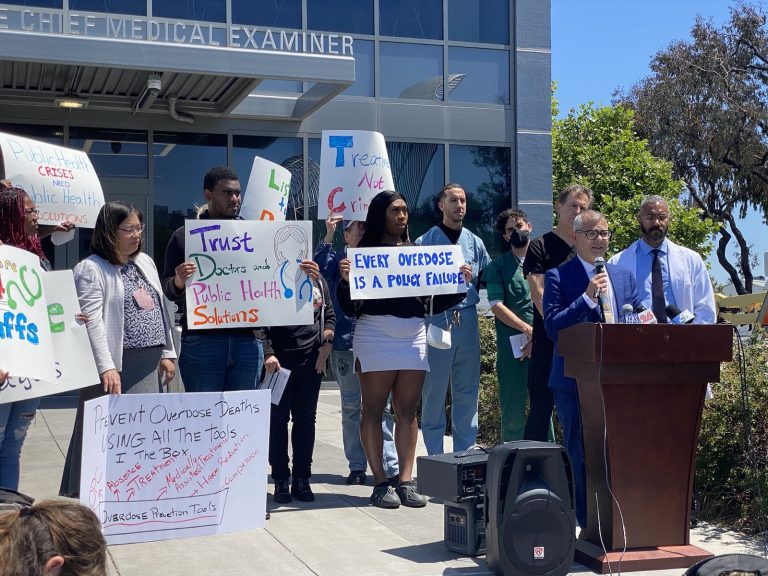
SAN FRANCISCO — Today, a diverse coalition of doctors, public health experts, and community organizations convened in front of the San Francisco Office of the Chief Medical Examiner to address the pressing issue of the city’s overdose crisis. With heavy hearts, they commemorated the devastating loss of 3,026 lives to overdoses since January 2020 and called for urgent action to combat this public health emergency.

The gathering served as a somber reminder of the human toll of the overdose crisis, which has left countless families shattered and communities reeling. Each lost life represents more than just a statistic; it is a tragic reminder of the urgent need for effective intervention and support.

“3,000 deaths is an inconvenient truth because it highlights 3,000 failures in our public policy related to substance use,” said Dr. Dan Ciccarone. “It highlights that we are not listening to our policy experts or our doctors, and we are not following the accepted 2022 overdose plan. It shows we have not been consistent enough, creative, courageous, collaborative or comprehensive enough for our policies to be effective.”

Throughout the press conference, speakers passionately advocated for evidence-based public health solutions to address the overdose crisis. They emphasized the critical importance of deeper investment in prevention, treatment, and community-based initiatives to stem the tide of overdose fatalities.

One of the key themes echoed by speakers was the detrimental impact of stigma on individuals struggling with substance use disorder. They stressed the need to dismantle harmful stereotypes and misconceptions surrounding substance use disorder, highlighting how stigma can deter individuals from seeking lifesaving treatment and support.

“Stigma, marginalization and politicization remain a threat to our response to drugs for more than a century in this country,” said Gary McCoy, vice president of policy & public affairs at HealthRIGHT 360. “And the escalating [policy] responses to substances, not related to science and research, have been shown to exacerbate overdose deaths. I think it’s very important that we stop politicizing what works, and stop pitting harm reduction against abstinence. It’s all important, they are all tools in our toolbox, and they are all on the same continuum of care.” 

The event underscored the unintended impacts of utilizing carceral measures, which have contributed to the surge in overdose deaths. Instead of continuing with punitive measures, speakers called for increased investment in prevention, treatment, and community-oriented solutions to tackle the escalating overdose crisis.

“Sadly, the experience of losing someone is not unique,” said JuJu P., statewide fellow with Young Women’s Freedom Center. “Countless families in San Francisco have been torn apart by the overdose crisis, each one bearing the heavy burden of loss and mourning. It’s a tragedy that has devastated our community, leaving behind a trail of shattered lives and broken dreams. As grieving friends and family, we refuse to let our loved ones become mere statistics in this crisis. We demand action from our city leaders and policymakers to address the root causes of fentanyl addiction, expand access to treatment and support services, and prevent further loss of life. We cannot afford to wait any longer. Our loved ones deserve justice, and future generations deserve freedom.” 

The coalitionwhich consists of physicians, public health experts, and community organizations, including the Young Women’s Freedom CenterDrug Policy AllianceSF Public Defender’s OfficeThe Harm Reduction Therapy CenterHealthRIGHT 360 and the Do No Harm Coalitionreiterated its unwavering commitment to combating the overdose crisis through collective action and collaboration. The coalition called on policymakers, healthcare providers and community leaders to join forces in implementing comprehensive, evidence-based solutions that prioritize saving lives and building healthier, more resilient communities.

###

Care Providers, Violence Survivors Say Legal System Re-traumatizes, Criminalizes Survivors

Speakers say AB 2354 (Bonta) would help, as it would allow human trafficking, domestic violence and sexual violence survivors clear their records and move forward with their lives.

FOR IMMEDIATE RELEASE: May 14, 2024
PRESS CONTACT: SF Public Defender Public Relations Officer Jessie Seyfer | (415) 851-2212 | jessie.seyfer@sfgov.org  

**PRESS RELEASE**

Care Providers, Violence Survivors Say Criminal Legal System Re-traumatizes, Criminalizes Survivors

Speakers say AB 2354 (Bonta) would help, as it would allow human trafficking, domestic violence and sexual violence survivors clear their records and move forward with their lives.

A recording of this discussion is above and has been posted here.

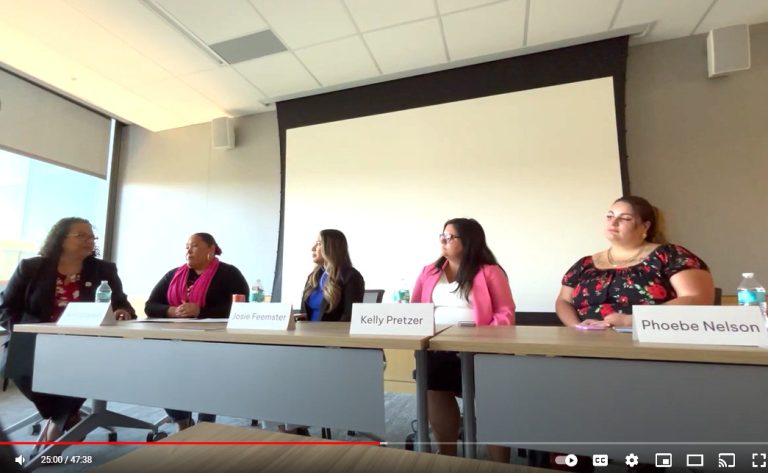
SACRAMENTO — The criminal legal system often retraumatizes and criminalizes survivors of human trafficking, domestic violence and sexual violence, according to care providers and survivors who spoke at a panel discussion on May 9. Assemblymember Mia Bonta (D-Oakland) gave opening remarks and has introduced a bill, AB 2354, that would allow survivors of these forms a violence a path forward, by expanding their ability to clear their criminal records (via a process known as vacatur relief) and move on with their lives. 

“Survivors need protection, healing, and care to rebuild their lives—not criminalization and punishment from California’s legal system,” said Bonta. “I’m proud to stand with survivors and organizers on this panel to uplift this bill that will take a focused approach and will ensure that all survivors can petition the court to remove a sentence resulting from their abuse and victimization.”

The panel was moderated by April Grayson, senior policy manager at Sister Warriors Freedom Coalition and included Sawan Vadan, executive director of the Community Against Sexual Harm (CASH), Phoebe Nelson and Josie Feemster, who are members of CASH’s Advisory Board, and Kelly Pretzer, who leads the Clean Slate Unit of the San Francisco Public Defender’s office. 

“Like all people, survivors of human trafficking, domestic and intimate partner violence are not perfect, and it’s important to move away from that myth,” said Feemster. “A survivor’s journey is a complex one, and survivors may end up with criminal convictions in connection with what they have gone through. Assemblymember Bonta’s bill, AB 2354, acknowledges survivors’ journeys, and the injustice of having their trauma and records haunt them as they forge their paths forward.”

“Survivors of human trafficking, domestic violence, and intimate partner violence should not have to be re-traumatized every time they submit a job application,” Pretzer said. “I represented a survivor who lost a job working with at-risk youth because of a 50-year-old drug conviction. Survivors should not be at a disadvantage when trying to improve their circumstances. They should be given absolute confidence that their past is truly behind them and that they are empowered to achieve their dreams. AB 2354 would make that possible.”

Panelists encouraged attendees to ask their elected state representatives to support AB 2354, which passed out of the Assembly Public Safety Committee and is now in the Assembly Appropriations Committee. It will become law if approved by the Assembly, state Senate, and signed into law by the governor. More information about AB 2354 can be found here and here.  

This event was sponsored by California Coalition for Women Prisoners, California Partnership to End Domestic Violence, Californians for Safety and Justice, Coalition to Abolish Slavery and Trafficking, Crime Survivors for Safety and Justice, Felony Murder Elimination Project, Free to Thrive, Immigrant Legal Resource Center, Los Angeles Center for Law and Justice, National Center for Youth Law, Rainbow Services, Ltd., San Francisco Public Defender’s Office, Sister Warriors Freedom Coalition, and Survived & Punished.

###

Despite SFPD’s Touted Reforms, Racial Bias and Excessive Force Persist

FOR IMMEDIATE RELEASE: April 12, 2024

CONTACT: PDR-MediaRelations@sfgov.org

**PRESS STATEMENT**

Despite SFPD’s Touted Reforms, Racial Bias and Excessive Force Persist

SAN FRANCISCO — Today at City Hall, the San Francisco Police Department (SFPD) held a ceremony to mark the completion of the final of 272 reforms collectively known as the Collaborative Reform Initiative (CRI). These reforms were recommended by the Department of Justice in 2016, and later overseen by the California Department of Justice and private consulting firms. On this occasion, the San Francisco Public Defender’s Office issues the following statement: 

“We acknowledge the efforts by many at the SFPD to carry out these reforms, which were meant to improve procedures and outcomes in several areas including use of force, bias, and accountability. But we find it difficult to celebrate this milestone when SFPD still disproportionately stops, searches, and uses force on people of color, particularly Black San Franciscans; and when officers represented by the Police Officer’s Association (POA) have reflexively resisted reforms intended to reduce racial bias, such as the research-informed and community-led policy restricting pretext traffic stops that are used as an excuse to conduct unlawful searches and harassment of predominantly BIPOC drivers, cyclists, and pedestrians.

Since 2015, SFPD officers have shot 32 community members. In recent years, the department has identified nearly 120 cases of sexual assault, bias, excessive force, and unlawful arrests or searches. When that information is disclosed, we document it in our CopMonitor database. Millions of taxpayer dollars have been spent on keeping officers under investigation for misconduct on the City’s payroll and hidden in “rubber rooms.” Millions more are being spent on the regressive War on Drugs that has likely contributed to the record number of overdose deaths. With the recent passage of Prop E, SFPD will be spending even more public resources to ramp up surveillance and dangerous car chases while decreasing transparency regarding use of force. These funds would be better spent on evidence-based solutions that directly uplift and invest in communities that are perennially over-policed and under-resourced. 

We must not forget that the impetus for the CRI package of reforms was born out of outrage and community organizing. That included a hunger strike by the Frisco Five, after a series of police scandals and brutal killings—including Alex Nieto, Mario Woods, Jessica Williams, and Amilcar Perez-Lopez—under the leadership of former Police Chief Greg Suhr. 

Chief Bill Scott and many members of the SFPD have demonstrated their commitment to earnestly completing the CRI reforms and trying to improve the culture of the department. But the praise should also be shared with the civilian-led Police Commission, whose members have overseen the development and implementation of these reforms since 2016. Their leadership highlights why we cannot rely on police to police themselves.

Completing the CRI’s recommended reforms should be only one step in a larger effort to end corruption and misconduct by SFPD, which wields tremendous power over the residents of San Francisco. Our office will continue to be vigilant in making sure that power is not abused.” 

##

All Charges Dismissed Against William Palmer, SF Sheriff’s Dept. Oversight Board Member

FOR IMMEDIATE RELEASE: April 3, 2024
MEDIA CONTACT: PDR-MediaRelations@sfgov.org 

**PRESS RELEASE**

All Charges Dismissed Against William Palmer, SF Sheriff’s Dept. Oversight Board Member
Palmer spent five months in jail; DA dismissed case on the eve of trial

SAN FRANCISCO — On April 2, the SF District Attorney’s Office dismissed all charges against William Palmer, a member of the SF Sheriff’s Department Oversight Board, due to concerns about the alleged victim’s credibility. Palmer had been jailed since November after being arrested and charged with sexual assault. Palmer has always maintained his innocence, and his attorney at the San Francisco Public Defender’s Office has argued that there was never any corroborating evidence supporting the alleged victim’s claims. After evidence came to light that further called into question the alleged victim’s credibility, prosecutors dismissed the charges just before a jury could be seated. 

“Mr. Palmer feels relieved and vindicated,” said Deputy Public Defender Sylvia Cediel. “He has denied these allegations from the very beginning. He lost five months of his life and livelihood being jailed on these false allegations, and I am grateful that he gets to go home.”

Palmer has been in jail for the last five months after a judge granted the DA’s motion seeking detention without bail. During that time, he relied on friends and community donations to help pay his rent so he would not lose his housing. 

Palmer is a board member of the nascent San Francisco Sheriff’s Department Oversight Board, which was created in 2020 to provide independent oversight and to evaluate the work of the Inspector General who investigates complaints about sheriff’s personnel. Palmer also served on the San Francisco Sentencing Commission. Now 53, Palmer was sentenced to life without the possibility of parole at age 17 for a failed robbery of an off-duty police officer, who shot Palmer several times. He was released in 2019, and a Court of Appeal later found that his sentence amounted to excessive punishment. Since his release from prison, Palmer has become a contributing member of the community through art, journalism, radio, activism, and civic engagement.

“I commend the defense team for their thorough investigation and staunch defense of Mr. Palmer, who unfortunately had to wait for the brink of trial to get justice,” said elected San Francisco Public Defender Mano Raju. “This case illustrates how important it is to push for a jury trial because it often takes that final push to make the state properly evaluate the evidence and realize that it cannot meet its burden.”

Palmer’s defense team was led by Deputy Public Defender Sylvia Cediel, second chair Deputy Public Defender Kleigh Hathaway, Investigator Collin Olsen, Paralegal Margaret Miller and Intern Charlotte Halifax.

##

Public Defense Chiefs Push Back on Misleading Crime Narratives That Are Driving Policy This Election Year

FOR IMMEDIATE RELEASE: March 18, 2024
PRESS CONTACT: Rabiah Alicia Burks, r.burks@nlada.org, (202) 452-0620

Public Defense Chiefs Push Back on Misleading Crime Narratives
That Are Driving Policy This Election Year
Speaking at Gideon Day press briefing, chiefs encourage reporters to speak to public defenders for better-informed stories, and discuss ways public defenders promote community safety

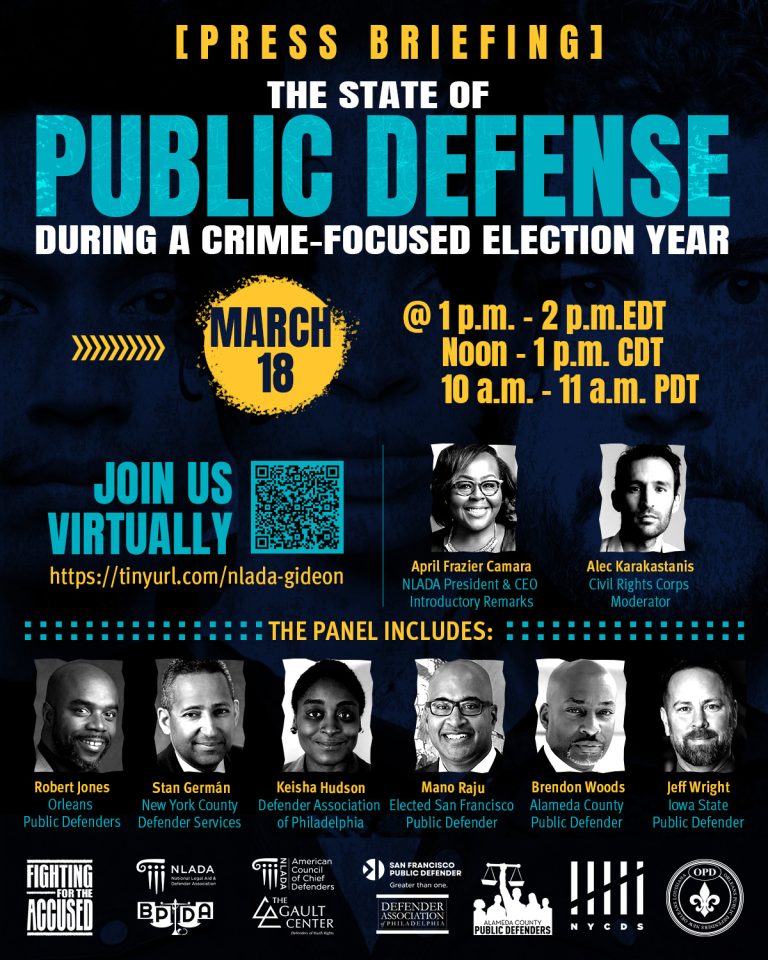
WASHINGTON — Chief public defenders from across the country gathered today for a discussion on the state of public defense during a crime-focused election year. Co-sponsored by the National Legal Aid and Defender Association (NLADA), the panel discussion commemorated Gideon Day, the anniversary of the U.S. Supreme Court’s unanimous decision in Gideon v. Wainwright, which recognizes the constitutional right to public defense for people who cannot afford counsel. A recording of the event can be found here, and a fact sheet/resource guide for reporters is available here.

“Public defender offices across the country are wholly under-resourced, while prosecutors and law enforcement are funded at several times the rate, and this funding discrepancy leads to greater disparities and injustices within the legal system,” said April Frazier Camara, president and CEO of NLADA. “Misleading narratives on crime and safety are fueling these policy decisions. Public defenders are joining forces to fight back against these fear-based tactics and to combat these practices.”

The discussion was moderated by Civil Rights Corps Founder Alec Karakatsanis, a civil rights lawyer and former public defender who has written extensively about “copaganda,” or the manipulation of media by police and prosecutors. 

“Public defenders are dedicated to safe communities, and their voices should not go unheard in the national conversation about crime and community safety,” said Karakatsanis. “The extraordinary focus by the media on low-level-crimes reported by police has the effect of manipulating what all of us think and feel are the most urgent problems in our society.  It distracts us from the greatest dangers that we face and obscures safety solutions right in front of our eyes. Public defenders can be an invaluable counterbalance to that.”

“Providing indigent individuals with fierce representation in court itself fosters safer communities—by guarding against wrongful convictions and by advocating against incarceration, which is incredibly destabilizing for families and communities,” said San Francisco elected Public Defender Mano Raju. “Our office also provides services that address the root causes of interactions with the criminal system, such as our MAGIC youth programs, our College Pathway Project, which helps formerly incarcerated people go to college and our End the Cycle program, which connects newly arrested people to services.”

Many reporters accept without question the information and crime statistics that police and prosecutors give them, and in turn, their stories are used to bolster policy decisions that benefit law enforcement and drive incarceration. Journalists do a disservice to their readers when their stories are more about feelings than facts, according to the panel.  

“We have seen this play out in New York State, where the Governor has rolled back our historic bail reform law on multiple occasions,” said New York County Defender Services Executive Director Stan Germán. “Politicians have succumbed to a fear-mongering campaign launched by proponents of mass incarceration rather than focus on the data analysis which clearly demonstrated the success of a bail law that reduced the racial and wealth disparities in our criminal legal system.”

Funding is an ongoing struggle for public defender offices in large cities as well as rural areas, despite the fact that basic fairness should dictate that prosecutors and defenders receive equal funding. 

“In most states, funding for DAs is two to one compared to public defenders, dollar for dollar,” said Alameda County Chief Defender Brendon Woods. “That’s not a fair fight. Another significant factor is the work police departments do in support of the prosecution, essentially providing a free investigatory wing to every prosecutor’s office in the state. If you fund systems that incarcerate people, more incarceration will result. And incarceration drains public resources away from solutions that address the root causes of crime like housing, jobs, and education.”

“One of our biggest challenges is retaining experienced attorneys, who often leave public defense for better-paying jobs in other sectors. If we had pay parity with other legal offices, we’d be able to keep more veteran lawyers, which means better representation to our clients,” said Defender Association of Philadelphia Chief Defender Keisha Hudson. “I think public defenders have tremendous value to the media because we have the insight and data to share the full story of our clients—not just as suspects, but as full human beings.”

“In rural communities, recruitment is challenging due to vast legal deserts. A shortage of lawyers makes workloads for existing public defenders extremely high,” said Iowa State Public Defender Jeff Wright. “We have difficulty competing with the salaries prosecutors and other legal professions are able to offer.” 

With greater funding parity, public defender offices are better able to engage in community outreach and to expand programs that prevent people from being funneled into the system in the first place, said Orleans Public Defenders Director of Community Outreach and Lead Organizer Robert Jones.

“Our clients are the community, so we need to be part of that,” said Jones, who is formerly incarcerated. “Community members need to see PDs everywhere. Our office partners with community organizations to assist people when they are in the criminal legal system, and moreover to keep them from having contact with the system.” 

This press briefing was sponsored by the NLADA, the American Council of Chief Defenders, the Black Public Defender Association, the Gault Center, San Francisco Public Defender’s Office, Defender Association of Philadelphia, the Alameda County Public Defender’s Office, Orleans Public Defender’s Office, and New York County Defender Services. This event is part of NLADA’s ongoing initiative, “Fighting for the AccUSed: The Public Defender Campaign for Safe, Secure Communities.” The Fighting for the AccUSed campaign is changing perceptions about public defenders in communities and the press. It also seeks to build public support for the passage of the federal EQUAL Defense Act (HR 3758) and the Quality Defense Act (S.850), and urges the Biden Administration to support other federal, state, and local efforts to fund public defense.

Public defenders are integral parts of the communities they serve and include social workers, investigators, community engagement professionals, and lawyers. Nationwide, about 80 percent of individuals who are accused of crimes in the legal system are represented by a public defender. 

The National Legal Aid & Defender Association (NLADA), founded in 1911, is America’s oldest and largest nonprofit association devoted to excellence in the delivery of legal services to those who cannot afford counsel. NLADA has pioneered access to justice at the national, state and local levels, playing a leadership role in the creation of public defender systems and other important institutions from The Sentencing Project to the Legal Services Corporation. A leader in the development of national standards for civil legal aid and public defense, NLADA also provides advocacy, training, and technical assistance for equal justice advocates across the country.

###

Media Advisory: San Francisco Public Defender Mano Raju to speak on panel regarding the state of public defense during a crime-focused election year

**MEDIA ADVISORY**

The State of Public Defense During a Crime-Focused Election Year

 On Gideon Day, public defense chiefs from across the U.S. will hold a virtual press briefing to commemorate the establishment of an accused person’s right to counsel and to challenge misleading narratives about crime

WHAT: Public Defender chiefs from across the United States will gather for a virtual press briefing, co-sponsored by the National Legal Aid and Defender Association, to discuss misleading narratives about crime, the effect of those narratives on criminal justice reform policies, and to propose tangible solutions for furthering community safety. The virtual event will be held on Gideon Day, Monday, March 18, the anniversary of the U.S. Supreme Court’s unanimous decision in Gideon v. Wainwright, which recognizes the Constitutional right to public defense for people who cannot afford counsel. The press briefing features a panel of leading public defender chiefs as well as a community equal justice advocate who will explore the critical role of public defense in advancing community safety and advocating for equal access to legal representation for all. 

WHEN: Monday, March 18 at 1-2 p.m. Eastern / Noon-1 p.m. Central / 10-11 a.m. Pacific

Please register here and a Zoom link will be sent to you. You can also register at tinyurl.com/nlada-gideon.

WHO: Panelists include: 

  • April Frazier Camara, president and CEO, National Legal Aid & Defender Association (Introductory remarks)
  • U.S. Rep. Jasmine Crockett, D-Texas (recorded remarks)
  • Alec Karakatsanis, founder, Civil Rights Corps (moderator)
  • Robert Jones, director of community outreach and lead organizer, Orleans Public Defenders 
  • Stan Germán, executive director, New York County Defender Services 
  • Keisha Hudson, chief defender, Defender Association of Philadelphia
  • Mano Raju, elected chief defender, San Francisco Public Defender 
  • Brendon Woods, chief defender, Alameda County Public Defender

ADDITIONAL BACKGROUND: 

This press briefing is sponsored by the NLADA, the American Council of Chief Defenders, the Black Public Defender Association, the Gault Center, San Francisco Public Defender’s Office, Defender Association of Philadelphia, Alameda County Public Defender’s Office, Orleans Public Defender’s Office, and New York County Defender Services. This event is part of NLADA’s ongoing initiative, “Fighting for the AccUSed: The Public Defender Campaign for Safe, Secure Communities.” The Fighting for the AccUSed campaign is changing perceptions about public defenders in communities and the press. It also seeks to build public support for the passage of the federal EQUAL Defense Act (HR 3758) and the Quality Defense Act (S.850), and urges the Biden Administration to support other federal, state, and local efforts to fund public defense.

Public defenders are integral parts of the communities they serve and include social workers, investigators, community engagement professionals, and lawyers. Nationwide, about 80 percent of individuals who are accused of crimes in the legal system are represented by a public defender. 

The National Legal Aid & Defender Association (NLADA), founded in 1911, is America’s oldest and largest nonprofit association devoted to excellence in the delivery of legal services to those who cannot afford counsel. NLADA has pioneered access to justice at the national, state and local levels, playing a leadership role in the creation of public defender systems and other important institutions from The Sentencing Project to the Legal Services Corporation. A leader in the development of national standards for civil legal aid and public defense, NLADA also provides advocacy, training, and technical assistance for equal justice advocates across the country.

###
Statement From the San Francisco Public Defender’s Office Regarding Misleading and Erroneous ABC7 News Story 

The San Francisco Public Defender’s Office stands by Deputy Public Defender Ilona Yañez, who was the subject of a recent misleading and erroneous report by ABC7 News’s Dan Noyes. The report omitted several key facts, misled viewers about the law and unfairly sought to impugn Ms. Yañez’s reputation. In publishing the story, ABC 7 News allowed itself to be a mouthpiece for DA Brooke Jenkins to carry out personal retribution against Ms. Yañez, and did a disservice to its viewers, who reasonably expect ethical journalism and professionalism. 

Our office attempted to correct these errors prior to the report’s publication, and though the report included portions of our statement, it omitted several key facts: 

The report omits the fact that an appellate court found District Attorney Jenkins had committed prosecutorial misconduct in a 2021 trial after Ms. Yañez raised concerns about Jenkins’ behavior. This fact is critically important because it explains Jenkins’ motivations for participating in and/or orchestrating this story attacking Ms. Yañez.  

The report omits the fact that Jenkins’ office vindictively punished our client, Mr. Gamero, for exercising his constitutional right to a jury trial by turning a domestic violence case into a life-eligible torture case. Mr. Gamero rejected an offer for him to plead guilty in exchange for six years state prison. Then after he decided to assert his right to trial, the District Attorney’s office added a new charge that would expose him to life in prison and made no offer to settle the case.  

The report does not cite a single state law or ethical rule that was supposedly violated. Rather, it quotes legal experts who had no firsthand knowledge of the case and had not spoken with our office. Likely because they were given one-sided information, the comments they made about this case are simply inaccurate. 

Contrary to the ABC 7 News report, it is appropriate and ethical under California law for a public defender to take the following actions as part of their duty to provide a vigorous defense of their client:  

1) Attempt to speak with a victim in a criminal case. Extensive case law supports this. The victim in criminal cases is a witness; and it is, in fact, considered ineffective assistance of counsel for a public defender to NOT try to speak with witnesses.  

  • “Defense counsel has a fundamental duty to the client to investigate and attempt to secure exculpatory information.” And: a “substantial portion of the [Constitutional] obligation counsel owes is not directly connected with the trial but involves investigation and advice at pretrial and post-trial stages.” (People v. Pope (1979) 23 Cal.3d)   
  • “Upon learning that a witness may have relevant evidence, there’s a duty to interview the witness.” (People v. Shaw (1984) 35 Cal.3d) 
  • “Where counsel is on notice potential exculpatory evidence exists, a decision not to investigate cannot be countenanced”; (People v. Rodriguez (1977) 73 Cal.App.3d)   
  • A criminal defense lawyer has a basic duty to “become thoroughly familiar with the factual and legal circumstances of the case” (Keenan v. Superior Court (1984) 31 Cal.3d;  
  • It is “patently incompetent” for a defense attorney not to interview a witness “regarding the crux of the anticipated defense” (In re Cordero (1988) 46 Cal. 3d) 

Further: Marsy’s Law (Cal. Const. art. I, sec. 28(b)(5)) establishes that a victim can refuse to be interviewed by anyone acting on behalf of the defendant. The victim in the Gamero case never refused to be contacted by Ms. Yañez and in fact reached out to Ms. Yañez via email to ask if there was any way she could speak to Mr. Gamero (and was told no). 

2) Convey information to and from their client regarding a civil (small claims) case, since the client is frequently not permitted to speak with the victim except through their attorney (as was the case here);  

There is no rule that prohibits criminal defense attorneys from communicating with victims of crime to arrange payment to settle a small claims suit. At the time of such communications in the Gamero case, Mr. Gamero was incarcerated and subject to a criminal protective order prohibiting communication between himself and the victim except through his attorney, Ms. Yañez. Ms. Yañez’s communications with Ms. Cahen were not only appropriate, but were also made specifically so her client could abide by the court’s order.  

3) Speak with jurors after a trial has concluded about what sentence a client could receive.  

After a trial has concluded, attorneys are permitted to speak with jurors, and jurors are permitted to ask attorneys about a case as well as to send letters expressing their thoughts to the judge. It is reasonable that Ms. Yañez responded to jurors’ questions about the sentence her client was potentially facing. The possible sentence was public information at that time. It’s also important to point out that in this case, the District Attorney’s Office itself issued a press release after the verdict and before sentencing that explicitly stated the possibility of a life sentence. The jurors who decided to contact the court regarding the client’s forthcoming sentencing did so of their own volition and were not coerced in any way. 

The attacks on Ms. Yañez’s ethics and character are totally baseless—she is a defense lawyer, and her job requires her to defend her client. As the U.S. Supreme Court unanimously held in Gideon v. Wainwright, 372 U.S. 335 (1963), everyone facing criminal charges has the right to legal representation under the Sixth and 14th Amendments to the Constitution. We stand by Ms. Yañez, who carried out her legal and ethical duty to her client in providing a vigorous defense.  

## 

Coalition to End Biased Stops Applauds SF Police Commission Vote to Implement Policy to Curb Racially-Biased Police Stops

FOR IMMEDIATE RELEASE: February 23.2024

MEDIA CONTACT: PDR-MediaRelations@sfgov.org 

**PRESS RELEASE**

Coalition to End Biased Stops Applauds SF Police Commission Vote to Implement Policy to Curb Racially-Biased Police Stops

SAN FRANCISCO – On Wednesday night, the San Francisco Police Commission voted to enact an historic policy (Department General Order 9.07) to curb SFPD’s use of racially-biased pretext stops. This vote comes after an unprecedented public input process that lasted more than a year and after nearly a year of bargaining with the Police Officer’s Association. The Commission has directed SFPD to implement this policy within 90 days. 

Police often use certain vehicle, pedestrian, and traffic codes as a “pretext” to look for evidence of other unrelated crimes without legal justification. Police disproportionately use such stops against Black and brown people, who are also more likely to suffer from police use of force during these interactions. 

According to the SFPD’s own analysis, SFPD officers stopped Black individuals at six times the rate of white individuals, searched Black individuals at more than ten times the rate of white individuals, and used force on Black individuals at more than twenty-one times the rate of white individuals. 

Members of the Coalition to End Biased Stops, which includes over 110 traffic safety and civil rights groups that pushed for the Commission to address the racial disparities in police stops, commented on the historic vote. 

“I applaud the courage of the independent Police Commissioners who put politics aside and voted to protect communities of color in San Francisco during this important month that we celebrate Black history,” said Deputy Public Defender Brian Cox, Director of the San Francisco Public Defender Integrity Unit. “These modest but important changes will help turn the tide on the unacceptable racial disparities in police stops and spare countless individuals and families the trauma of unlawful searches, needless detentions, and police violence.”  

Sameena Usman, Senior Government Relations Coordinator for Secure Justice stated, “The vote to restrict pretextual stops was essential, given the evident patterns of SFPD officers disproportionately stopping, searching, and using force against Black individuals, far exceeding rates for white individuals. We remain committed to fostering a society where everyone, irrespective of their background, can move freely without fear of unwarranted stops of profiling.”

“The Police Commission’s vote to restrict pretext stops is an important step towards reducing racist policing tactics where police officers disproportionately stop and search Black and Brown people under the guise of traffic enforcement,”  said Yoel Haile, Director of the Criminal Justice Program at the ACLU of Northern California. “Now we will work to make sure SFPD implements the policy to prevent unnecessary encounters between police officers and San Francisco residents that all too often escalate and end in tragedy.”

“While voting to enact this policy limiting racially-biased stops is an important step, we recognize that more work needs to be done to heal the harms inflicted on communities of color due to decades of over-policing and underinvestment,” said San Francisco Public Defender Mano Raju. “My office looks forward to participating in the rollout of this pretext policy by informing the public of their rights. The fight for racial justice continues.”

##

Traffic Safety, Civil Rights Groups Urge SF Police Commission to Override Police Union’s Stalling and Enact Policy Limiting Racially-Biased Pretext Stops  

FOR IMMEDIATE RELEASE: Feb. 7, 2024

MEDIA CONTACT: SF Public Defender’s Office | Jessie Seyfer |  PDR-MediaRelations@sfgov.org | (415) 851-2212

**PRESS RELEASE**

Traffic Safety, Civil Rights Groups Urge SF Police Commission to Override Police Union’s Stalling and Enact Policy Limiting Racially-Biased Pretext Stops  

SAN FRANCISCO – The Coalition to End Biased Stops, a coalition of more than 110 civil rights, traffic safety, and community groups, is urging the San Francisco Police Commission to enact its Pretext Stop policy (DGO 9.07). The Coalition worked together over a 16-month period to urge the Commission to address the harms caused by pretext stops — the police practice of using alleged traffic or pedestrian violations as a “pretext” to detain and search people. Although the Commission approved the policy nearly a year ago after extensive community outreach and input from SFPD, the policy has not gone into effect because it remains stalled in the Police Officers Association’s “meet & confer” process.  Today, the Coalition submitted a letter urging the Commission to end negotiations with the POA so that the policy can go to a final Commission vote for implementation. The policy is on tonight’s Commission meeting agenda for discussion in a closed session.

The Coalition letter states:

“For more than two years, the Coalition has proudly participated in one of the most comprehensive DGO community outreach processes. In 2022 alone, the Commission held 4 public meetings and 7 Human Rights Commission-led community listening sessions across the city, in addition to two meetings just for officers. This DGO has also been discussed at Commission meetings more than a dozen times, with public comment. Furthermore, the Human Rights Commission led an online survey process and reported on the survey results to the Commission. The Commission also publicly posted each DGO draft from May 6, 2022, until March 15, 2023, when the Commission unanimously approved to send the DGO to the [POA’s] meet and confer process. Before doing so, the Commission incorporated Chief Scott’s feedback, who actively participated in the entire process and supported the final version.”

Extensive research has shown that pretext stops are in fact racially-biased stops, as police disproportionately use such stops against Black and brown people, who are also more likely to suffer from police use of force during these interactions. According to the SFPD’s own analysis, SFPD officers stopped Black individuals at 6x the rate of white individuals, searched Black individuals at more than 10x the rate of white individuals, and used force on Black individuals at more than 21x the rate of white individuals. SFPD may be stopping and searching BIPOC drivers based on racist assumptions at an even higher rate than the data indicates. A 2023 SF Department of Police Accountability report found that one SFPD officer had misidentified the race of at least 25 individuals he had stopped. The California Racial and Identity Profiling Advisory Board (RIPA), the Public Policy Institute of California (PPIC), and the American Public Health Association have all recommended reducing pretext stops to curb these pervasive racial disparities, which inflict untold economic, physical, psychological and intergenerational harm on Black and brown communities.

In March 2023, the Commission unanimously adopted Department General Order DGO 9.07 which identifies nine types of traffic stops that SFPD could no longer use as the primary reason to pull someone over without further justification. It would not prevent police from making traffic stops for hazardous driving or if officers suspect that a crime has been committed. SFPD Police Chief Bill Scott supported the Police Commission adopting this version of the policy. 

Members of the Coalition to End Biased Stops – which includes GLIDE Foundation, SF Bicycle Coalition, ACLU of Northern California, Office of the San Francisco Public Defender, Walk San Francisco, and Secure Justice – provided the following quotes in support of ending pretext stops: 

Claire Amable, Director of Advocacy, SF Bicycle Coalition: “Ending pretext stops is in line with what San Franciscans want — safer streets and more livable communities for all. This policy will help SFPD focus their efforts on the dangerous driving behaviors killing people on our streets and will reduce the racial profiling that has been inflicted on Black and brown communities.” 

Jodie Medeiros, Executive Director, Walk San Francisco: “As part of the Coalition, we are asking the Police Commission to adopt a comprehensive policy that ends pretext stops. For pedestrian safety, law enforcement should be focused on dangerous driving behaviors, not non-safety violations.” 

Naeemah Charles, Senior Director of the Center for Social Justice, GLIDE Foundation: “Glide is proud to have been closely involved in the extensive community engagement process for this DGO that lasted over two years. The Police Commission has already passed this DGO unanimously, and it’s time to finally put this policy into action for the safety and wellbeing of all our diverse community members.” 

Sameena Usman, Senior Government Relations Coordinator, Secure Justice: “Pretext stops for minor infractions – like hanging prayer beads from a rearview mirror or having one broken taillight – are an abuse of state power and perpetuate economic and racial injustice, which is recognized as such by everyone but the POA. The Commission has continued to allow this injustice through their unacceptable inaction and delay.” 

Yoel Haile, Criminal Justice Program Director, ACLU of Northern California: “San Francisco cannot wait any longer for this urgently needed reform to go into effect. Racially-biased police stops are ineffective and a waste of taxpayer resources. Other jurisdictions around the state and around the country have already taken steps toward banning these stops because they too often lead to violations of civil rights, police use of force, and fatalities. The San Francisco Police Officers Association is once again stalling the implementation of an important policy that has been recommended statewide, and it’s time for the Police Commission to exercise its authority to declare an impasse in order to put this policy into action for the safety and well-being of the community.” 

Elected San Francisco Public Defender Mano Raju: “Our communities are depending on San Francisco’s independent Police Commission to protect the public from the harms of racially-biased stops, which put Black and Brown drivers, cyclists, pedestrians and families at greater risk of harassment, police violence, and unnecessary contact with the criminal legal system. The police have shown time and time again that they cannot police themselves, and we need a strong pretext stop policy to ensure equal treatment of all community members.”

##