Home Blog Page 28

Federal Judge orders ICE to release four detained immigrants at risk of serious illness or death from COVID-19 infection

Federal Judge orders ICE to release four detained immigrants at risk of serious illness or death from COVID-19 infection

SAN FRANCISCO – On April 8, 2020, a federal judge ordered the release of four immigrants detained in two ICE detention centers in California on the grounds that their age and medical conditions make them especially vulnerable to the potentially fatal COVID-19 infection.

“None of these [individuals] is in a position to meaningfully limit his exposure to COVID-19 while at Yuba or Mesa Verde,” Judge Chesney affirmed in a ruling Wednesday.

The judge’s decision came in response to a lawsuit filed by the ACLU Foundations of Northern California and Southern California, Lawyers’ Committee for Civil Rights of the San Francisco Bay Area, the San Francisco Public Defender’s Office, and Lakin & Wille LLP. 

“Immigration detention is unnecessary generally, but now with COVID it is putting people at risk,” said Shelly Clements, the wife of Charles Joseph, one of the plaintiffs ordered released. “I feel blessed that my husband is coming home.”

Collectively the four plaintiffs suffer from a range of serious medical conditions, which the CDC has identified as placing people at a particularly high risk of contracting this highly contagious disease. 

Salmon Medina Calderon has been diagnosed with diabetes. He has lost all of the vision in one eye and 70 percent in the other. Gennady V. Lavrus also has diabetes that requires insulin injections. Charles Joseph suffers from severe asthma. J. Elias Solario Lopez, 82, has a history of hypertension and kidney disease.

“This decision is an important step,” said William Freeman, senior counsel at the ACLU Foundation of Northern California. “The stakes for the release of detained persons are at an all-time high as the threat of the COVID-19 outbreak places them at an elevated risk of serious ailments or death.”

San Francisco Public Defender Manohar Raju said that, “The judge recognized that releasing vulnerable immigrants because of the COVID pandemic is urgent, constitutionally mandated, and in the interest of public health. Immigrants in ICE detention centers should be released immediately. It is unfortunate we had to resort to the courts for this relief. ICE should be doing this on its own.”

“ICE’s abysmal response to COVID-19—including its intransigent refusal to heed public health experts and release as many detainees as necessary—violates the Constitution,” said Jordan Wells, an attorney with the ACLU Foundation of Southern California. “Worse, it risks human life and threatens to exacerbate the pandemic. We are relieved for those who the Court ordered ICE to release. And we will continue fighting for everyone unsafely languishing in ICE prisons.”

Bree Bernwanger, senior staff attorney at the Lawyers’ Committee for Civil Rights of the San Francisco Bay Area, issued the following statement: “Our brave clients have shown that while the rest of world takes unprecedented safety measures in the face of a global pandemic, ICE has endangered their lives by continuing business as usual. But in this decision, the Court recognized that no immigration policy is more important than protecting human life.”

Judah Lakin of Lakin & Wille LLP, issued the following statement: “ICE’s refusal to change its policies and practices during this pandemic is not only disheartening, but clearly unconstitutional. We will continue to fight not only for the remaining plaintiffs in our lawsuit, but the greater incarcerated population at large.”

#
PRESS STATEMENT: San Francisco Public Defender Mano Raju Calls for Release of Immigrant Detainees at Yuba County Jail and Mesa Verde Detention Center

0

All of our incarcerated clients – including our clients in immigration detention centers – continue to be at a heightened risk of being exposed to COVID-19, and my office is fighting every day for their health and safety.

Immigration detention facilities are particularly at risk with regards to spread of infectious diseases because of congregate-style sleeping arrangements, crowding, the proportion of vulnerable people detained, the lack of proper sanitation supplies, and consistently inadequate medical care resources.

Yuba County Jail and the Mesa Verde Detention Center – the two ICE detention centers where most of our immigrant clients are being held – are not equipped to keep detainees or staff safe during this public health crisis. For over forty years, Yuba has been under court-ordered Consent Decree due to its failure to provide detainees with adequate medical care. The Mesa Verde Detention Facility is a privately run, for-profit facility that houses up to 400 non-citizen detainees in congregate settings who are in civil detention.

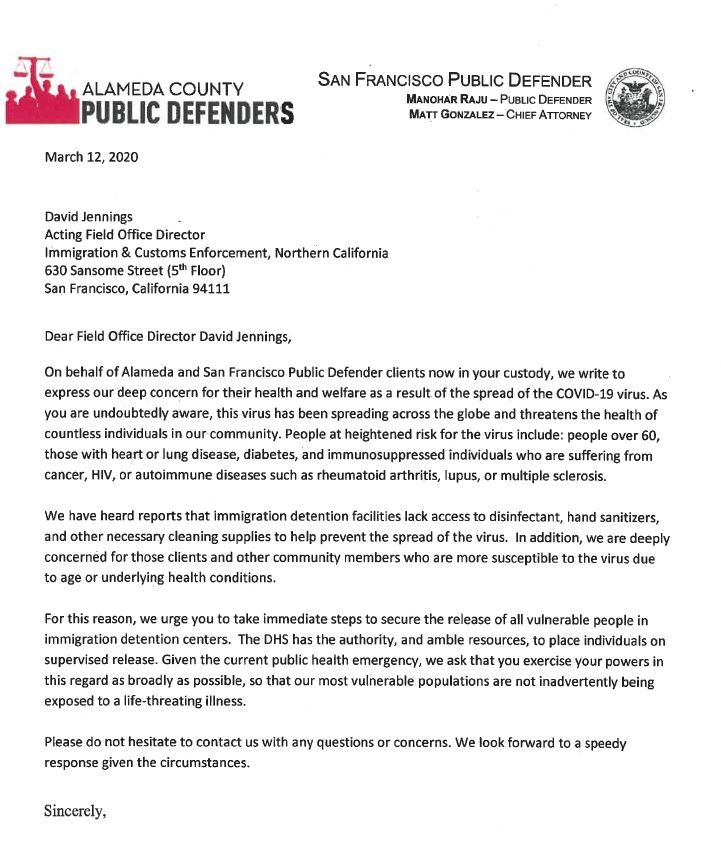
For these reasons, I sent a letter today to ICE Field Officer David Jennings, requesting the immediate release of detainees from these two locations.  

Congress has explicitly granted ICE the authority to release detainees for “urgent humanitarian reasons or significant public benefit.”  ICE not only has the authority to exercise discretion and release individuals from custody, but also has routinely exercised this discretion to release vulnerable detainees in the past. Detainees can be released to federally-approved alternatives to detention such as telephonic reporting requirements or even electronic monitoring.

In this crisis, every single detainee held at Yuba and Mesa Verde is vulnerable to contracting and spreading the virus, and should be released from custody and provided opportunities for alternatives to detention immediately. We must take these urgent measures now to protect immigrant detainees, detention center staff members, family members, and the broader community from contracting this virus.

Mano Raju, Public Defender of San Francisco – March 19, 2020

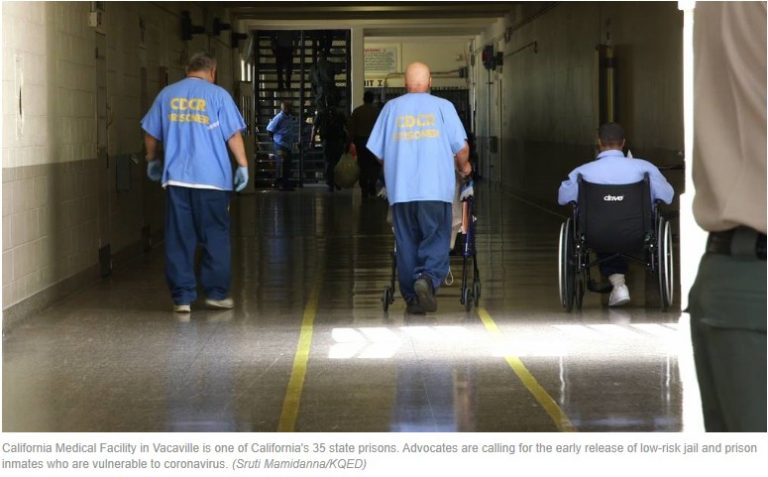
Calls Mount for Release of Vulnerable Prisoners as Justice System Struggles to Respond to Coronavirus – KQED

Calls Mount for Release of Vulnerable Prisoners as Justice System Struggles to Respond to Coronavirus

By Marissa Lagos – KQED

As much of California life grinds to a halt because of the coronavirus pandemic, some groups are asking local and state officials to take sweeping actions — including letting people out of prison or jail early — to protect those who are incarcerated or otherwise connected to the state’s criminal justice system.

So far, state and local officials haven’t responded with any wide-scale releases. Most lockups, including state prisons, have suspended visiting hours and programs in order to guard against the spread of the virus.

But courts are still operating: San Francisco Superior Court, for example, is delaying civil trials and telling lawyers, jurors and defendants not to come to court if they are sick but so far has not suspended in-person operations.

Among those calling for a widespread early release of prison and jail inmates are civil liberties groups. Last week a group of two dozen, including the ACLU, sent a letter to California officials demanding that Gov. Gavin Newsom take extraordinary steps to protect the state’s roughly 123,000 prison inmates from the coronavirus — including the early release of some low-risk prisoners.

The groups singled out those who are most vulnerable — the medically fragile and people over 60 — as well as those already scheduled for release in the coming weeks and months.

Lizzie Buchen, ACLU Northern California’s criminal justice project director, noted that state prisons remain at about 130% of their designed capacity in California.

“Prisons and jails are such breeding grounds for disease … and they are just packed and overcrowded with people who are extremely vulnerable to this disease, including people who are elderly and people with other underlying health conditions like asthma and cancer and HIV,” she said. “They are in conditions that are the perfect breeding grounds for coronavirus to spread. It’s unsanitary. People are sharing things. People are sharing toilets. People share close airspace. … [It’s a] combination that will result in a humanitarian crisis.”

San Francisco Assessing Jail Population

San Francisco Public Defender Mano Raju announced Thursday that his office is filing motions seeking to secure the release of all pretrial detainees who are at heightened risk for the virus because of their age or compromised immune systems.

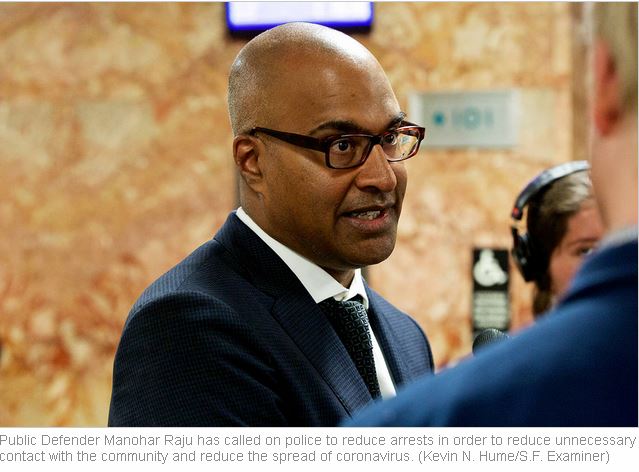
Raju has also called on local police to reduce “unnecessary contact” with the public, including suspending low-level arrests.

Raju asked San Francisco Sheriff Paul Miyamoto to assess the jail population and identify anyone eligible for immediate release through work release or electronic monitoring.

“I’m asking for people in law enforcement to really alter behavior based on the fact that we are in an international health crisis,” he told KQED News. “There are at least 300 people in the jail … [who are] going to be released in six months or less. … All I’m saying is that if they’re going to be released in a few weeks, let’s look at just releasing them now.”

Miyamoto responded that his agency is already doing that as part of its normal operations.

Miyamoto also noted in an interview Friday that inmates do have access to health care — sometimes better care than some may have access to in the community, he argued — and said jails are set up to allow people to quarantine in cells.

A few hours after Friday’s interview, Miyamoto decided to suspend jail visits. He said the department is ensuring that inmates can continue to communicate with their lawyers and is working to ensure that families can keep in touch.

“We are sensitive to the difficulties that suspended visits may cause families of the incarcerated,” he said in a written statement. “We value visitation as an essential part of rehabilitation and encourage families to stay in touch with their loved ones and friends through phone calls and letters. We are reviewing our jail operations and will make adjustments to accommodate future visiting.”

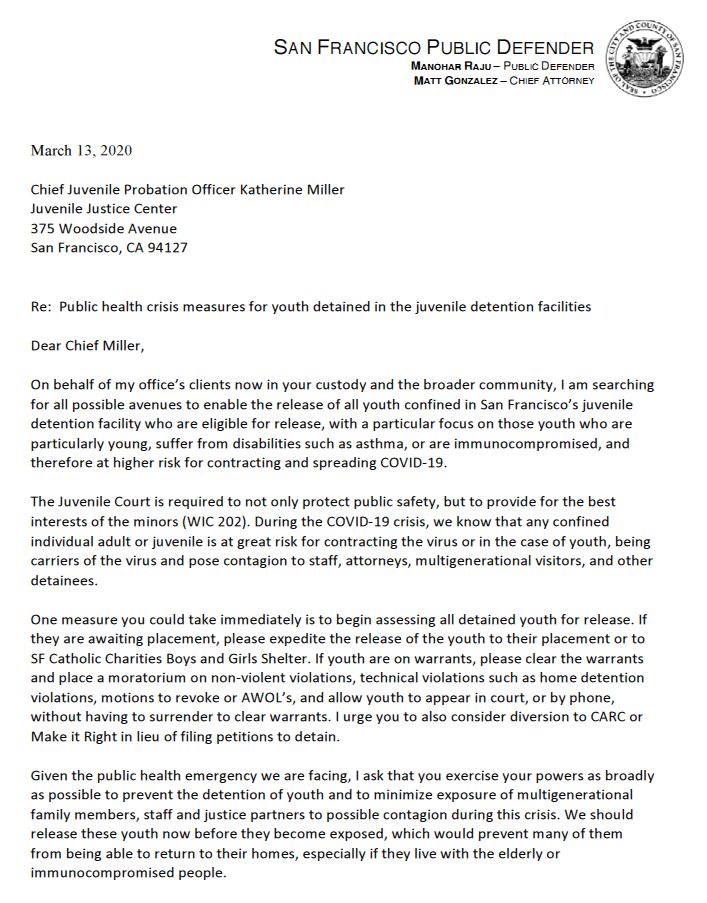
Letter to Juvenile Probation in regards to COVID-19

0

San Francisco Public Defender, Mano Raju, sent the following letter to the Director of Juvenile Probation:

San Francisco and Alameda County Public Defenders’ joint letter to ICE of Northern California

0

Mano Raju, San Francisco Public Defender

Brendon Woods, Alameda County Public Defender

Coronavirus fears prompt call for SF police to halt arrests in non-violent cases – The SF Examiner

Coronavirus fears prompt call for SF police to halt arrests in non-violent cases

Public defender asks SFPD to reduce ‘all unnecessary contact’ with detainees who pose no safety risk

By Michael Barba – San Francisco Examiner – March 12, 2020

Citing the need to undercut the spread of coronavirus, San Francisco’s public defender has called on police to stop issuing citations or arresting people for crimes as serious as non-violent felonies.

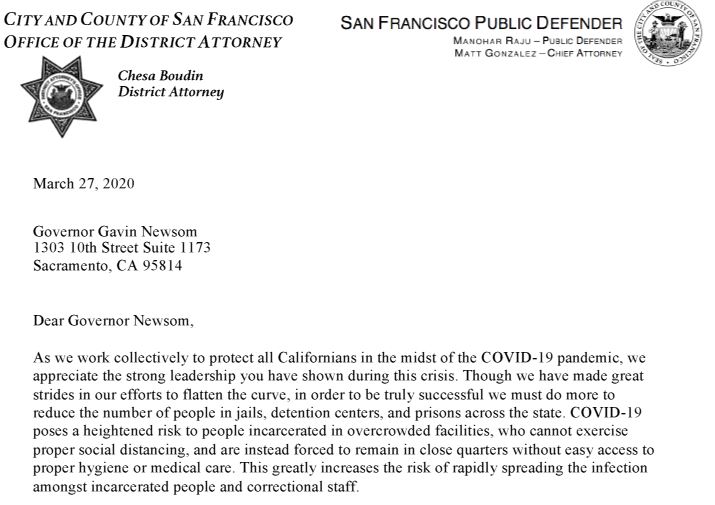
Public Defender Manohar Raju sent a letter to Police Chief Bill Scott on Wednesday urging him to help ensure that “detained persons are not inadvertently being exposed to a life-threatening illness.”

“As we all follow recommendations to avoid congregating and preserving more personal distance than usual,” Raju wrote, “We must be especially mindful to reduce criminal legal system contact to the greatest extent possible, while also upholding the duty to protect public safety.”

Raju asked Scott to command his officers to “reduce all unnecessary contact with the community.”

He said officers should stop citing or arresting people for infractions, misdemeanors and non-violent felonies “unless there is a clear and present danger of imminent harm.”

The public defender specifically requested that people not be cited for infractions, or cited or arrested for “low-level misdemeanors that do not pose a public safety risk.”

The San Francisco Police Department did not immediately respond to a request for comment.

Earlier this week, Raju called on Sheriff Paul Miyamoto to take steps to prevent a COVID-19 outbreak in San Francisco’s jails. He also asked Miyamoto to help secure the release of inmates who may be vulnerable to the virus or eligible to be let out.

On Thursday, Miyamoto published an action plan to prevent the virus from spreading with measures that included beefed-up screening procedures for people being booked.

“We screen every person for infectious diseases as part of the jail booking process,” Dr. Lisa Pratt, medical director of Jail Health Services, said in a statement. “In addition, we have instituted enhanced screening and isolation procedures to rapidly identify and separate any person with concerning symptoms.”

While the number of confirmed coronavirus cases in San Francisco climbed to 18 on Thursday, no inmates have tested positive at this point, according to city officials.

Raju has also asked the Police Department to produce a plan for avoiding the spread of coronavirus on items like handcuffs and in areas including police vehicles and holding cells.

Letter from Mano Raju to Chief Bill Scott – Seeking SFPD response to COVID-19

0

Reference: Washington Association of Sheriff’s & Police Chiefs

Jury Acquits Mother Charged with DUI after Fleeing Domestic Abuse

Jury Acquits Mother Charged with DUI after Fleeing Domestic Abuse

SAN FRANCISCO — Yesterday, a jury found Liz Anaya, 31, not guilty of DUI charges that arose when she was fleeing domestic abuse from her partner. 

Her attorney, Deputy Public Defender Nitin Sapra, successfully argued that she had not planned on driving that night, but only did so out of necessity to get away from a dangerous situation.

“The circumstances surrounding DUIs are often much more complex than meets the eye. Ms. Anaya was terrified for her life, and was just trying to get away from a violent situation. I am glad that the jury saw this for what it was — a young mother doing whatever she needed to do to flee an abuser,” said Sapra.

Ms. Anaya had been in an abusive relationship for 4 years. During the trial she shared that her partner had taken control over her life, cutting her off from family, friends and her profession as a hairstylist. The night of February 25, 2019, when he came home, he realized that she had had a drink with their housemate, and he became outraged. He then began to batter her, and she feared that he would beat her as he had done before. She was able to flee her home and drive around the corner, where she turned off the car, put on her hazard lights, and called her son who was on his way home.  Meanwhile, her partner called the police and accused her of drunk driving. 

Body worn cameras showed that police arrived and talked to her partner for several minutes outside the home before they went looking for Ms. Anaya. They found her in the car with the engine off, but instead of asking her about the domestic disturbance or why she had fled her home, they proceeded with a DUI investigation. 

Prosecutors refused to dismiss the case prior to trial. 

Ultimately, the jury agreed that, despite having alcohol in her system, she had only driven out of necessity to escape a situation that was more dangerous than her driving a short distance, where she did not injure any person nor destroy any property.


San Francisco Officials Push to Reduce Jail Population to Prevent Coronavirus Outbreak – The Appeal

By Darwin BondGrahamThe Appeal – Mar 11, 2020

San Francisco Officials Push to Reduce Jail Population to Prevent Coronavirus Outbreak

The public defender and district attorney both directed their staffs to keep individuals who are more vulnerable to the virus out of jail.

The two public officials on opposing ends of San Francisco’s criminal legal system are taking action to prevent the holding of individuals at greater risk of dying from the COVID-19 virus in the county’s jails.

San Francisco Public Defender Manohar Raju issued a statement Tuesday that his office’s attorneys “will begin filing motions to seek the immediate release of all clients being held pre-trial in San Francisco county jails who are at heightened risk for illness from coronavirus.” This includes people over 60 years of age and those with medical conditions like heart and lung disease. Raju called San Francisco’s jails “cramped and unsanitary.”

San Francisco District Attorney Chesa Boudin directed his prosecutors not to oppose motions to release pretrial detainees facing misdemeanor charges or drug-related felony charges if the person is deemed to pose no threat to public safety. Boudin also directed his staff to “strongly consider” credit for time served in plea deals so that more people can be released.

As of Tuesday, 14 people in San Francisco had contracted the coronavirus, according to county health officials. The city’s jails, which hold approximately 1,200 people each day, haven’t yet reported any cases of the dangerous virus.

Raju is also seeking earlier release for some who are already sentenced. In a letter sent to San Francisco Sheriff Paul Miyamoto on Tuesday, Raju requested the sheriff immediately assess all sentenced persons in the jails for immediate release on electronic monitoring and work release programs.

In a response to Raju, the sheriff wrote that “those who are under our care receive medical treatment that is among the best in the country.” The sheriff’s office told The Appeal that its jails have access to medical test kits through the Department of Public Health, and dedicated medical isolation units for those who show symptoms.

An enormous number of people are booked into California’s jails each day, making it quite possible the coronavirus will soon appear behind bars where many are forced to live in close proximity with hundreds of strangers, often in unsanitary conditions. 

Across San Francisco Bay, the Santa Rita Jail located in Alameda County, one of the nation’s largest with an average daily population of 2,600, has already been dealing with two influenza incidents this year. In February, three people tested positive for Influenza Type A, a viral infection of the respiratory system that can sometimes require hospitalization.

Sgt. Ray Kelly of the Alameda County Sheriff’s Office told The Appeal that the incident resulted in a quarantine affecting 70 people. The quarantine was lifted after no others tested positive, but on Monday another detainee was found to have Influenza Type A, and a new quarantine affecting 50 people is in place.

Kelly said the flu outbreak was good preparation in advance of the coronavirus, and that the jail and county medical staff are taking extra steps to screen people booked in the jail.

“We know if we get one COVID case in the jail it probably is going to bring a major disruption to the criminal justice system in Alameda County,” Kelly said. “It will affect the courts, jail, and officers on the street who may not be able to book arrestees into our jail.”

Many people in jail are also at greater risk of dying from the virus. 

“We’re dealing with a very at-risk population with a lot of underlying health problems,” Kelly said. “Some have compromised immune systems, HIV, cancer, and hepatitis. This is like the most at-risk group in society who ends up in jail.”

Santa Rita recently added a nurse in the jail’s public intake area to screen people for symptoms of coronavirus as they arrive. The Sheriff’s office has also reached out to local police asking them to use their discretion and not book people into the jail for misdemeanors, if the person isn’t a threat to public safety.

Other California jails are also bracing themselves for the COVID-19 virus.

In Los Angeles, site of the largest jail system in the nation, the sheriff’s department announced plans to closely monitor and isolate those who show symptoms. Those who test positive will be relocated to the jail’s medical ward. The Los Angeles jails have yet to report any COVID-19 cases. The Los Angeles Department of Public Health will also monitor people after they are released from jail for symptoms, according to a press release from the sheriff.