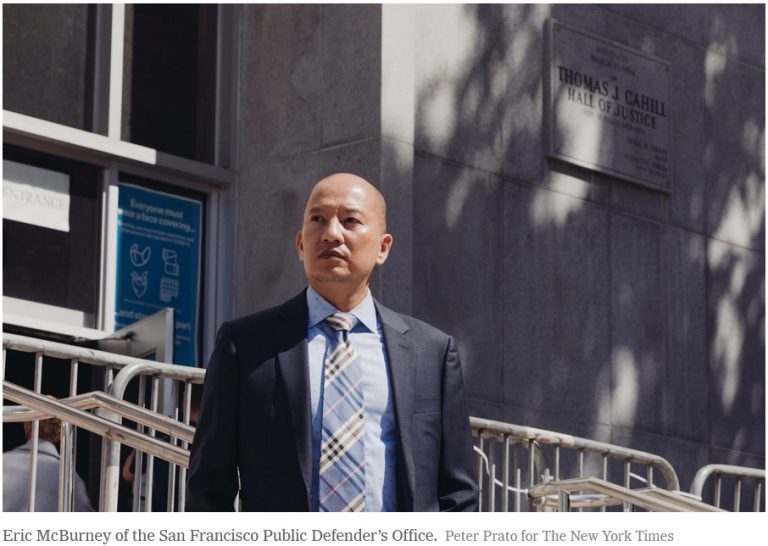
In this excellent profile by Thomas Fuller of the New York Times, he interviews Deputy Public Defender Eric McBurney who is defending Steven Jenkins, the man accused of attacking two elderly Asian people at U.N. Plaza in San Francisco on March 17, 2021. Mr. McBurney, who was born in Taiwan and adopted as a teen by a family in the American South, received general hate mail and even criticism from his extended family in Taiwan, for representing Mr. Jenkins in an act that was initially reported around the world as another incident in a string of attacks against Asian people. In April, Mr. McBurney and the San Francisco Public Defender’s Office released previously unseen video surveillance revealing that Mr. Jenkins was himself the victim of a violent attack from multiple unknown parties moments before he encountered and struck the 75-year-old woman once before being tackled by a security guard.
“It’s when the whole world is against your client, that’s when a public defender says, ‘Yeah, this is my job.’” – Eric mcburney
The Complex Case Emerging of the Attack of an Asian Woman in San Francisco
Eric McBurney of the San Francisco Public Defender’s Office says his client is mentally ill, not hateful.
Steven Jenkins, a 39-year-old homeless man with a long history of severe mental illness, was arrested on charges of assaulting two Asian residents, including a 75-year-old woman who, according to the headlines flashed around the world, had bravely fought her attacker.
In an unusual attempt to dispel the notion that his client acted out of hate, McBurney in April released a seven-minute video showing the assault on Xie and the moments that preceded it.
On the day of the attacks, Jenkins, who has been homeless for the past decade, was mingling among the tents and belongings of the unhoused at U.N. Plaza. In footage taken from security cameras, Jenkins is seen being punched and kicked dozens of times by a number of unknown assailants, attacks that McBurney describes as unprovoked.
One attacker in a bright-yellow vest appears to land two right hooks to Jenkins’s face and then follows him across a sidewalk on Market Street. Jenkins staggers, turns around and swings. He strikes Xie, who is on a street corner, in the face.
Tackled by a security guard, Jenkins is on the ground when Xie hits Jenkins’s feet with a wooden board, the video shows. Not captured in the footage was another assault that Jenkins is accused of committing on Ngoc Pham, an 83-year-old Vietnamese man.
On the day of the attack, the first images that streamed around the world showed Jenkins on a stretcher with a bloodied face and Xie nearby holding a wooden board. The story of the elderly Asian woman who fought back was born.
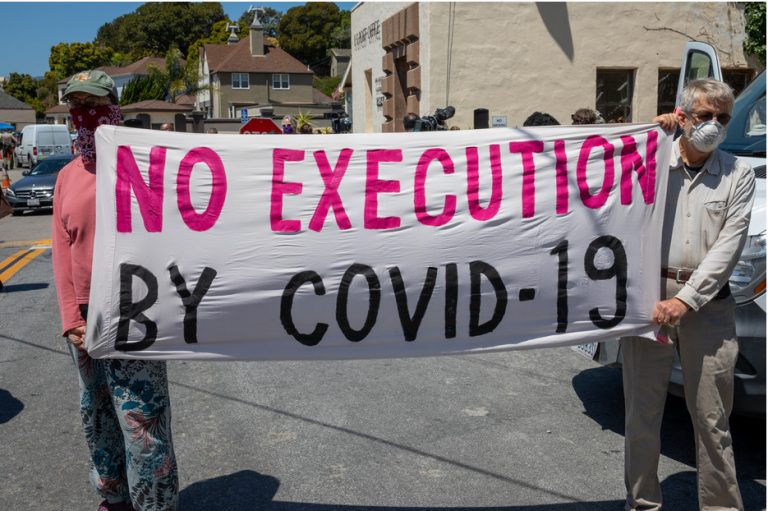
On May 19, 2021, testimony began in an evidentiary hearing against San Quentin State Prison and the California Department of Corrections and Rehabilitation (CDCR) for their mishandling of a disastrous transfer of COVID-19-infected persons from the California Institution for Men to San Quentin, resulting in a massive outbreak and 29 deaths in the summer of 2020. The cases come to court as individual “habeas corpus” petitions – emergency filings alleging unlawful incarceration under the Eighth Amendment to the United States Constitution’s prohibition against “cruel and unusual punishment.” Over 300 petitions were joined together for the evidentiary stage of the proceeding.
To learn more about this habeas case – including a chronological FAQ, court filings, and the link to watch the proceedings, please visit SFPublicDefender.org/habeas.
The Davis Vanguard is publishing articles on the daily testimony. We’ll continue update this page, but here the headlines and some telling excerpts. Click through to the full articles.
After being exposed to unsafe conditions for a few hours, Mattox and the other 23 transfers were escorted to their buses that would take them on an 11 hour ride to San Quentin...
Upon arrival at San Quentin, Mattox recalled being uncuffed and put in a cell with three to four other people.
Two days after Mattox arrived he was finally tested for COVID, but was informed four to five days after taking the tests. After he had been tested he was put in an isolation cell. He described the unsanitary conditions of the cell and informed the court of the carelessness of the officers in maintaining cleanliness. He recalled that the cell was “filthy and an officer took water with bleach and doused the walls and mattress and left without giving me a towel to wipe up.
The witness began crying as he explained that when the medical staff came by, his friend was not responding. The witness began to yell at the staff that he was not breathing.
When they returned with more medical support, they dragged his friend out by his feet and started to do CPR for 55 minutes.
The witness, continuing to cry, mentioned that he “watched the entire time this was happening with a mirror. “It felt like trash…they treated him like cattle…they didn’t treat him like a human.
…
Dr. Matt Willis was brought in to testify about the events that lead to the outbreak in San Quentin and his interactions with the prison. He is the Public Health Officer for the Department of Health and Human Services for Marin County.
During the outset of the pandemic, Dr. Willis informed the court that he had contact with all local hospitals and medical care providers in Marin County, including San Quentin State prison, through the Healthcare Preparedness Program (HPP).
He recalled that all medical care providers were asked to submit a plan of how they would respond to increases of COVID-19. While medical care providers complied with the request, San Quentin prison did not offer a plan nor were they meeting deadlines set forth by the HPP.
Pachynski [Chief Medical Executive for San Quentin State Prison] also testified that the time between an inmate being tested for COVID-19 and receiving their test results could be shockingly long. Due to widespread limited testing capacity during the summer, resulted could take 5-6 days to be received by San Quentin physicians. At that point, the inmate would receive a letter via the prison mail service, adding another few days, and possibly a week, to the response time from the test.
The prison was also offered rapid testing for covid-19 by Fyodor Urnov, a researcher at UC Berkeley, in April 2020. Despite the need for testing within the prison population, administrators declined the offer, which would have allowed them to receive results within 36 hours.
No inquiries were made about whether the inmates being transferred from CIM had been tested recently, their most recent tests having been three to four weeks prior to the transfer date. Nor had anyone inquired into the manner of social distancing that the prisoners had utilized during the transfer.
Prior to the transfer it was believed the inmates would be housed in the Adjustment Center, a separate building with solid doors, where they could be quarantined.
According to [Warden] Bloomfield solid doors, as opposed to bars through which the virus may travel, are necessary to maintain isolation. The Adjustment Center is the only unit at San Quentin, aside from the hospital, that meets this criteria.
However, the building proved to only hold 100 people safely and was too small to house the incoming population. At the last minute, officials at San Quentin decided to use the Adjustment Center to house inmates who were symptomatic, and hold the new inmates in their own units in the main facility.
The expectation was that the inmates would be quarantined in their units for 14 days and then released to the main prison population. This did not come to pass, said the warden.
On the day of the transfer, two inmates determined to be symptomatic by nursing staff were sent to isolation in the Adjustment Center, while the rest were ordered to units in the main facility.
Michael Burroughs is an incarcerated person who works as a main chef at San Quentin, preparing meals and maintaining the kitchen area. He revealed that, despite feeling sick in late June of last year, he was ordered to continue working as a chef until July 5 although he was handling food while infected.
When asked whether or not he had the right to refuse working in the kitchens, Burroughs answered, “No, I don’t have the ability to refuse to work at the kitchens” and that if he does refuse he would get penalized and written up for a rules violation report.
When [Mr. Johnson] was brought back from the hospital he was taken to the adjustment center, he disclosed that he saw many guards moving around unmasked, even in the area where he was quarantining.
“San Quentin expects us to hold ourselves fully accountable for our actions and I think it would be quite reassuring to know that it holds itself to the exact same standard of accountability,” he said. “They don’t practice what they preach, I don’t see that happening here at all, that’s why I’m here.”
The health and safety protocols of the prison remained in the spotlight as the two parties look to establish the conditions in place during the transfer of inmates from the California Institute for Men in Chino, California.
The witnesses of the day primarily discussed the employee perspective of the outbreak, detailing conduct violations such as a notorious photo of a group of employees and supervisors posing maskless on site during the pandemic.
There is not a single staff cohort who work in the adjustment center. According to Stanton, “They are able to work other places, as well as overtime…We call them swaps, but they work other people’s shifts and they would in turn work their shifts at a later date.”
He further acknowledged that an officer could work in the unit with COVID-19 positive patients one day and then in a different unit the next day.
San Quentin experienced a five-day delay in PCR test results during the time of the COVID outbreak.
Attorney Nathaniel Brown, who cross-examined Yumang [Registered Nurse at San Quentin], asked her if this elongated delay in test results could both make it difficult to manage an outbreak and result in another positive testing person exposing others within that time. Yumang answered yes.
—
According to Dr. Klausner [Professor at the USC Department of Medicine, and a member of the Center of Disease Control], close contact that results in an infection “means being within six feet for more than 15 minutes within a 24 hour period.” Based on prior testimony by San Quentin inmates, “we know some of them were exposed for longer than 15 minutes in a 24-hour period to inmates testing positive.”
Pederson explained that if staff displayed symptoms of COVID-19, they were sent home. Further, he disclosed, staff that were sent home were paid for the day; however, they were not paid for the subsequent days that they were home with symptoms.In her questioning, Reeves implied that this lack of pay would motivate staff to lie about their symptoms and return to work, perpetuating the spread of the virus.
However, when it came to the urgent recommendation for San Quentin reduce its prison population to 50 percent, the facility instead looked into implementing alternative housing units to address overcrowding instead. Brockenborough confirmed that in July of last year, there were no plans from the San Quentin facility to reduce its prison population.
The opening brief for this case is scheduled for July 7 with a reply on August 18. No dates were set for the final decision.
San Francisco Public Defender’s Office, (628) 249-7946, Valerie.Ibarra@sfgov.org
Sean Lai McMahon, Pangea Legal Services, (415) 471-0754
**PRESS BULLETIN**
UPDATE: Federal Judge Grants Temporary Reprieve – Stops Deportation of Willian
SAN FRANCISCO – Today, Federal District Court Judge Charles Breyer extended an emergency temporary restraining order, halting Willian’s deportation until the Court can hear arguments and review the case. The Court set a hearing for Wednesday, June 2, at 12:30 p.m. to hear arguments on why ICE should not deport Willian to El Salvador.
Willian’s life is at risk. In February of this year, he received a terrifying death threat from a gang in El Salvador. He filed a motion to reopen his immigration case with the Board of Immigration Appeals (BIA), requesting an opportunity to make his case before an immigration judge, and show it is likely he will be tortured if deported. The BIA is still considering the motion; however, the BIA also denied Willian’s request to stay his deportation while the BIA renders its decision.
“The Court made the right decision,” said Francisco Ugarte, one of Willian’s lawyers and lead attorney at the Immigration Defense Unit of the San Francisco Public Defender. “We are pleased that the Court recognized the stakes at issue, and welcome the opportunity to show why it would be unjust for ICE to deport him.”
“I am happy for finally having hope that someone will listen to us,” says Diana, Willian’s longtime partner and mother of his children. “Willian is a marvelous man, who is fighting as hard as he can for me, and our children, and I truly hope people will see that.”
ICE has transferred Willian twice this week, first from California to Arizona, and then to Louisiana, where he currently awaits his fate.
The Federal District Court will likely make a final decision on whether to stop Willian’s deportation after hearing arguments from Willian’s attorneys and the government on June 2, 2021.
San Francisco Public Defender’s Office, (628) 249-7946, Valerie.Ibarra@sfgov.org
Sean Lai McMahon, Pangea Legal Services, (415) 471-0754
**PRESS RELEASE**
SF Public Defender and Pangea Legal Services File Emergency Motion to Stop Deportation of a Young Father Who Faces Extreme Danger in El Salvador
SAN FRANCISCO – Yesterday, attorneys from the San Francisco Public Defender’s Office and Pangea Legal Services filed an Emergency Motion for Temporary Restraining Order with the Federal District Court asking for judicial intervention to stop the imminent deportation of a young father from El Salvador, Willian, who learned that ICE was preparing to deport him as early as May 26. Despite the fact that Willian has a motion to reopen his immigration case which has not yet been heard in court, the Board of Immigration Appeals did not contest ICE’s plan to deport him, which is what prompted attorneys to file for an emergency injunction to prevent it.
“I am a dead man if I am deported,” says Willian, “I am asking that the court think of me, and my children, before they make their decision.”
Courtesy photo of Willian.
Willian, 24, is a survivor of torture in El Salvador who, as a youth, was trapped between violent gangs and abusive police. He fled his country and found refuge in the United States at the age of 16 years old. He found employment, fell in love, and became a father, and his children are U.S. citizens However, just after turning 18 years old, he was falsely accused of a crime, and like many working class people throughout the country, pled guilty – without knowing the immigration consequences – so he could get out of jail.
Immigration authorities arrested him in November 2018, and he has been fighting his civil immigration case while in ICE custody ever since. In February 2021, while detained and after he had already been given a deportation order, he received a terrifying and credible death threat from a gang in El Salvador, threatening to kill him. At the same time, conditions in El Salvador are deteriorating, as the new President, Nayib Bukele, is moving toward authoritarianism and empowering the gangs, leading to an increasing culture of lawlessness and impunity.
Immigrants have a right to file a motion to reopen their immigration case with the Board of Immigration Appeals (BIA) when there is new evidence that they can be harmed in their country of origin. Even though Willian filed a motion to reopen, ICE is still trying to deport him before his motion can be decided. In a four sentence decision, the BIA denied Willian’s request to stop his deportation despite the fact that a judge has not yet reviewed his claim.
Willian and his supporters are calling on the federal court to intervene and stop his deportation until his motion to reopen can be decided.
Willian’s attorney Francisco Ugarte, lead attorney at the Immigration Defense Unit of the San Francisco Public Defender, states: “The Board of Immigration Appeals has become a broken institution intent on stripping rights from immigrants, promoting deportation, and undermining the rule of law. Judicial intervention by the federal court is now the only way to stop Willian’s deportation, and provide a check and balance to ICE’s and the BIA’s overreach.”
Sean Lai McMahon, immigration attorney and co-director at Pangea Legal Services, states: “Willian has new evidence of his fear of persecution and torture in El Salvador, and has had no chance to have this evidence considered. He has the right to have his motion adjudicated, and not to be deported under cover of darkness while his motion is pending. ICE is risking deporting an individual to death.”
“This is unfair,” said Diana, Willian’s longtime partner and mother of his children. “We feel so sad because we have two children who always ask me when daddy is coming home, and I don’t have an answer because my heart is broken. I hope the judge sees him as the good man he is, we miss him and want him home.”
“Deporting victims and those directly impacted by violence in their countries of origin, while separating them from their children and families, is a human rights violation in itself,” says Lariza Dugan Cuadra, Executive Director of the Central American Resource Center (CARECEN). “CARECEN will continue our work of advancing justice and Due Process for our people in this country and in our countries of origin.”
“Time and time again, we see the deportation system crush people, particularly young Central Americans. He simply wants fairness and an opportunity to be heard, and when you look at the particularities of his case, he is being denied both,” said Mano Raju, Public Defender of San Francisco.
Adachi Project Releases From Inside – A Documentary Short About the Psychological Impact of Being Caught in the County Jail System During COVID
SAN FRANCISCO – Today, the Adachi Project released From Inside — a short film featuring raw, candid interviews between public defenders and their clients as they recount the isolating fear and anxiety of being incarcerated during the COVID-19 pandemic. Set in San Francisco County Jail and framed by disorienting graphics, fractured visual fields and the virtual reality of video-conferencing, From Inside is the third release of DEFENDER-Vol. 00 — the Adachi Project’s inaugural work — and a vivid mindscape of the unsettling reality faced by people locked inside during the pandemic.
“It is impossible to explain — to anyone — the psychological impact of being in county jail, waiting months for a backed-up criminal legal system to get to your case, not knowing when or if you’ll go to trial, or go home, and making it more likely that you’ll plead guilty just to get out of jail rather than fight your case,” says Hadi Razzaq, Managing Attorney at the San Francisco Public Defender’s Office and a core member of the Adachi Project. “Now, imagine adding the pandemic to that reality and being packed into small, controlled spaces and dealing with the fear we all face of getting infected, possibly dying, and not knowing when or if this will ever end.”
From Inside grew out of the San Francisco Public Defender’s Office concern for the acute danger the COVID-19 pandemic posed for people in crowded, congregate settings — especially jails, prisons and immigration detention facilities. As the Public Defender’s Office worked with city agencies to decrease the jail’s population, their clients began to speak out about the physical risks they faced due to the pandemic, but also the compounding mental effect of being further “caged” and isolated by COVID-protocols, including indefinite incarceration due to court delays. The Adachi Project, understanding the critical value of bringing this to light, began documenting the situation, led by its creative division and founding partner, Even/Odd.
“The anxiety that these people were expressing created a tension that was hard to capture solely with words. By incorporating design, animation and sound that reflected the distorted pace of a racing mind, we tried to convey a more accurate feeling of the lived reality of being incarcerated during the pandemic,” said Mohammad Gorjestani, Founding Partner of the Adachi Project and Founder and Creative Director of Even/Odd.
As of May 2021, many of the nation’s jails remain precipitously overcrowded and although San Francisco County has worked with the Public Defender and other agencies to reduce its jail population during the COVID-crisis, it remains over 20 percent above standards recommended by public health experts. The Public Defender has long advocated for a reduction in all jail populations to avoid humanitarian crises such as what are happening now, but also in support of more humane policies that recognize the radical effect incarceration can have on individuals, especially in creating or exacerbating mental health issues.
“From Inside puts a spotlight on the lasting psychological impact on individuals in jail,” says Mano Raju, San Francisco Public Defender. “The pandemic has forced us to ask crucial questions about why we have so many people in jail, and the human impact on them, their families, and communities. And, on this one year anniversary of the murder of George Floyd, we must ask ourselves the question — what is the value our criminal legal system puts on human life?”
###
About the Adachi Project and its First Series of Work, DEFENDER
The San Francisco Public Defender, with partners Even/Odd and Compound, founded the Adachi Project in memory of late-Public Defender and filmmaker, Jeff Adachi, with a goal to use creative media to reveal how our criminal legal system has evolved to inherently dehumanize the very society it seeks to represent. From Inside is one example of this, but it is not the only example. We see this every day, often hidden from public view, and typically represented in micro-realities of the “system” that don’t make it into the larger public narrative regarding systemic injustice. But, these smaller realities — such as being locked in county jail under conditions we should wish on no person — are what combine to create a system that ultimately regards some people as less than others, and less deserving of true justice. We do not see the world in that same light. We believe justice is not “just” if it only applies to some, but not all, people. And, our mission with the Adachi Project is to show how this happens — to stop it from happening again. – Santhosh Daniel, Founding Partner
About the Partners
San Francisco Public Defender’s Office
SFPublicDefender.org For 100 years, the San Francisco Public Defender’s Office has provided effective and zealous legal representation to people who are charged with a crime and unable to afford an attorney. Led by elected Public Defender Mano Raju, the office provides legal representation to over 25,000 indigent people charged with crimes each year, while also fighting for systemic change outside of the courtroom. The Adachi Project coordinating team for the office is made up of Deputy Public Defender Hadi Razzaq, SF Policy Director Carolyn Goossen, and Public Information Officer Valerie Ibarra.
Even/Odd | Creative Direction and Production www.evenoddfilms.com Even/Odd is an award-winning San Francisco- and Los Angeles-based creative studio, research team, and production company whose role is to lead the Project’s creative direction and production of content. Led by Mohammad Gorjestani and Malcolm Pullinger, the studio has earned a Cannes Lion, The Tribeca X Award, 4 Webby Awards, The Grand Jury Prize at SXSW, Clio Awards, and has been featured by outlets including The Guardian, New York Times, The Atlantic, VICE, The New Yorker, and more. They are a proud, minority-owned studio with industry-leading inclusivity practices providing a platform for diverse and urgent voices, and Gorjestani and Pullinger bring over 20 years of collective creative multi-disciplinary experience to their role with the Adachi Project.
Compound | Communications and Impact Strategy www.compoundcreate.com Compound is a San Francisco- and Seattle-based creative strategies studio whose role is to manage and direct the Project’s communications and impact strategy. Led by Santhosh Daniel, the studio’s current and past partners include Bill & Melinda Gates Foundation, Virgin America, Medium, U.S. Department of State, Smithsonian, Oakland Museum of California and Umpqua Bank; and productions such as the Open Account podcast and films Bloodline and Liquid Flow. Daniel also brings experience as former head of The Global Film Initiative; advisor to media funds such as the California Documentary Project and California Arts Council Public Media Grants; board member of California Humanities and Found Sound Nation; and advisor to the Quentin Cooks professional program at San Quentin State Prison to his role with the Adachi Project.
“From Inside” – the third film of DEFENDER-Vol.00, the inaugural body of work from the Adachi Project. All films & editorials are available on WeAreDefender.com.
CONTACT: San Francisco Public Defender’s Office – (628)249-7946 – Valerie.Ibarra@sfgov.org
**PRESS STATEMENT**
Statement from the Office of the San Francisco Public Defender – In Support of Tare Beltran Chuc’s Parole Grant
In response to public statements made by the San Francisco District Attorney’s Office and others who have expressed opposition to the Board of Parole’s decision to grant parole to our client, Tare Beltran Chuc, we stand in support of the Board’s decision.
Let us be clear: the Board of Parole does not make decisions to release people lightly. The Board of Parole is tasked with the specific mandate to make release decisions for people serving indeterminate life sentences. In recent years, on average less than 20% of people appearing before the Parole Board are granted release, which should give pause to anyone who objects to the BPH’s decision to grant parole. These grants then undergo an administrative and Gubernatorial review. Before being granted parole, a person incarcerated for a life-term must undergo mental health evaluations, multiple assessments, and an intensive hours-long hearing where two Board of Parole Hearing commissioners extensively question the individual being considered. Many, like Mr. Beltran Chuc, go through this process more than once over the years after they become eligible to be considered.
A study from the Stanford Criminal Justice Center noted that the rate of re-offense for people who have been granted parole is exceedingly low — of the 860 people convicted of murder and subsequently granted parole over a 15 year period, only 0.5% went on to commit another felony, and none resulted in a subsequent life term.
It is particularly notable that the Parole Board has now granted Mr. Beltran Chuc parole on two different occasions, even in spite of strong opposition. Over the years, Mr. Beltran Chuc has participated in thousands of hours of programs while incarcerated, numerous substance abuse, victim impact, and anti-violence courses, and has been certified by Marin County Probation Department as a Batterer’s Program Facilitator. In addition, he picked up five vocations, completed his GED, and is working towards his Associate Degree in prison. The Board received numerous letters in support of Mr. Beltran Chuc’s parole, including from San Quentin teachers and staff.
While Mr. Beltran Chuc and our office recognize that nothing can restore the life lost or ever fully repair the harm done, he has made tremendous progress over the past decade. Our office stands ready to support him in ensuring his successful reentry.
We are sensitive to the pain and fear related to intimate partner violence, and violence more generally, as most of our clients have endured it all their lives in myriad forms. We are committed to continuing to support efforts to undo the harms of this violence, not through single-minded punishment and retribution, but through challenging the conditions that give rise to a society in which safety is tenuous for the most marginalized, including in particular for women of color. Incarceration does not make us safe, and the idea that any human being is beyond repair is an inhumane one.
Hundreds of incarcerated petitioners allege CDCR caused an explosive, deadly COVID-19 outbreak at San Quentin constituting “cruel and unusual punishment”
SAN FRANCISCO – Nearly a year since the disastrous transfer of COVID-19-infected persons from California Institution for Men (CIM) to San Quentin, the case against San Quentin State Prison and the California Department of Corrections and Rehabilitation (CDCR) for the the resulting massive outbreak of COVID-19 will be put on trial in Marin County Superior Court, beginning Monday, May 17. The hearing is expected to last several weeks.
“This case provides even more evidence of how harmful our system of mass incarceration is, exposing its fundamental failures and illuminating the dire need for decarceration,” said Mano Raju, the Public Defender of San Francisco.
The cases come to court as individual “habeas corpus” petitions – emergency filings alleging unlawful incarceration under the Eighth Amendment to the United States Constitution’s prohibition against “cruel and unusual punishment.” Over 300 petitions were joined together for the evidentiary stage of the proceeding.
These consolidated cases have been unfolding since last summer, when hundreds of emergency petitions decrying inhumane conditions were filed after a fateful decision by CDCR in May 2021 to transfer 121 people from CIM – then the state prison with the highest COVID-19 rate in California – to San Quentin. There were no confirmed cases of COVID-19 at San Quentin before the transfer. As a result of the transfer, over 2,614 people living and working at San Quentin tested positive for COVID-19 and 29 have died – making it one of the worst outbreaks in the country. The crisis led to severe staffing shortages and extreme fear for those trapped inside and their families.
In one such habeas case, In re Von Staich, a three-judge Court of Appeal panel found the conditions at San Quentin amounted to cruel and unusual punishment in violation of the Eighth Amendment because the prison did not heed expert advice to halve the population there, thus failing to take reasonable, known measures that would prevent death and serious illness. The state appealed that decision to the California Supreme Court which directed the appellate court to consider whether the matter required an evidentiary hearing. The appellate court ultimately transferred the case to the Marin County Superior Court for that purpose, where it joins hundreds of others awaiting their day in court.
Richard Braucher, Staff Attorney at the First District Appellate Project, who represented Von Staich, and is now part of the legal team representing petitioners in the Marin County case explained, “In the court of appeal opinion of In re Von Staich, decided last year without a hearing, Justice Anthony Kline declared: ‘By all accounts, the COVID-19 outbreak at San Quentin has been the worst epidemiological disaster in California correctional history.’ Now that this case is going to a hearing in Marin County Superior Court, the public will learn firsthand that this was also a tragic, but entirely avoidable, human rights disaster—something Californians do not expect to see in civilized society. The evidence will unfailingly show that the outbreak and the death, sickness, and human suffering it brought, was not at all accidental, but rather was the inevitable consequence of CDCR officials’ deliberate indifference to the lives and wellbeing of many hundreds of people at San Quentin, who, unable to protect themselves from the virus, were at the mercy of prison officials who failed to protect them.”
Petitioners are asking that prison officials be held publicly accountable for their actions in causing the worst COVID-19 outbreak in the nation and the illness and deaths that ensued. And, petitioners are asking for dramatically improved living conditions so that nothing like this can ever happen again. “This isn’t just a prison issue. It is a community and public health issue affecting everyone’s Constitutional Rights. The public has the right to know what occurred in San Quentin as part of government transparency,” said Christine O’Hanlon, Deputy Public Defender at the Marin County Public Defender’s Office.
Jennifer Huber, a partner at Keker, Van Nest & Peters LLP who also represents petitioners explains, “This is an opportunity to raise awareness of the CDCR’s utter failure to enact policies and protocols that prioritize the health and safety of incarcerated people. This horrific outbreak and the resulting deaths were preventable. We hope to hold the CDCR accountable for their actions and to highlight the need to reduce overcrowding in our prison system and ensure that incarcerated individuals are treated with the respect and dignity due to them as human beings.”
Attorneys for petitioners include the San Francisco Public Defender’s Office, Keker, Van Nest & Peters LLP, Law Offices of Charles Carbone, the Marin County Public Defender, Law Office of Matthew A. Siroka, Sanger Swysen & Dunkle, Foley & Lardner LLP, and the First District Appellate Project.
The hearing will be before Marin County Superior Court Judge Geoffrey Howard. A public access link to view the proceedings over Zoom is available on the Marin County Superior Court website, and the link has been added to the original media advisory.
More information about the case is available at the San Francisco Public Defender’s Website, here.
MEDIA CONTACT: San Francisco Public Defender’s Office – Valerie.Ibarra@sfgov.org – (628)249-7946
**MEDIA ADVISORY**
San Quentin COVID-19 Outbreak on Trial: Hearing to Start May 17
Weeks of Evidence and Testimony Expected
WHAT:
An evidentiary hearing in the case against San Quentin State Prison and the California Department of Corrections and Rehabilitation (CDCR) for their mishandling of a transfer of COVID-19-infected people into San Quentin, which resulted in a massive outbreak of COVID-19 and 29 deaths.
WHEN:
UPDATE – Testimony is set to begin 5/20 at 9am. The hearing is expected to last several weeks.
WHERE:
Marin County Superior Court; Department TBA.
HOW:
The public may not attend in person, but can join the zoom webinar directly through the link below, which is also available on the Marin County Superior Court Website:
To file a media request to record or broadcast the San Quentin Writ Proceeding, please contact the Marin County Superior Court. These are the four consolidated case names and case numbers you can site in your request: In re Michael Hall (SC212933); In re Darious Sommons (SC213244); In re Dontaye Harries (SC213534); In re Von Staich (SC212566).
WHO:
Attorneys for petitioners include the San Francisco Public Defender’s Office, Keker, Van Nest & Peters LLP, Law Offices of Charles Carbone, the Marin County Public Defender, Law Office of Matthew A. Siroka, Sanger Swysen & Dunkle, Foley & Lardner LLP, and the First District Appellate Project.
BACKGROUND
Nearly a year since the disastrous transfer of COVID-19-infected persons from California Institution for Men – then the state prison with the highest COVID-19 rate in California – to San Quentin, the case against San Quentin State Prison and the California Department of Corrections and Rehabilitation (CDCR) for the their mishandling of the transfer, which resulted in a massive COVID-19 outbreak, will be put on trial through an evidentiary hearing in Marin County Superior Court, beginning Monday, May 17th, before Judge Geoffrey Howard.
The case has been unfolding since last summer after individuals filed “habeas corpus” petitions – an emergency filing alleging unlawful incarceration under the Eighth Amendment to the United States Constitution’s prohibition on cruel and unusual punishment. Over 300 petitions were joined together and will be heard collectively for the evidentiary stage of the proceeding.
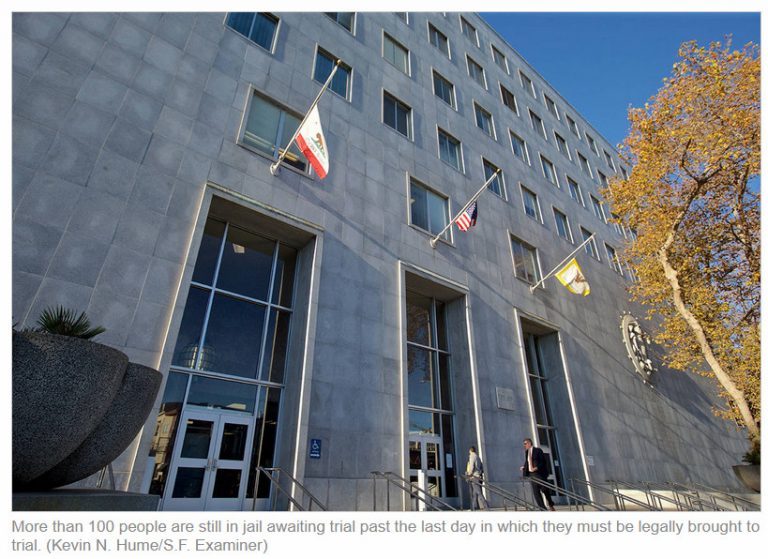
Photo: More than 100 people are still in jail awaiting trial past the last day in which they must be legally brought to trial. (Kevin N. Hume/S.F. Examiner)
The lack of courtroom access in San Francisco is a human rights issue
By Mano Raju
The murder of George Floyd by Derek Chauvin, a former Minneapolis police officer, is a brutal and horrific example of how government institutions fund and sanction violence against people of color in this country. While the conviction of Chauvin does mean there has been some accountability in that particular case, it does nothing to mitigate the normalized, institutional harm that continues to happen at every level of the criminal legal system every day.
We do not have to look far to find it.
Here in San Francisco, over 100 people are still languishing in jail awaiting trial past the last day in which they must be legally brought to trial — the majority have been waiting over a month, and some for many months past their deadlines. The unlawful pretrial incarceration of hundreds of people, who are presumed innocent, is not just a matter of moral, ethical, and human rights — San Francisco Courts are flagrantly violating the law.
I just finished reading a letter from one of our clients who has been locked up in our jails for months past the legal deadline for his trial to be conducted. He describes the current conditions like being “housed at a super max level 5 federal prison” and during the limited time they get out of their cells daily “for one hour, 8 people are forced to share 4 phones and 3 showers… shave, get hair cut, find a book” and make any personal or legal calls.
This man has lost family members while in jail, and he hasn’t been able to grieve with his family or stay connected to his children.
Sadly, he is not alone.
People are not only being illegally held in San Francisco jails, they are being held in solitary-like confinement as a result of the jail’s COVID-19 precautions – no family visits, no programming, 23-24 hours a day in their cell, and no yard time. These punitive conditions are psychologically and physically damaging. While the San Francisco Sheriff has said they are planning to resume visits and end lockdowns at the jails at some point, there is no official date set.
These court delays are not happening in our neighboring counties. Contra Costa has held 103 jury trials since May 2020. Sacramento has held at least 118 trials since mid-March 2020. In contrast, San Francisco has held only 10 criminal jury trials in the past year, nearly ten times less than these peer counties.
We have learned from our neighbors that with the right precautions, we can safely hold jury trials during COVID. We are unaware of reports of trial-related COVID outbreaks inany of these counties. https://9488398ceb10593651f10f5e5e418e3a.safeframe.googlesyndication.com/safeframe/1-0-38/html/container.html
The reason for San Francisco’s massive backlog is because the Courts have not allocated enough courtrooms. At the Hall of Justice, at least twelve courtrooms have the capacity to hold a socially-distanced trial, yet the Court has only opened four courtrooms for trials. Another four courtrooms are being used as “satellites” where people can watch ongoing trials on zoom, but these satellites are almost always empty. The Civic Center Courthouse at 400 McAllister Street is now handling misdemeanor jury trials in two courtrooms for people who are out of custody. It has also held an eviction jury trial and conducted jury selection for a civil trial that later settled. Yet, citing unfounded security concerns, the Court is not holding any felony trials at Civic Center for people who are in custody.
Other counties have used alternative venues for trial proceedings — San Mateo is using its convention center and Sonoma is using its county fairgrounds. While our Court has been awarded emergency funding to address its massive backlog, it has not utilized any alternative venues to hold trials, nor made any documented efforts to seek them out. We know that because my office submitted a judicial records request for all records relating to the Court’s efforts to find alternative venues and to remedy its personnel shortages, and the Court informed us that there were no such records.
With jury trials being safely held in neighboring counties, businesses open, and widespread vaccinations — including 72% of San Franciscans over the age of 16 with at least one dose of the vaccine, and 49% percent having received both doses — our Court has no justification for these delays. More courtrooms should be opened up for trials, and there should be public access via YouTube for people to attend remotely – which our Court has done only sporadically while many other counties have been doing so all along.
People who are presumed innocent and caged should not be sitting in jail for one day longer than the law allows. When that right is denied — as it was for Kelief Browder, a young Black man who was accused of stealing a backpack and locked up at Rikers Island without trial — the consequences can be fatal and tragic.
Public defenders are in court every day fighting for our clients’ right to a jury trial. But so far our Superior Court refuses to honor this right, generating a huge backlog of cases and incarcerating members of our community for months after the law says they can be held.
A backlog isn’t a reason to keep a human being in jail for a single day – let alone well over one hundred people in jail for months under lockdown conditions. Nor is COVID-19an excuse for the cruelty and bureaucratic inertia. We must do better.
Mano Raju is the elected Public Defender for San Francisco.
MEDIA CONTACT: SF Public Defender’s Office – (628)249-7946 – Valerie.Ibarra@sfgov.org
**PRESS RELEASE**
SF Jury Acquits on Murder Charge, Agrees that Public Defender Client Acted in Self-Defense
SAN FRANCISCO – Today, a San Francisco jury found a Fresno man not guilty of murder by virtue of self-defense. Although the man conceded to a single felony count of possession of a firearm, Deputy Public Defender Kathleen Natividad and her team presented physical evidence and character witnesses to show that her client had acted in self-defense.
In August 2020, Robert Brewer was visiting San Francisco in a rental car, getting his mother a birthday gift. Mr. Brewer had parked, but later found himself lost on foot in the city. Mr. Brewer approached a vehicle he believed to be his rental car, but soon realized he was mistaken when he encountered Darrelle Scales, the owner of the car. Mr. Scales began threatening Mr. Brewer, who walked away. Mr. Scales then followed Mr. Brewer for over two blocks. When Mr. Brewer saw Mr. Scales reach for a shiny object in his waistband, which he believed to be a gun, he shot at Mr. Scales one time out of fear. Mr. Scales, who died later, was found with an 18” long silver metal pipe.
“The jury understood that Mr. Brewer was in fear for his life and was acting in self-defense,” said Natividad. “Situations like this are so complex because you have someone like Mr. Brewer who grew up in an area where he was exposed to so much violence and was only carrying a gun for protection.”
The defense team included Deputy Public Defender Kathleen Natividad, second chair Nikita Saini, Investigators Nigel Phillips and Carolyn Phillips, Paralegal Sercan Ersoy, and Law Clerks Elly Leggatt and Matt Bertini.
“I am proud of our defense team who worked hard to demonstrate that this was an act of self-defense. Mr. Brewer would have never fired if he was not in fear for his own life. We are pleased that the jury understood the reality of the altercation and made the right decision,” said Public Defender Mano Raju.
Mr. Brewer has been in San Francisco County jail since August 2020 despite the fact that he asserted his right to a speedy trial in October. Due to a large backlog and the San Francisco Superior Court only conducting criminal jury trials in four courtrooms, Mr. Brewer waited nearly five months beyond the last day that his trial should have been heard.